Robo-adviser fees, custody, and conflicts: a due-diligence framework
Compare robo-advisors by service scope, total fees, portfolio method, custody, protection, conflicts, data, registration, support, and exit terms.
In this guide
The easiest way to compare robo-advisers is to look past the label and compare the service underneath it. A useful comparison asks: what does the service do, what information does it use, what will you own, what will you pay in total, who holds the assets, what incentives shape the choices, what happens to your data, and how can you leave?
The short answer is that there is no single “robo-adviser safety” score. A service can be convenient but limited, inexpensive but narrow, automated but dependent on a separate custodian, or registered but still unsuitable for a particular goal. Compare the same fields for every provider and keep current, jurisdiction-specific terms separate from general education.
This framework is not a ranking or a recommendation. It is a way to produce a comparison you can audit later.
For background, see our robo-adviser explainer, fund-cost guide, AI-claims checklist, and financial-data permissions guide.
1. Define the service you are comparing
“Robo-adviser” can mean automated portfolio management, a digital advice questionnaire, a hybrid service with human planners, a self-directed app with algorithmic suggestions, or a bundle that includes cash and banking products. Put the comparison in a box before looking at price.
Record:
- Is the service giving advice, managing assets, executing trades, or only displaying research?
- Is a human adviser available, and is that advice included or an extra tier?
- Does the service offer one account type or several taxable and retirement accounts?
- Can it manage outside assets, or only assets held at its affiliated custodian?
- What happens after you stop paying or stop meeting a minimum?
The SEC’s robo-adviser bulletin notes that services differ in human interaction, products, fees, and registration. A low headline price may describe a narrower service than a higher price. Compare like with like before comparing percentages.
2. Test the questionnaire and portfolio method
A questionnaire is an input to a decision system, not a complete financial plan. The SEC says robo-advisers commonly ask about goals, time horizon, income, other assets, and risk tolerance. That does not mean every service asks about debt, emergency liquidity, concentrated employer stock, taxes, insurance, estate needs, or a goal that changed last month.
Ask each provider:
- Which facts change the recommendation?
- What important facts are not collected?
- How is risk defined—willingness to see a loss, ability to absorb one, or both?
- What portfolio models are available, and what securities or funds can they use?
- How are allocations rebalanced, and can you restrict or customize holdings?
- What happens when your answers change or the service’s assumptions change?
Then look through the model label. “Balanced” does not reveal equity concentration, bond duration, cash treatment, fund overlap, or whether the service uses proprietary products. Read fund objectives, major holdings, risks, and expenses rather than counting the number of funds.
If a provider markets “AI,” ask what that changes in practice. It may summarize information, suggest an allocation, monitor drift, or simply describe the interface. A confident explanation is not evidence of better returns or lower risk.
3. Calculate total cost in your own units
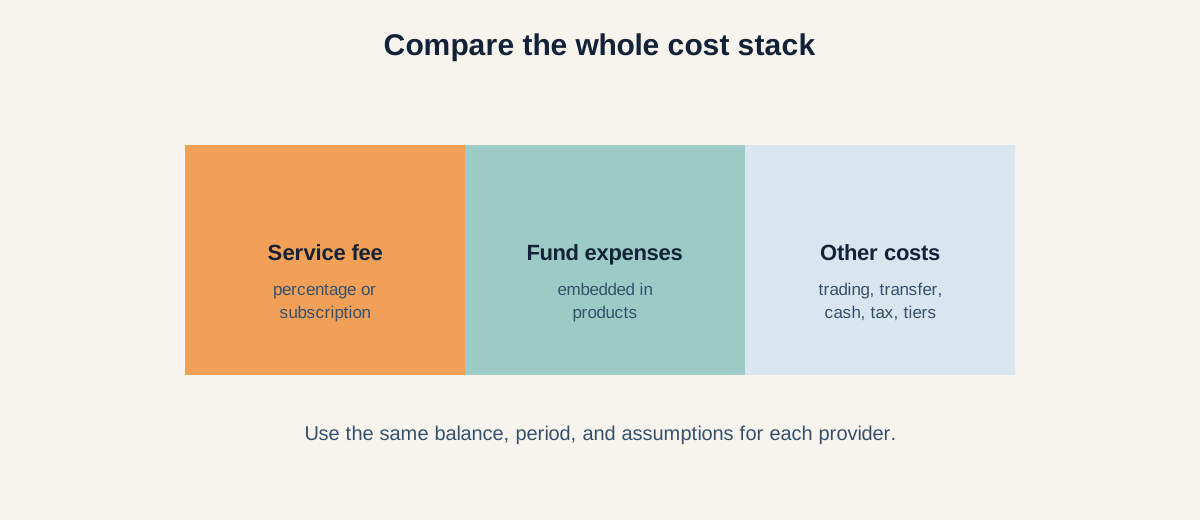
Figure: Compare the service fee, fund expenses, and other account-level costs separately.
The advertised advisory fee is only one possible layer. Depending on the service, total cost may include an asset-based fee, a flat subscription, fund expense ratios, trading costs, spreads, cash-program economics, account charges, transfer fees, tax-related costs, or a premium human tier.
Build a simple annual estimate using your expected balance and activity:
Total estimated cost = service fee + product expenses + trading/transfer costs + other required charges.
Then ask:
- Is the fee a percentage, a fixed monthly amount, or both?
- Does the percentage apply to all assets or only a managed sleeve?
- Are underlying funds proprietary, and do they have different expenses?
- Is cash held in a program with terms different from the investment account?
- What happens to the fee if the balance falls or rises?
- Are tax-loss harvesting, financial-planning sessions, or human advice included?
The SEC’s subscription-fee bulletin gives a useful warning: a small fixed monthly charge can represent a large percentage of a small account. For a hypothetical $1,200 balance, a $5 monthly charge is $60 a year before any fund expense—5% of the starting balance. This is an illustration, not a current provider fee or an expected return.
Use the same balance, time period, and assumptions for every provider. See fund-cost education for the difference between a headline expense ratio and broader ownership cost.
4. Map custody and protection separately
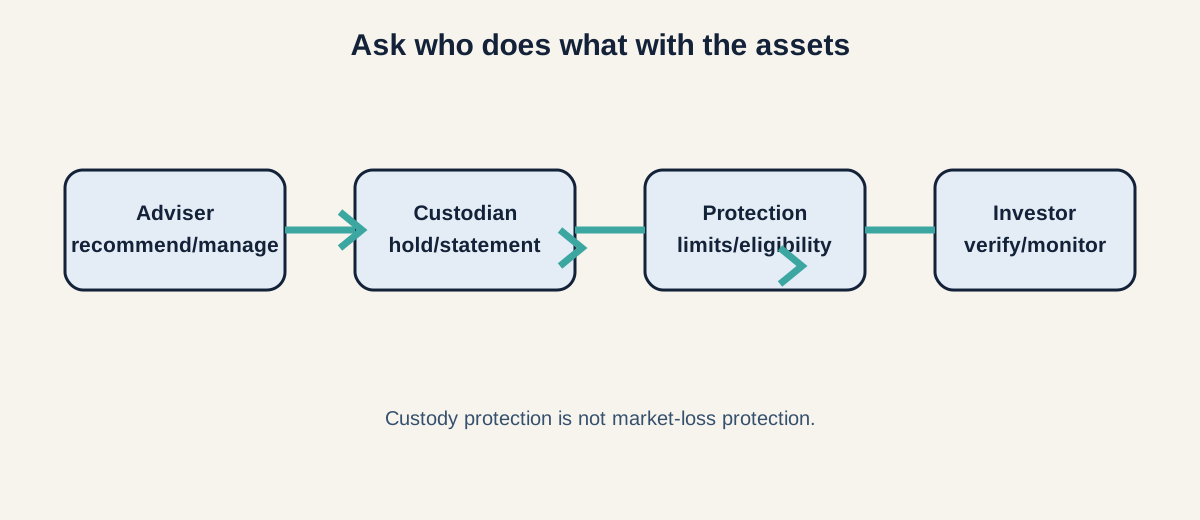
Figure: Keep adviser, custodian, protection scope, and investor responsibilities distinct.
The adviser recommending a portfolio and the firm holding the account may be different legal entities. Identify the custodian or brokerage named in the account agreement, statements, and Form CRS or Form ADV materials.
Ask:
- Who holds cash and securities?
- Who executes trades and sends statements?
- Can you log in directly with the custodian?
- What happens if the adviser platform is unavailable?
- Which protection scheme applies, to which legal entity, account type, and assets?
For a U.S. brokerage account, SIPC says protection is available when a SIPC-member brokerage fails and eligible cash or securities are missing, subject to a $500,000 customer limit including a $250,000 cash limit. SIPC does not protect market loss, promised performance, bad advice, or every asset type. It is not FDIC deposit insurance, privacy protection, or a guarantee that you recover every loss.
Do not use a protection limit as a service-quality score. Verify membership and eligibility for the actual entity and account. Outside the United States, use the local investor-protection and custody rules.
5. Find conflicts and incentives
A comparison should show how the provider makes money and whether that could influence the choices presented to you.
Check:
- referral, affiliate, or marketing payments;
- affiliated funds, brokerages, cash programs, or insurance products;
- revenue from securities lending or cash balances;
- different prices or features by account tier;
- compensation for recommending a transfer or premium service; and
- whether the provider can change the investment menu or fee terms.
The SEC’s robo-adviser bulletin directs readers to ask whether a robo-adviser pays referral or marketing fees or receives other incentives. Form CRS and Form ADV can help identify services, fees, conflicts, disciplinary information, and the nature of the relationship. A conflict is not automatically wrongdoing; an undisclosed or poorly explained conflict is a reason to investigate further.
6. Check data permissions and security questions
Some robo-advisers ask to connect bank, card, payroll, or outside brokerage accounts. A data aggregator may sit between the app and the financial institution. The CFPB warns that access may be ongoing and recommends checking scope, frequency, third-party sharing, storage, transaction authority, revocation, and deletion.
Ask:
- Which accounts and fields can the service access?
- Is access read-only, or can it initiate payments or transfers?
- Which aggregator or intermediary receives the data?
- How long are data, logs, and derived profiles kept?
- How do you revoke access at both the app and financial institution?
- What happens to historical data after closure?
Read the privacy notice and connection permissions, not only the app-store description. See the financial-data permissions guide for a fuller lifecycle checklist.
7. Verify registration and disclosures
For a U.S. adviser, search the SEC’s Investment Adviser Public Disclosure database independently. Read Form ADV and Form CRS rather than relying on a badge or a link in an advertisement. Confirm the legal entity, services, fees, conflicts, disciplinary history, and whether the entity is acting as an adviser, broker, or both.
Registration is a verification route, not an endorsement. It does not prove the portfolio is suitable, the algorithm is accurate, or returns are protected. A service operating outside the United States may have different registration and complaint pathways. Use the official regulator for the jurisdiction in which the account is offered.
8. Measure human help and exit friction
Human access is a feature to compare, not a vague trust signal. Ask:
- Can you reach a qualified investment professional or only technical support?
- Is human help available to every account or only a premium tier?
- What is the channel, schedule, minimum balance, and extra cost?
- Who handles an unusual tax question, transfer problem, fraud concern, or changed goal?
- How do you close the account, transfer assets, or download records?
- Are there liquidation, transfer, or waiting costs?
Test documentation and a support route before funding an account. A chatbot can be useful for navigation, but its availability does not prove that it can resolve a custody, tax, or suitability issue.
A transparent comparison example
Suppose two hypothetical services both advertise a 0.25% management fee. Service A charges no subscription but uses funds with 0.20% expenses. Service B charges $5 per month, uses funds with 0.05% expenses, and includes one annual human-planning session. Assume a $1,200 balance, no trading costs, no taxes, and stable balances for illustration only.
- Service A: 0.25% of $1,200 = $3.00; fund expenses at 0.20% = $2.40; illustrative total = $5.40 per year.
- Service B: 0.25% of $1,200 = $3.00; fund expenses at 0.05% = $0.60; subscription = $60; illustrative total = $63.60 per year.
The arithmetic does not decide which service is suitable. It shows why the same headline percentage can hide a different cost structure. You would still need to compare holdings, custody, protection, conflicts, data, human support, and exit terms. If the balance, fund expenses, or subscription changes, recalculate rather than treating the example as a forecast.
A one-page comparison worksheet
For each provider, fill in the same fields:
- Service scope: advice, management, trading, research, or bundle.
- Questionnaire: goals, time horizon, risk, debts, liquidity, taxes, other assets.
- Portfolio: asset mix, funds, overlap, customization, rebalancing.
- Total cost: percentage, subscription, product expenses, trading, transfers, tiers.
- Custody: legal entity, statements, direct access, account type, protection.
- Conflicts: affiliates, cash, referrals, securities lending, menu control.
- Data: connected accounts, fields, aggregator, frequency, retention, revocation.
- Registration: regulator, legal entity, Form CRS/ADV, disciplinary disclosures.
- Human help: channel, qualifications, minimums, price, escalation.
- Exit: close, transfer, records, liquidation, delays, and remaining obligations.
If a field is unclear, write not verified rather than filling it with a guess. That small discipline makes the comparison more honest and easier to update.
Sources
- SEC Investor.gov — Investor Bulletin: Robo-Advisers
- SEC Investor.gov — Subscription-based Advisory Fees
- SEC Investor.gov — Relationship Summaries (Form CRS or Form ADV Part 3)
- SEC Investor.gov — Form ADV
- SEC — Investment Adviser Public Disclosure
- SIPC — What SIPC Protects
- CFPB — What to consider when sharing your financial data