AI investing claims: a verification checklist for readers
Learn how to test AI investing claims by checking the mechanism, evidence, timeframe, fees, risks, registration, conflicts, and data handling.
In this guide
“Powered by AI” can describe a useful research assistant, a rules-based screen, a portfolio-management system, a chatbot, or a marketing slogan. It does not by itself prove that a recommendation is accurate, suitable, profitable, or even generated by a meaningful model.
The short answer is to turn the claim into a testable statement, then check the mechanism, evidence, time period, benchmark, total costs, risks, provider identity, conflicts, data practices, and human oversight. The SEC, NASAA, and FINRA warn that AI-generated information can be inaccurate, incomplete, misleading, outdated, or made up, and should not be the sole basis for an investment decision.
This checklist is financial education, not a recommendation to use or avoid an AI tool.
For related background, read our financial-data permission guide, fund-cost guide, and robo-advisor explainer.
The short answer: “AI” is a label, not evidence
An investing claim can hide several different propositions:
- the system summarizes information faster;
- it predicts a price or direction;
- it selects securities;
- it executes trades automatically;
- it manages a portfolio;
- it reduces taxes or risk; or
- it produces better returns than an alternative.
Those propositions need different evidence. A fluent chatbot answer is evidence that software produced text, not evidence that an investment thesis is correct. A backtest is evidence about a historical simulation under stated assumptions, not a guarantee of future results. A registration record confirms a legal status or filing, not a performance endorsement.
Step 1 — Rewrite the claim so it can be checked
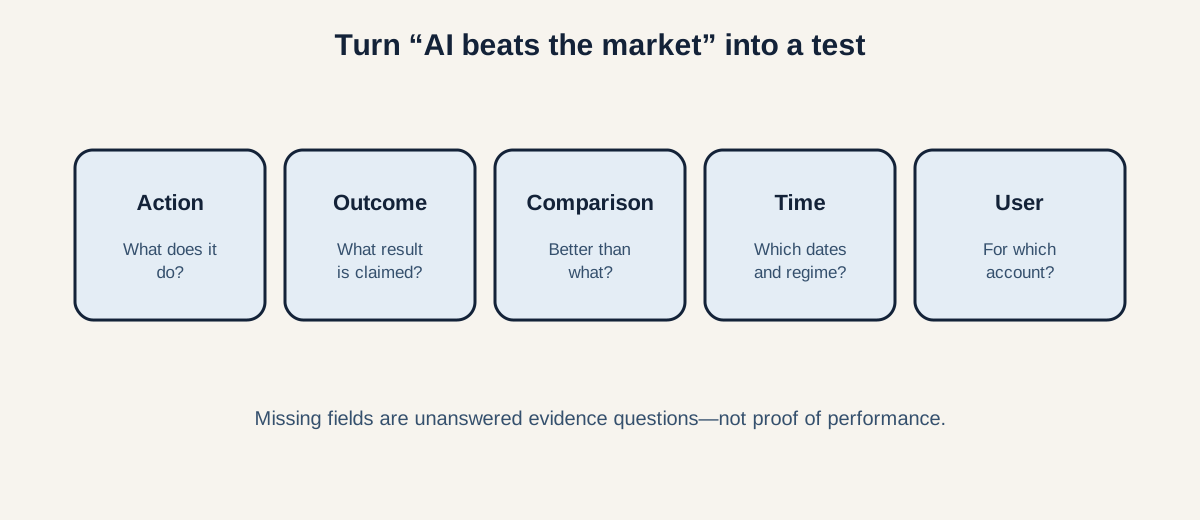
Figure: A checkable claim names the action, outcome, comparison, time period, and user context.
Copy the exact sentence, screenshot, video timestamp, or sales-page promise. Then rewrite it using five fields:
- Action: What does the tool do—summarize, rank, recommend, trade, or manage?
- Outcome: What result is claimed—accuracy, return, lower volatility, time saved, or something else?
- Comparison: Better than what—cash, an index, a benchmark, a human adviser, or no action?
- Time: Over what dates, market conditions, and holding period?
- User: For which account, country, risk level, and investor situation?
“Our AI beats the market” is not yet a useful claim. “A model-selected U.S. large-cap portfolio beat the S&P 500 from January 2022 through December 2024 before fees, using monthly rebalancing and no taxes” is more specific. It may still be unconvincing, but now you know what to verify.
If the promoter refuses to state the comparison, dates, or assumptions, the missing detail is itself important evidence about the quality of the claim.
Step 2 — Identify what the system actually does
Ask the provider to explain the workflow in plain language. You do not need the source code, but you do need to distinguish the model from the surrounding product.
Questions to ask:
- What inputs does it use: financial statements, prices, news, social posts, alternative data, or your account information?
- How often are the inputs refreshed?
- Does the model produce an investment recommendation, or only organize information for a human to review?
- What happens when data is missing, contradictory, delayed, or outside the model’s training range?
- Can a human review, override, or stop an output before an order is placed?
- Is the “AI” a language interface around fixed rules, a statistical model, a third-party service, or a combination?
FINRA’s guidance on automated investment tools emphasizes that outputs depend on the questions asked and information supplied. A tool may use limited options, assumptions that do not fit current conditions, or affiliated products. The important question is not whether the system sounds advanced; it is whether its process matches the claim being made.
Step 3 — Demand a time period, benchmark, and assumptions
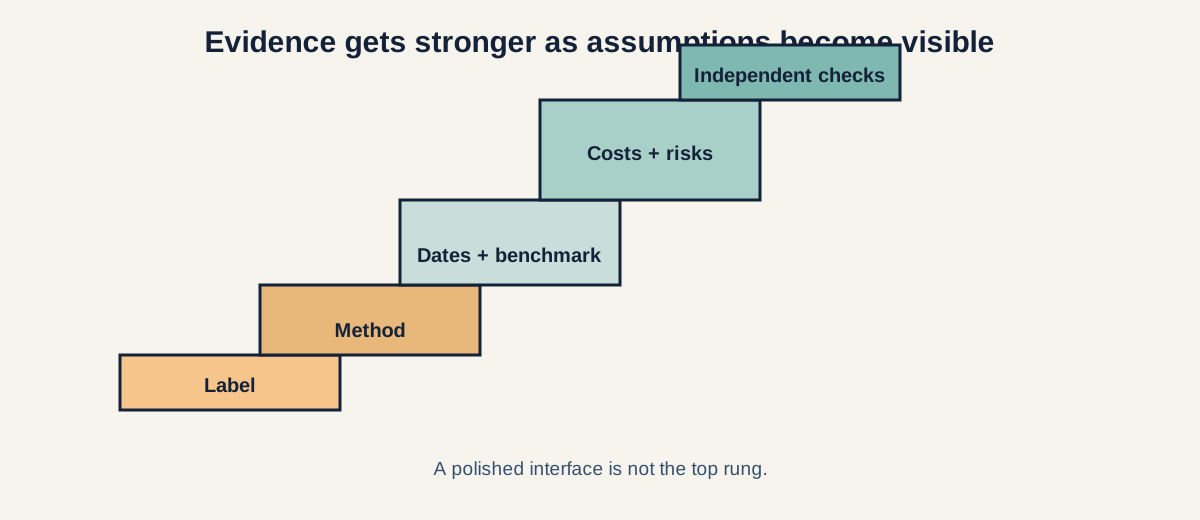
Figure: Move from a label to method, dated comparison, costs and risks, and independent checks.
Performance claims are meaningless without a comparison and a clock. Ask for:
- start and end dates;
- whether the period includes a bull market, sell-off, or both;
- the exact benchmark and whether it includes dividends;
- rebalancing, turnover, leverage, and cash assumptions;
- the universe of securities available at the time;
- survivorship and look-ahead-bias controls; and
- whether the result is live, paper, backtested, hypothetical, or reconstructed.
Do not let a single winning chart stand in for a record. If the claim shows only a selected period, request other periods and the full distribution of outcomes. A model that worked in one regime may fail when volatility, liquidity, interest rates, or correlations change.
If a tool displays a probability or forecast, ask what the number means. A 70% probability is not the same as a 70% return, and a model confidence score is not a promise that the forecast will be correct.
Step 4 — Separate gross results from what an investor keeps
“Return” can mean a simulated price change, a gross portfolio result, or an investor’s after-fee, after-tax outcome. Ask whether the claim includes:
- advisory or subscription fees;
- fund expense ratios;
- brokerage commissions, spreads, and market impact;
- borrowing costs or financing;
- cash drag;
- taxes and account restrictions; and
- deposits, withdrawals, and the timing of cash flows.
The SEC’s investor education materials distinguish transaction and ongoing costs because both reduce money available to earn returns. A low headline fee does not make a forecast reliable, and a strong backtest before costs may not survive implementation costs.
When comparing two results, use the same currency, period, cash-flow convention, and risk measure. Never infer that a tool is better because a promotional number is larger than a number calculated on different assumptions.
Step 5 — Look for conflicts, promotion, and “AI washing”
The word AI can add authority to an ordinary product. That is sometimes called AI washing: presenting a vague or limited technology as if it were a sophisticated source of investing advantage. The label alone is not proof of deception, but it is a prompt to ask for specifics.
Check:
- Who pays the provider—subscription, spread, referral, asset-based fee, affiliate compensation, or a combination?
- Does the tool recommend affiliated funds, securities, or platforms?
- Are testimonials, screenshots, or “top picks” selected from winners only?
- Are hypothetical or simulated results clearly labeled?
- Does the provider disclose material conflicts and the limits of its method?
The SEC’s administrative order involving Global Predictions described alleged misleading statements about AI capabilities, a “regulated AI financial advisor” status, and unsupported performance claims. The lesson is not that every AI claim is false; it is that a provider must be able to substantiate what it says and disclose material context.
Step 6 — Verify the provider and the legal relationship
Find the legal entity behind the product. A website domain, app-store listing, or social-media account is not the same as a verified adviser or broker record.
For a U.S. service, check relevant SEC, FINRA, or state records independently rather than using a link supplied in an unsolicited message. Ask:
- Is the firm registered or licensed for the service it offers?
- Which entity holds assets, executes trades, or provides advice?
- What disclosures describe fees, conflicts, disciplinary events, and the relationship?
- Who can you contact if the product stops responding?
Registration is a starting point. It does not prove that the model is accurate, that the portfolio fits your goals, or that losses are protected. Outside the United States, use the official securities regulator for your jurisdiction.
Step 7 — Check data, security, and human oversight
An AI investing product may collect identity data, account balances, holdings, transactions, income, or behavioral information. Read the privacy notice and permissions before connecting an account.
Ask:
- What data enters the model, and is it used to train or improve a service?
- Which third parties receive prompts, documents, or account data?
- How long are inputs, outputs, logs, and uploaded files retained?
- Can you delete or export your information?
- Is multi-factor authentication available?
- Can a human review a recommendation or investigate an error?
FINRA has warned that generative AI can make identity documents, voices, images, and videos look credible enough to support account takeovers or new-account fraud. Strong passwords, unique credentials, a password manager, and independent verification of contact details reduce exposure, but no control eliminates all risk.
Step 8 — Treat urgency and guaranteed outcomes as stop signs
Be especially cautious when a message combines AI language with:
- guaranteed or unusually consistent returns;
- pressure to act immediately;
- requests to keep the opportunity secret;
- an unregistered platform or unclear legal entity;
- a request for account credentials or remote-control software;
- payment in an unusual form; or
- testimonials that cannot be independently verified.
The SEC/NASAA/FINRA investor alert says unsolicited AI-themed investment messages can be used to stir emotion and impersonate professionals, friends, or family. Verify through an official channel you locate yourself. Do not transfer money because a voice, video, chatbot, or polished dashboard appears familiar.
A worked example with explicit assumptions
Imagine a social post says: “Our AI stock picker returned 38% last year and predicts the next breakout.” Before treating that as evidence, write down what is missing:
- Which account and securities were eligible?
- Was 38% gross or net of fees and taxes?
- Which dates and benchmark were used?
- Were deposits, withdrawals, leverage, or cash included?
- Was the result live, paper, or backtested?
- How many signals were generated, and how many were losers?
- Does “predicts” mean a probability, a ranking, or a guaranteed call?
- Who operates the product and what compensation or affiliation exists?
Until those questions have credible answers, the post is a marketing claim, not verified investment evidence. You can decide not to engage, seek independent sources, or ask a qualified professional—but do not fill the gaps with optimism.
A one-page verification checklist
Before relying on an AI investing claim, confirm:
- The exact action and outcome are stated.
- The model’s inputs, method, and human role are understandable.
- Dates, market conditions, and the comparison benchmark are named.
- Live, hypothetical, paper, and backtested results are separated.
- Fees, spreads, taxes, cash flows, and implementation limits are addressed.
- The full set of outcomes is available, not only selected winners.
- Conflicts, affiliate compensation, and product limits are disclosed.
- The provider’s legal entity and registration can be verified independently.
- Data collection, retention, sharing, security, and deletion are explained.
- Urgency, secrecy, guaranteed returns, and credential requests are treated as stop signs.
If one of these cannot be answered, label the claim unverified. “Unverified” is not the same as “false”; it means you do not yet have enough evidence to rely on it.