Brokerage protection explained: custody failure is not market loss
Learn what SIPC protects when a member brokerage fails, including the $500,000 limit, cash sublimit, eligible securities, and exclusions.
In this guide
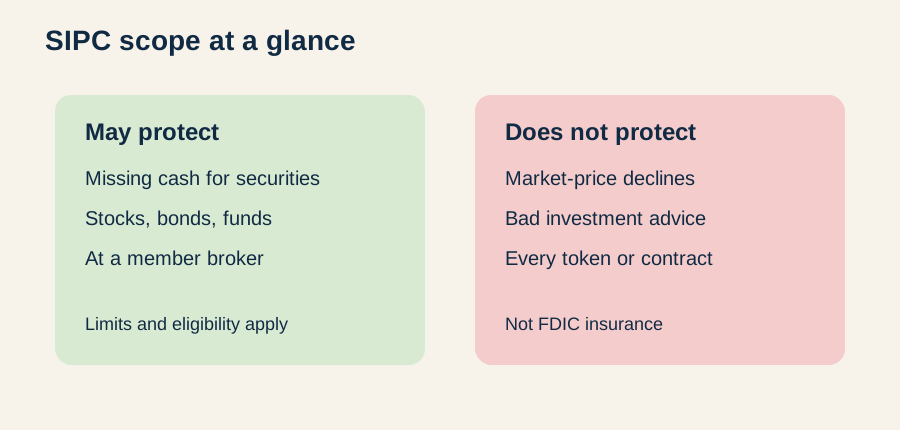 SIPC addresses missing customer property, not market loss.
Short answer: SIPC helps return missing cash and securities when a financially troubled SIPC-member brokerage is liquidated. It does not reimburse a stock that falls, a worthless investment, bad advice, fraud by an unrelated party, or every digital asset. The standard protection limit is $500,000 per customer, including a $250,000 cash limit. These are U.S. rules checked against SIPC’s current page on 2026-09-08, not a promise of full recovery.
What problem SIPC is designed to solve
Brokerage firms hold customer property. If a member firm fails financially and customer cash or securities are missing, SIPC can step into the liquidation process. Its function is custody restoration: returning the same securities where possible or arranging replacement value within the legal limits. SIPC is not an investment-performance guarantee.
The protection depends on the firm being a member, the claimant meeting the customer definition, the property qualifying, and the facts of the liquidation. Check membership through the broker’s disclosures and SIPC’s member information rather than assuming every investing app is covered.
What the $500,000 limit means
SIPC describes a combined customer limit of $500,000, with no more than $250,000 for cash. The headline is not a blanket amount per app, login, ticker, or transaction. Account treatment and “separate capacity” rules can affect how claims are grouped. A large balance may therefore not receive a simple $500,000 payment, and a smaller claim can still require documentation and a court-supervised process.
SIPC protection is about replacing missing property, not freezing its market value. If you owned 100 shares and those shares are present in the liquidation, the relevant asset is the shares; their price can rise or fall after you bought them. If securities are missing, the trustee works through the claim process under SIPA and SIPC rules.
How multiple accounts are grouped
The limit applies by customer in a legally recognized separate capacity, not simply by account number. SIPC explains that individual, joint, corporate, trust, guardian, estate, and certain retirement capacities may be treated separately when their legal ownership genuinely differs. Accounts held by the same customer in the same capacity are generally combined even if they have different numbers or contain different securities.
For example, opening two individual brokerage accounts at the same failed member does not automatically create two limits. An individual account and a qualifying joint account may be treated separately because the ownership capacities differ. Changing a label, adding a beneficiary, or spreading positions across app screens does not by itself establish separate treatment.
This is a legal classification, not a planning trick. The trustee applies the statute and facts of the liquidation. Verify the registration, owners, and legal entity on each statement; do not assume that tax treatment, an account nickname, or a broker’s marketing category matches SIPC’s capacity rules.
What happens during a liquidation
SIPC does not usually send every customer a flat insurance check. A federal court appoints a trustee, customer accounts and broker records are reconciled, and customers receive claim instructions. Where records and assets are available, accounts may be transferred to another brokerage. If property is missing, the trustee determines the customer’s net equity claim and uses customer property plus SIPC advances within applicable limits.
The process can take time, especially when records are incomplete or ownership is disputed. Read every notice and submit the required claim by the stated deadline. Keep statements, trade confirmations, deposit records, and correspondence somewhere you can reach without logging into the failed broker. Records can support a claim, but they do not override the legal classification of the account or asset.
Cash at a broker can follow different protection paths
“Cash” on a dashboard can mean several things. Cash held by a broker for purchasing or selling securities may fall within SIPC’s cash protection. A bank sweep may instead create deposits at one or more banks, potentially subject to FDIC rules and aggregation at those banks. A money-market mutual fund is a security whose value and protection framework differ from a bank deposit.
Ask for the sweep disclosure and identify the legal holder, destination institution, and product. The same dollar balance can move between legal categories when a sweep occurs. Neither a high yield nor the word “cash” tells you which protection applies.
What SIPC generally covers
SIPC’s explanation lists cash held for the purchase or sale of securities and securities such as stocks, bonds, Treasury securities, certificates of deposit, mutual funds, and money-market mutual funds. Coverage can include cash denominated in a non-U.S. currency when held for securities transactions. Eligibility is fact-specific, so the list is a starting point, not a certificate that every instrument qualifies.
What SIPC does not cover
SIPC does not protect:
- a decline in the market price of a stock, fund, bond, or other security;
- a security that becomes worthless because the issuer fails;
- losses caused by a broker’s bad or unsuitable investment advice;
- commodities or commodity-futures positions in ordinary circumstances;
- foreign-exchange trades;
- fixed annuities and certain unregistered investment contracts; or
- digital or crypto assets that do not qualify as registered securities.
SIPC also is not FDIC deposit insurance. FDIC protection concerns eligible deposits at an insured bank. A brokerage cash balance can be treated differently depending on how and why the broker holds it. Ask whether idle cash is swept to a bank, held for securities transactions, or invested in a money-market fund; each has different legal and risk characteristics.
A custody failure is different from a bad market day
Consider two unrelated events. In the first, you own an index fund and its market value drops 25%. SIPC does not make up that decline. In the second, your member broker enters liquidation and the trustee cannot locate part of your fund shares or securities-transaction cash. SIPC may help restore missing property, subject to eligibility and limits. The same account can face both events, but one is market risk and the other is custody failure.
This distinction matters when reading a broker’s “SIPC protected” badge. The badge does not mean your balance cannot go down, that a broker selected a suitable investment, or that losses from phishing, a fake website, or an unauthorized transfer are automatically reimbursed. Report suspected fraud to the firm and relevant authorities promptly and preserve records.
Margin, options, and complex assets need extra care
SIPC protection does not erase a margin debit. If you borrow from a broker and securities fall, you can owe the loan even if eligible securities are later returned. A margin call or forced sale is an account-risk event, not a claim that SIPC pays your trading loss. See the companion guide to cash and margin accounts.
Options, limited partnerships, private placements, annuities, and crypto-linked products can have special eligibility rules. Read the account agreement, product prospectus, and SIPC’s current definitions before relying on a protection label. Do not infer coverage from a familiar ticker or from the fact that an asset appears in an app.
Questions to ask your broker
- Is the legal broker-dealer a current SIPC member, and which entity holds my account?
- Which balances are treated as securities-related cash, and which are bank deposits or funds?
- How are multiple accounts or capacities grouped for the customer limit?
- Which products in my account are excluded or require special treatment?
- Where can I find the current account agreement, custody disclosures, and claim instructions?
- What records should I retain—statements, confirmations, tax lots, and cash ledgers—in case a claim is needed?
Maintaining statements and trade confirmations is sensible recordkeeping, not evidence that a future claim will succeed. A trustee and court may determine the amount and priority of a claim.
The rule to remember
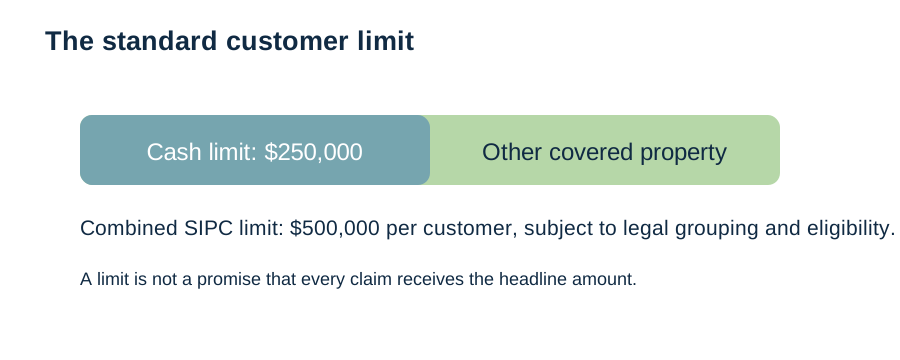 The headline limit includes a cash sublimit and eligibility rules.
SIPC is a backstop for missing customer cash and securities when a member brokerage fails. It is not insurance against market loss, poor advice, investment fraud, bank failure, or every token and contract. Check the member entity, the asset’s legal classification, the account capacity, and the current limits before treating SIPC as part of your risk plan.
To separate brokerage protection from bank-deposit protection, read what FDIC deposit insurance covers, then continue through the Brokers & Platforms learning path.
This U.S.-focused guide is general education, not legal, tax, or investment advice. Membership, customer status, account grouping, eligible property, limits, and liquidation facts must be rechecked before publication.