What FDIC deposit insurance covers—and what it does not
Learn what FDIC insurance covers, the $250,000 limit, ownership categories, and which bank-sold investments are not protected.
In this guide
If an FDIC-insured bank fails, FDIC insurance generally protects eligible deposits up to $250,000 per depositor, per insured bank, per ownership category. It covers deposit accounts such as checking, savings, certificates of deposit (CDs), and money market deposit accounts, including accrued interest through the bank’s closing date. It does not protect stocks, bonds, mutual funds, crypto assets, annuities, life insurance, U.S. Treasury securities, or the contents of a safe-deposit box merely because a bank sold or held them.
This is a U.S. rule. The limit and categories below are from FDIC materials checked on September 8, 2026. Your bank’s charter, account registration, beneficiaries, and any pass-through arrangement can change the result. Confirm the institution and account with FDIC’s official tools before relying on a coverage calculation.
What FDIC insurance is designed to protect
FDIC insurance is protection against the failure of an insured depository institution—not protection against every way money can lose value. When a covered bank closes, the FDIC pays insured deposits or transfers them to another bank under the applicable resolution process. The insurance is attached to the deposit and the ownership category, not to a particular brand name or mobile app.
Covered deposit products commonly include:
- checking and transaction accounts;
- savings accounts;
- money market deposit accounts (MMDAs);
- CDs and other time deposits;
- cashier’s checks, money orders, and similar official items issued by the bank.
Coverage is dollar-for-dollar up to the applicable limit. Principal and interest already credited through the date of failure count toward that limit. Interest that has not yet accrued is not a separate insured amount.
The $250,000 rule has three parts
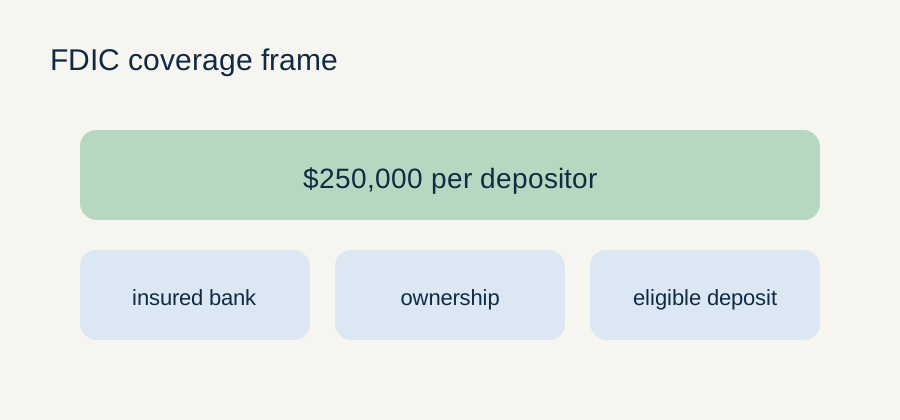
Visual guide: the four conditions that frame the standard coverage limit.
The standard limit is often shortened to “$250,000,” but all three qualifiers matter:
- Per depositor: the legal owner or owners matter.
- Per insured bank: accounts at separate FDIC-insured banks are generally insured separately. Different branches of the same bank are not different banks for this purpose.
- Per ownership category: accounts owned in different recognized capacities may receive separate limits if the requirements are met.
For example, if one person has $180,000 in a single-owner savings account and $100,000 in a single-owner CD at the same insured bank, those balances are added in the single-account category. The total is $280,000, so $30,000 is above the standard category limit. Moving the CD to another insured bank could change the calculation; simply opening it at another branch would not.
Ownership categories can change the calculation
FDIC materials describe categories including single accounts, joint accounts, certain retirement accounts, trust accounts, employee-benefit-plan accounts, corporation/partnership/unincorporated-association accounts, and government accounts. The rules differ by category.
Single accounts
Deposits owned by one person without beneficiaries are combined at the same bank and insured up to $250,000 for that category. A person’s checking and savings balances are not automatically separate limits just because they are different products.
Joint accounts
Qualifying joint accounts are generally insured up to $250,000 per co-owner. A two-person joint account may therefore have a $500,000 category limit, subject to the ownership and signature requirements. The limit is based on each co-owner’s share, not on the account label alone.
Certain retirement accounts
Certain IRAs and other eligible retirement deposits have a separate $250,000 limit per owner at the same bank. This rule concerns deposits held in the retirement account; securities held in a retirement brokerage account are not made FDIC-insured by the account wrapper.
Trust and payable-on-death accounts
Trust-account coverage depends on owners, distinct beneficiaries, and the type of trust. FDIC guidance includes a formula for many revocable and irrevocable trust arrangements and caps coverage for an owner with five or more beneficiaries at $1,250,000 for all trust accounts at one bank. Beneficiary eligibility and account records matter, so do not infer coverage from “POD” or “trust” printed on a statement alone.
Business and government accounts
Qualifying business accounts can receive coverage separate from the owners’ personal accounts when the entity is separately organized and meets FDIC requirements. Government-account coverage is tied to the official custodian and has specialized rules.
What is not FDIC-insured
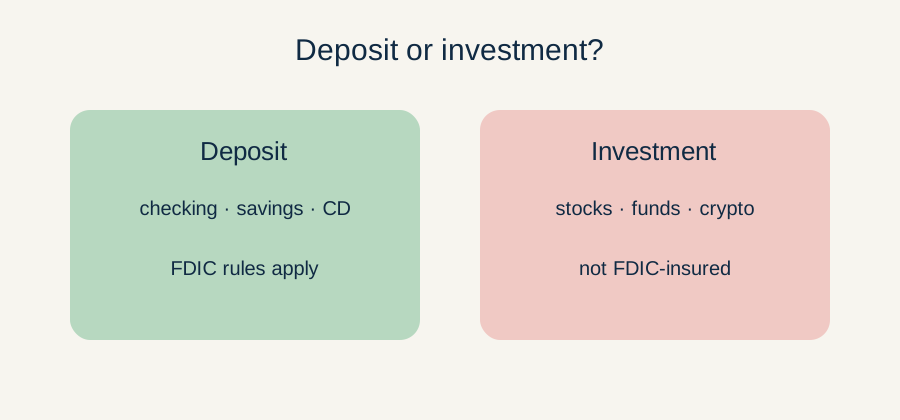
Visual guide: product type, not the sales channel, determines the starting coverage question.
FDIC’s consumer materials list many non-deposit products that are not covered, even when an insured bank sells them in a branch, app, or website:
- stocks and bonds;
- mutual funds, including money market mutual funds;
- crypto assets;
- annuities and life-insurance policies;
- municipal securities;
- U.S. Treasury bills, notes, and bonds (these have a different U.S. government backing);
- safe-deposit boxes and their contents.
The key distinction is deposit versus investment. A money market deposit account is a bank deposit; a money market mutual fund is a security. A bank’s logo, custody arrangement, or sales channel does not turn the second product into an insured deposit. Market losses, issuer default, fraud, and theft also involve protections outside FDIC deposit insurance and must be assessed separately.
Fintech apps and “banking” brands need an extra check
An app may provide banking services through a partner bank without being an FDIC-insured bank itself. Coverage can depend on the partner institution, the legal owner of the funds, account records, and whether a valid pass-through arrangement exists. A sweep program may spread cash across several banks, but the customer still needs to understand how balances are allocated and aggregated.
Look for the actual insured institution and the official FDIC digital sign or BankFind record. Do not assume that a familiar app name, a debit card, or the phrase “FDIC eligible” answers the coverage question. Ask which bank holds the deposit, whose name appears in the records, what ownership category applies, and how the program handles a bank failure.
A transparent coverage example
Assume Alex has these balances at one FDIC-insured bank:
Scroll sideways or use arrow keys to read the full table.
| Account | Registration | Balance | Category treatment |
|---|---|---|---|
| Checking | Alex alone | $90,000 | Combined with Alex’s other single accounts |
| Savings | Alex alone | $140,000 | Combined with Alex’s other single accounts |
| CD | Alex and Jordan jointly | $300,000 | Separate joint category if requirements are met |
| IRA deposit | Alex’s IRA | $80,000 | Separate eligible retirement category |
Alex’s single-owner total is $230,000, under the $250,000 category limit. The joint account is evaluated under the co-owners’ joint-account limit, and the IRA deposit is evaluated under the retirement-account limit. This example does not decide whether the registrations qualify; it shows why product type alone is not enough.
A practical verification checklist
Before treating a balance as insured, record:
- the legal name and charter of the institution that actually holds the deposit;
- the account type and whether it is a deposit or an investment;
- every owner, co-owner, beneficiary, and trustee shown in the bank’s records;
- the ownership category and the combined balance in that category at that bank;
- accrued interest and any sweep or pass-through structure;
- the date the information was checked.
Use the FDIC’s Deposit Insurance Estimator or contact the FDIC for complicated trust, business, retirement, or fintech arrangements. Keep statements and account agreements; a calculator cannot correct inaccurate registration data.
What FDIC insurance does not promise
FDIC insurance does not promise a return, preserve purchasing power, reimburse an unsuitable investment, or eliminate tax and liquidity issues. A deposit can be fully insured and still lose real purchasing power when prices rise. Coverage also does not mean every account at every financial company is insured. Verify the bank, product, ownership, and current rules.
For a broader planning context, connect this protection framework with a long-term financial goal plan and review borrowing trade-offs in debt avalanche vs. debt snowball.
This article is general education, not individualized financial, legal, or tax advice. FDIC rules are U.S.-specific; other countries use different deposit-protection systems.