Cash account vs. margin account: borrowing changes the downside
Compare cash and margin brokerage accounts, including interest, maintenance requirements, margin calls, forced sales, and losses beyond your deposit.
In this guide
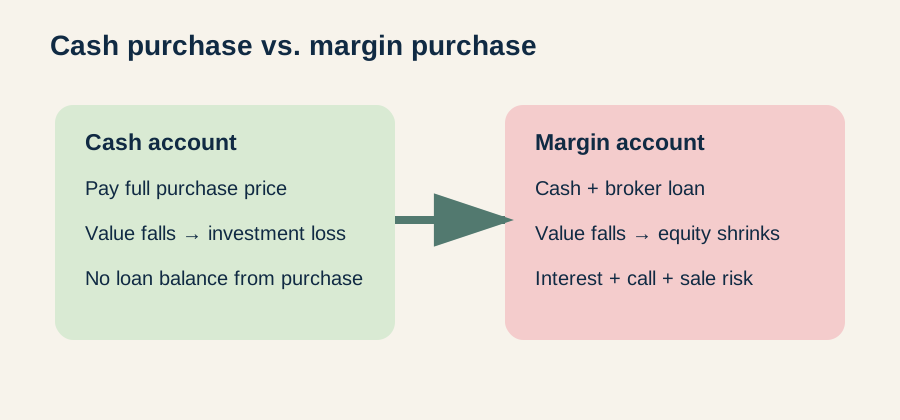 Cash requires full payment; margin adds a broker loan.
Short answer: a cash account requires you to pay in full for purchases. A margin account lets the broker lend against eligible assets. That loan can increase buying power, but it adds interest, minimum-equity rules, margin calls, forced sales, and the possibility of owing more than you deposited. This article is U.S.-focused education, based on documentation reviewed on 2026-09-08—not a recommendation or a funded-account test.
Cash and margin in plain language
In a cash account, the broker does not lend you money for a securities purchase. If you submit a $1,000 stock order, you need enough settled or otherwise available cash under your broker’s rules. A falling share price can reduce the value of your investment, but there is no margin loan balance created by that purchase.
In a margin account, the firm may lend you cash using securities as collateral. You still own the position, but part of its cost can be debt. The agreement sets the interest method, eligible securities, collateral rules, and the firm’s rights if equity falls. Some applications make margin the default, so confirm the account type before signing.
A simple example of leverage
Suppose a stock costs $50. In a cash account, you pay $50. If it rises to $75, your gain is $25, or 50% before costs. If it falls to $15, your loss is $35, or 70%; the position is worth $15 and you do not owe a loan from that purchase.
In a simplified margin example, you pay $25 and borrow $25. At $75, the $50 position has $50 of equity after repaying the $25 loan: a $25 gain on your $25 contribution, or 100% before interest. At $15, the position has $15 of value against the $25 debt. Your equity is negative $10, before interest. You have lost all of your initial contribution and still owe the broker. Real calculations depend on the agreement, other holdings, interest, and trading rules.
What maintenance margin means
Your equity is generally the market value of securities minus what you owe. U.S. FINRA rules require at least 25% maintenance equity for many long positions, while firms can impose higher “house” requirements, often varying by security and volatility. Regulation T generally permits borrowing up to 50% of a new purchase, but the broker may require more cash or prohibit margin for particular securities.
These are regulatory baselines, not a promise that your broker uses them. Requirements can change, sometimes immediately. Read the current agreement and the security-specific requirement shown in your platform.
Margin calls and forced sales
A margin call can occur when you trade beyond buying power, your account value declines, or the firm raises a house requirement. The broker may require cash or eligible securities on short notice. If you cannot meet the call, the firm can sell securities to restore equity—and may sell without waiting for you or letting you choose which assets. A call is not a price-protection mechanism; liquidation can happen after a sharp fall and may lock in losses. A remaining loan balance is still your responsibility.
The SEC warns that a firm may not be required to notify you before selling, and you are not entitled to an extension. That is why an alert or a promise to “add money later” should never be treated as a risk-control plan.
Interest changes the break-even point
Margin borrowing is a loan. Interest accrues under the broker’s disclosed method and directly reduces returns. Rates can vary substantially between firms and can change under the agreement. A position must earn enough to cover both its market risk and the financing cost before borrowing has helped you. Ask how interest is calculated, when it posts, and what happens if cash is insufficient.
Cash does not mean risk-free
Paying in full removes the loan risk from that purchase, but the security can still fall to zero, trade at a wide spread, or become difficult to sell. A cash account can also have settlement and good-faith restrictions if you reuse sale proceeds before they settle. Those are operational rules, not a guarantee of safety. Diversification, time horizon, and the quality of the investment remain separate questions.
The account wrapper also does not decide whether an investment is appropriate. A concentrated position in one company can be highly volatile in either account type. An exchange-traded fund can fall in a broad market sell-off in either account. The difference is that margin adds a creditor relationship on top of those market outcomes.
Why the same decline feels different
Imagine two investors each control $10,000 of stock and the price falls 30%. The cash investor owns a position now worth $7,000 and has lost $3,000. The margin investor might have used $5,000 of cash and $5,000 borrowed. The position is also worth $7,000, but after repaying the loan the investor has $2,000 of equity: a $3,000 loss on $5,000 of starting equity, or 60%, before interest. If the fall is large enough, the account can breach its requirement before the investor has time to decide what to sell.
This illustration ignores maintenance formulas, other collateral, dividends, interest, taxes, and price gaps. Its purpose is to show why a percentage decline in the asset can be a much larger percentage decline in the investor’s own capital.
Read the agreement, not just the buying-power display
Broker apps often show a single buying-power number. That number can depend on settlement, security eligibility, concentration, volatility, day-trading status, and house rules. It is not a promise that every order will be accepted or that the displayed borrowing capacity will remain available.
Before enabling margin, locate the sections covering: the debit balance; interest-rate schedule and changes; initial and maintenance requirements; the firm’s liquidation authority; notices and communication; securities lending; short sales; options; transfers; and dispute procedures. Save the version and date of the agreement you accepted. If a term is unclear, ask the broker for a written explanation.
If you do not intend to borrow, ask whether the broker can place the account in cash-only status or disable margin features. Confirm how that choice affects settlement, options permissions, and the ability to trade on unsettled proceeds. Account labels differ, so rely on the signed agreement and current disclosures.
Other account-level differences to check
- Settlement and trading permissions: cash accounts can have restrictions when you sell before a purchase is fully settled; margin may provide different buying-power treatment. Rules vary, so check the broker’s current disclosure.
- Short selling and options: many short-sale and advanced options strategies require margin and can create losses beyond the initial amount.
- Securities lending: some margin agreements allow the firm to lend securities when there is an outstanding loan; ask about voting rights and dividend tax treatment.
- Transfers: an outstanding loan can affect whether and how securities move to another broker.
- Taxes and protection: forced sales can have tax consequences. Investor protection rules address broker failure, not a market loss or debt owed on a loan.
A decision checklist
Before opening or switching an account, ask:
- Is margin enabled by default, and can I request cash-only status?
- What interest rate, benchmark, spread, and calculation method apply today?
- What are initial, maintenance, and house requirements for the securities I may hold?
- Can requirements change without advance notice?
- How will the firm contact me, and can it liquidate without a call?
- Which strategies, securities, and account types are restricted?
- Could I repay a loan if the position fell sharply and other assets were sold?
Questions by situation
If you are investing a small amount from a regular paycheck and do not need to borrow, the most useful first step may be confirming that margin is off and understanding settlement. That keeps the account question narrow: how will orders be funded and when can sale proceeds be reused? It still leaves the normal work of choosing diversified investments and checking costs.
If you are considering margin for a short-term trade, write down the maximum loan, the interest you would pay if the trade takes longer than expected, and the price decline that would reduce equity below the firm’s requirement. Then ask what happens overnight, during a trading halt, or if the broker raises a house requirement. A spreadsheet scenario is not a guarantee, but it can expose how little room remains after borrowing.
If you are transferring an existing portfolio, ask both firms whether they accept the account type and whether the new firm will honor the same collateral treatment. An outstanding debit may need to be repaid or moved under a new agreement. Do not assume that a transfer preserves your old interest rate, maintenance percentage, options level, or securities-lending terms.
Readers outside the United States should treat the examples and regulatory percentages as illustrations only. “Cash” and “margin” labels, investor compensation schemes, settlement cycles, lending permissions, and liquidation notice requirements can differ materially. Use the agreement and regulator for the country where the account is legally held.
For order mechanics, see market order vs. limit order. For portfolio-maintenance context, see portfolio rebalancing.
The rule to remember
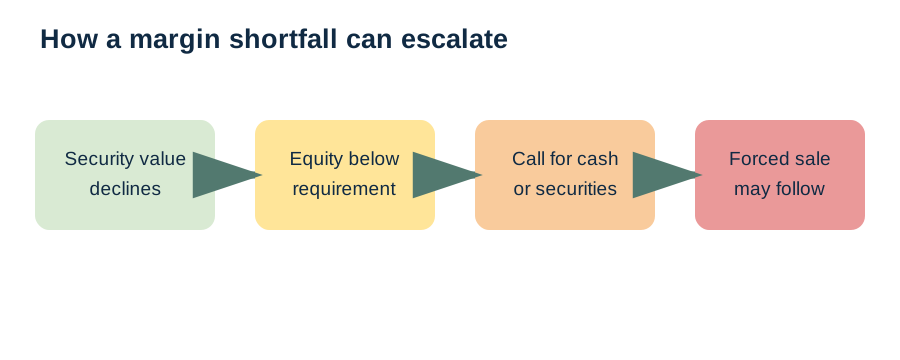 A shortfall can progress from declining value to a call and possible sale.
Cash removes borrowing from the purchase, but it does not remove investment risk. Margin adds a loan secured by your portfolio: gains and losses are magnified, interest reduces returns, requirements can change, and the broker may sell assets without waiting. Treat the account agreement—not an app label or headline buying-power number—as the controlling document.