The assumptions inside a retirement projection
Learn which assumptions drive a retirement projection—goals, time, contributions, inflation, returns, fees, taxes, and withdrawals—and how to stress-test them.
In this guide
A retirement projection is a conditional model: it estimates what could happen if a chosen set of goals, cash flows, returns, inflation, fees, taxes, and withdrawal rules were to occur. It is not a promise, a personal recommendation, or evidence that a particular retirement date is affordable.
The most useful question is not “What number does the calculator give me?” It is “Which assumptions produced that number, and what happens when I change them?” Investor.gov says a usable goal needs a specific objective and time frame. FINRA likewise connects time horizon, risk, and the need to manage withdrawals. Those are inputs to investigate, not a universal formula.
The short answer: projections are only as honest as their inputs
Write down at least these assumption groups:
- Goal and horizon: What spending must be funded, and for how long?
- Starting assets: Which accounts and balances are included?
- Contributions: How much, how often, and until what date?
- Other income: What wages, pensions, public benefits, or rental income may arrive?
- Returns and volatility: What range and order of returns will you test?
- Inflation: Are expenses and withdrawals nominal or inflation-adjusted?
- Costs and taxes: Which fees, tax rules, and account charges are included?
- Withdrawals: How much leaves the portfolio, when, and under what adjustment rule?
If an output changes sharply when one assumption moves slightly, that sensitivity is important information. It is not a reason to choose the input that produces the most comfortable answer.
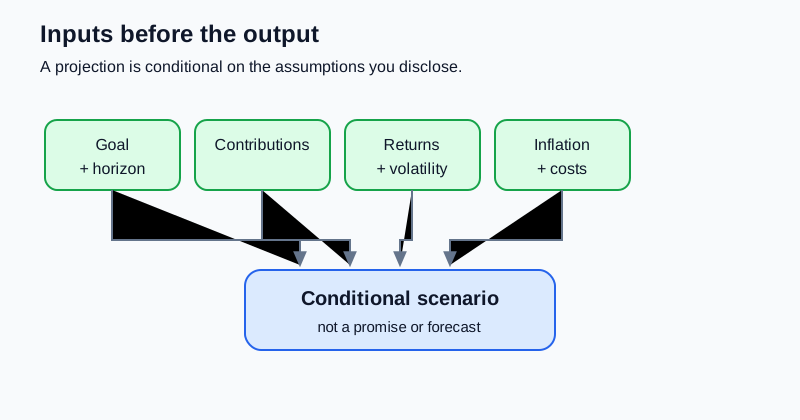
Visual: goals, cash flows, returns, inflation, and costs are inputs to a conditional scenario, not a promise.
Keep a change log beside the model. Record the date, the old assumption, the new assumption, and why it changed. This prevents a later reader—including you—from treating an optimistic input as if it had always been the baseline. It also makes a projection easier to review with a qualified adviser or family member without relying on memory.
Projection, scenario, forecast: keep the labels separate
A projection says, “If these assumptions hold, this is the modeled result.” A scenario changes one or more assumptions to explore a possible path. A forecast claims something about what is likely to happen in the real world. A spreadsheet with three return rows is a scenario table, not proof of probability.
The distinction matters because retirement models often display a precise-looking balance decades into the future. Precision in the output can hide uncertainty in the inputs. A model can be mathematically correct and still be unsuitable for a decision if it uses an unrealistic contribution, omits taxes, or treats a smooth return as guaranteed.
1. Define the goal before the portfolio
“Retire comfortably” is not a measurable input. Start with a spending question: which costs must the plan support, in which currency, and from what date? Separate essential costs from flexible spending and one-time goals such as education, a home renovation, or helping family.
K-0029 records financial freedom as a personal target, not a validated portfolio amount or timeline. K-0059 adds that a usable goal needs a time frame. Together they support a planning habit: define the outcome and date, then document what remains uncertain.
Longevity is another assumption, not a date you can know in advance. A projection that ends at an average life expectancy may understate the years your assets need to support. Test more than one horizon and say whether the model includes a reserve for late-life care or other support.
2. Make the time horizon and contribution path visible
Record the starting balance, contribution amount, frequency, first date, final contribution date, and whether contributions rise with income or inflation. If an employer match or government contribution is included, identify it separately and verify the relevant rule.
For an early-career reader, the contribution path may matter more than a small change in the assumed return. A plan that requires an amount you cannot sustain has exposed a constraint. It has not diagnosed a personal failure. Possible levers include the goal, time frame, contribution path, spending, or risk—but each change has a trade-off.
3. Choose return assumptions as a range, not a wish
Returns are uncertain and arrive in an order. Use a lower, middle, and higher scenario, but do not label them pessimistic, likely, and optimistic unless the evidence supports those probabilities. Keep nominal and real assumptions consistent.
Sequence-of-returns risk becomes especially relevant when withdrawals begin. Two paths can have the same average return but different outcomes if losses arrive before or after withdrawals. Test at least one unfavorable early sequence instead of using only a smooth annual average. The dedicated sequence-of-returns explainer shows the mechanism with an explicitly invented example.
Risk tolerance and risk capacity are different questions. Willingness to endure a decline does not prove that your cash flow can absorb it. The risk tolerance and capacity guide explains why both belong beside a projection.
4. Treat inflation as an assumption about spending
The U.S. Bureau of Labor Statistics explains that price indexes can translate nominal amounts into constant-dollar purchasing power. That does not mean one broad index matches every household. Housing, healthcare, education, and transport can move differently, and readers outside the United States need the measure relevant to their own spending.
Choose one system: model future nominal dollars with an inflation assumption, or model today’s purchasing power with real returns and real spending. Do not inflate expenses and then unknowingly apply a real return without converting the two systems.
5. Include fees, taxes, and account rules
The SEC’s investor bulletin explains that transaction and ongoing costs reduce money available to earn returns. List product expenses, advice charges, account fees, trading costs, and transfer or withdrawal costs separately. Taxes may depend on account type, country, income, timing, and withdrawal rules; do not hide them inside a single unexplained “net return.”
Account rules also determine when money can be accessed and how benefits or penalties work. Investor.gov’s lifetime-income guidance notes that defined-contribution balances do not guarantee an adequate retirement income. A projection should therefore show which income is contractual, which is modeled, and which depends on market returns.
A transparent worked illustration
The following is invented for teaching. It is not a recommended return, withdrawal rate, currency, or retirement target.
Scroll sideways or use arrow keys to read the full table.
| Input | Illustration |
|---|---|
| Spending target in today’s purchasing power | 30,000 per year |
| Time until withdrawals begin | 25 years |
| Starting balance | 10,000 |
| Monthly contribution | 500 at month-end |
| Inflation scenario | 2% per year |
| Gross return scenarios | 3%, 5%, and 7% per year |
| Annual ongoing cost | 0.50% of balance |
| Included | Contributions, compounding, stated cost |
| Excluded | Tax, public-benefit rules, changing contributions, volatility, healthcare shocks |
The model’s output is not “you will retire with X.” It is a set of balances conditional on these inputs. If the return is changed from 5% to 3%, the required contribution or projected balance may move materially. If inflation is higher, the future nominal spending target rises. If withdrawals begin after a market decline, sequence risk can make the path worse than a smooth average suggests.
Stress-test one assumption at a time
Run a baseline, then change one item:
- start withdrawals five years earlier;
- pause contributions for 12 months;
- reduce contributions after a job change;
- use a higher spending inflation rate;
- apply a lower return range;
- place poor returns in the first five withdrawal years;
- add a fee or tax that the baseline omitted; or
- extend the horizon.
For each result, write a response you can actually control. That might be delaying a goal, changing future contributions, reducing flexible spending, or seeking current jurisdiction-specific advice. Do not silently increase the return assumption to repair an uncomfortable result.
Review triggers matter more than a single annual rerun
Set a regular review date, but also name events that should reopen the model:
Scroll sideways or use arrow keys to read the full table.
| Assumption | Review trigger |
|---|---|
| Goal spending | New rent, healthcare, education, or care estimate |
| Contributions | Lasting income or essential-cost change |
| Horizon | Career, family, health, or relocation change |
| Inflation | A different spending basket or country |
| Fees and taxes | Provider, account, or rule change |
| Risk | A shorter horizon or lower loss capacity |
| Other income | Pension, benefit, or employment start-date change |
Updating a projection does not mean reacting to every market headline. It means replacing an old assumption with better information and recording what changed.
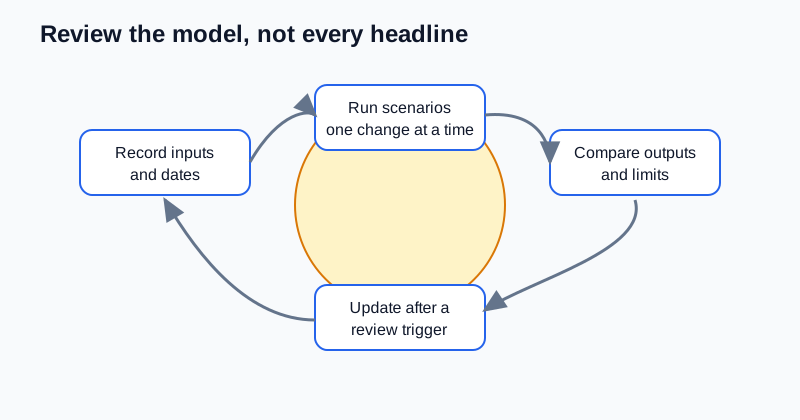
Visual: review the model after a meaningful trigger rather than reacting to every headline.
What a retirement projection cannot decide
No generic model can determine your suitable investment, exact retirement date, tax treatment, benefit eligibility, healthcare cost, estate plan, or legal rights. Public programs, account rules, and tax systems vary by jurisdiction and change over time. A projection is a decision aid, not a substitute for verifying current official rules or obtaining qualified advice for a high-stakes decision.
Copyable assumption checklist
Goal: [spending purpose, currency, essential and flexible costs] Horizon: [start date, withdrawal start, tested end dates] Starting assets: [accounts, balances, exclusions] Contributions: [amount, frequency, changes, end date] Other income: [source, amount, start date, uncertainty] Returns: [lower/middle/higher, nominal or real, early-loss test] Inflation: [measure, country, spending categories] Costs and taxes: [what is included and excluded] Withdrawals: [amount, timing, inflation adjustment] Review triggers: [dates and events]
The value of a projection is not its far-out decimal. It is the clarity it gives you about which facts, choices, and uncertainties deserve a better answer.
Continue with the Retirement & Long-Term Goals learning path, or browse the learning-path directory.
This article is general education, not individualized investment, tax, legal, or retirement advice. All numerical examples are invented illustrations.
Sources
- Investor.gov — Define Your Goals
- Investor.gov — Managing Lifetime Income
- FINRA — Know Your Risk Tolerance
- FINRA — Managing Your Retirement Portfolio
- U.S. Bureau of Labor Statistics — Purchasing power and constant dollars
- SEC Investor.gov — How Fees and Expenses Affect Your Investment Portfolio
- Investopedia — Understanding Sequence Risk