Risk tolerance vs. risk capacity: why willingness and ability differ
Learn the difference between willingness to take investment risk and the financial ability to absorb losses, with practical questions and clear limits.
In this guide
Risk tolerance and risk capacity are related, but they answer different questions. Risk tolerance is how much investment uncertainty or loss you are willing to accept. Risk capacity is how much loss your finances can absorb while you still meet important obligations and goals.
That distinction matters because a person can feel comfortable with a volatile portfolio while lacking the cash flow, time or reserves to recover from a large loss. The reverse can also happen: someone may have a long horizon and flexible finances but feel unable to tolerate temporary declines. A useful portfolio discussion considers both dimensions instead of turning one questionnaire answer into a recommendation.
In short: willingness describes your reaction to risk; capacity describes the consequences your financial life can withstand. Neither term, by itself, tells you what to buy.
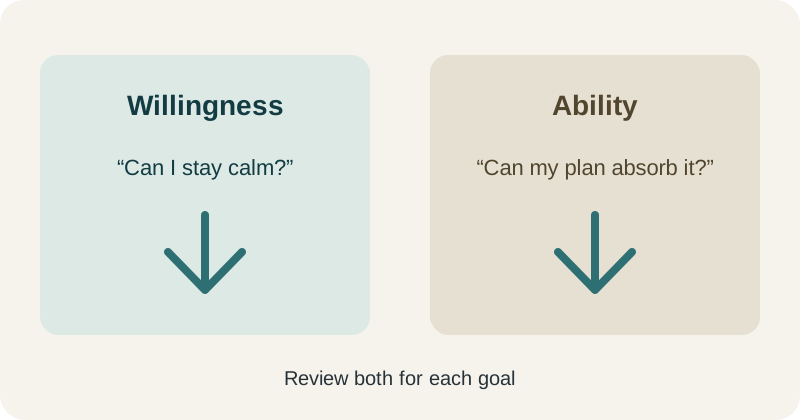
A useful review separates emotional willingness from financial ability for each goal.
Risk tolerance is willingness under uncertainty
Tolerance is personal and can change with experience, stress and recent market events. It is about how you might respond when an investment falls, remains volatile or underperforms a safer alternative. FINRA's risk-tolerance guidance describes tolerance as the amount of investment risk an investor is willing and able to accept, and warns that decisions should fit objectives, needs, time horizon and market-change tolerance.
Useful questions include:
- How would you react if a diversified portfolio fell and the loss were visible on your statement?
- Could you follow a written plan without selling solely because headlines were frightening?
- Do you understand what the investment owns, what can make it lose value and how quickly it can be sold?
- Is your answer based on a considered plan or on how markets have felt in the last few weeks?
A high self-reported tolerance is not proof of knowledge, discipline or suitability. A stressful event can change behavior. Treat an answer as information to examine, not a permanent identity.
Risk capacity is financial ability to absorb loss
Capacity is constrained by the rest of your balance sheet and calendar. Consider the money’s purpose, when it may be needed, dependable income, emergency liquidity, debt payments, dependants, insurance, other assets and how flexible the goal is. Investor.gov links allocation to time horizon and risk tolerance, noting that shorter horizons generally leave less room for volatile investments.
Capacity asks what would happen if the portfolio lost value at the wrong time. A loss may be financially manageable for a long-term goal with flexible timing, but damaging for a near-term tuition payment, rent reserve or required debt payment. FINRA's brokerage-account information lists financial situation, needs, liquidity needs, objectives, time horizon and risk tolerance as parts of an investor profile.
Capacity is not the same as wealth. A high account balance does not create capacity for money that must be spent soon, and a modest portfolio may still have a long horizon if essential expenses are funded elsewhere. Capacity is goal-specific: the same person can have different capacity for an emergency reserve, a home deposit and a retirement account.
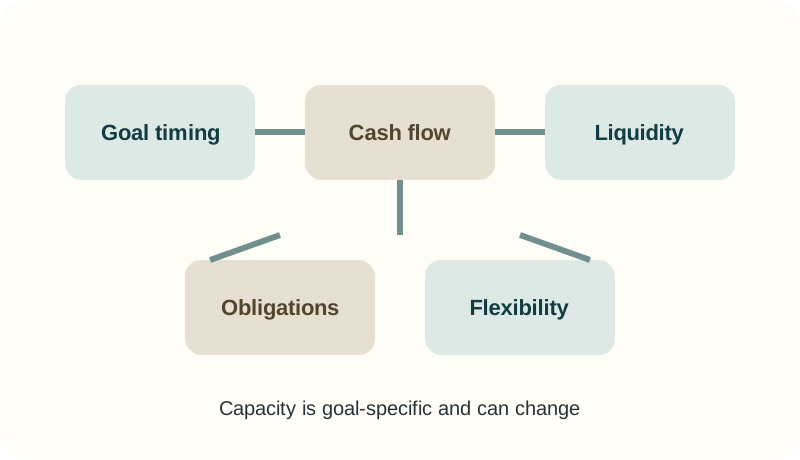
Capacity is shaped by the practical facts around a goal, not by an age label alone.
What can reduce capacity without changing tolerance
Capacity can fall even when a person’s feelings about markets stay exactly the same. A job loss can make income less dependable. A new loan can increase mandatory payments. A family change can add care costs. A health event can reduce the flexibility to work or delay a goal. A concentrated position can make the portfolio more fragile even if its headline value is unchanged. A deadline moving closer also matters: money needed next year has less time to recover from a fall than money intended for a goal decades away.
These are planning facts, not signals to predict prices. They are reasons to update the information behind a portfolio decision. The reverse is also possible: a larger emergency reserve, lower fixed costs or a more flexible goal may improve capacity, but does not automatically make a person comfortable with more volatility.
Why tolerance and capacity can disagree
Imagine two scales. Tolerance is the emotional and behavioral side: “Could I stay with this level of uncertainty?” Capacity is the practical side: “Could my plan survive a loss without forcing a bad-time sale or missed obligation?”
The safer planning boundary is often the lower of the two, but that is a framing principle, not a formula or a prescribed allocation. If willingness is lower, a person may abandon a risky plan during a fall. If capacity is lower, a person may be unable to wait for recovery even if they feel brave today. Increasing tolerance by watching more market videos does not create emergency cash, and increasing capacity by ignoring fear does not create emotional resilience.
Three illustrative scenarios
These examples use invented facts to show the distinction. They are not model portfolios or advice.
A near-term goal with high confidence
Jordan says a temporary 30% fall would not bother them. However, the money is earmarked for a payment due in 18 months, income is variable and there is little emergency cash. Jordan’s willingness appears higher than the goal’s capacity. The relevant question is not whether Jordan can imagine staying calm; it is whether a loss near the deadline would force a sale or disrupt the payment.
A long horizon with low comfort
Mina has stable income, a funded cash reserve and a retirement goal decades away. She still feels distressed by monthly price changes. Her capacity for market uncertainty may be higher than her current tolerance. A plan she cannot follow may be unsuitable in practice, even if a spreadsheet says the horizon is long.
A changing household
Sam was comfortable with risk when single, renting and saving regularly. After a job change, new debt and responsibility for a family member, the same portfolio may now have less capacity behind it. The change is not a market forecast; it is a reason to review goals, liquidity and time horizon.
When the labels create confusion
Calling someone “aggressive” because they chose a volatile fund can hide the real question. The fund may be a small part of a much larger household balance sheet, or it may be money needed for a near-term bill. Likewise, calling someone “conservative” because they prefer cash may miss a long horizon and a strong ability to wait. Describe the facts and the goal before attaching a label.
A practical review checklist
Use these prompts for education and record-keeping, not as a trading instruction:
- Name each goal. What is the money for, and what date or range might it be needed?
- Separate essential from flexible spending. Which withdrawals cannot be delayed?
- Map dependable resources. Include income, emergency cash, insurance, other assets and liabilities.
- Describe a loss scenario. What would a 10%, 20% or larger decline mean for the goal? These percentages are stress-test examples, not forecasts.
- Check liquidity. Could you meet obligations without selling a volatile asset at an inconvenient time?
- Check behavior. What action would you likely take during a sharp fall, and what written guardrail could reduce an impulsive decision?
- Review understanding. Can you explain the investment’s risks, costs, liquidity and concentration?
- Set a review trigger. Revisit after changes in income, debt, dependants, health, horizon, goal or portfolio exposure.
Keep the notes dated. A snapshot from one calm month should not be treated as a permanent assessment. If a plan is shared with a partner or family member, make sure the people who depend on the goal understand the timing and the possible range of outcomes.
It can help to write the two answers in separate sentences: “I am willing to stay invested through…” and “I could financially absorb…” The first sentence describes behavior you hope to sustain; the second names the boundary imposed by real obligations. Keeping them separate makes a mismatch visible and gives you a concrete topic to review.
How this connects to allocation and rebalancing
Risk tolerance and capacity inform a planning conversation; they do not produce a universal stock-and-bond percentage. Investor.gov says the appropriate allocation can change with time horizon and tolerance, while diversification spreads money among assets and investments. Review the portfolio rebalancing guide for how a target mix is maintained; fund count alone does not prove diversification.
Once a target allocation is chosen for a specific goal, market moves can make the actual mix drift. The portfolio rebalancing guide explains calendar and threshold reviews, cash-flow methods and the costs and taxes to check. Rebalancing returns a portfolio toward a chosen target; it does not repair a target that no longer fits your capacity.
Your time horizon is also part of a broader long-term financial goal plan. A horizon is not a promise that markets will recover by a particular date. It is one input to deciding how much uncertainty a goal can reasonably carry.
Limits of questionnaires and online scores
Risk quizzes can help a reader articulate feelings, but a score is not a complete suitability assessment. It may omit debt, emergency liquidity, taxes, account restrictions, concentrated holdings, dependants or a goal that cannot move. Answers can also shift under stress. Do not treat a label such as “moderate” as a product instruction, and do not assume age alone determines a suitable plan.
If a decision has material consequences or the facts are complicated, consider qualified local financial or tax advice. A professional’s process should still explain assumptions, conflicts, costs and what information was used. No professional review is claimed for this article.
The idea to take with you
Tolerance is willingness; capacity is ability. Compare both for each goal, then include time horizon, liquidity, obligations, flexibility and understanding. When the two disagree, investigate the mismatch instead of forcing a neat score. The aim is a plan that can meet real-life needs and that a person can follow through ordinary volatility.
This article is general education, not personalized investment, tax or legal advice. The sources below are U.S. investor-education materials; rules, products and protections differ by jurisdiction. Pages were checked on 2026-09-08.