Retirement income is a system: map sources, timing, taxes, and risk
Map retirement income sources, timing, taxes, spending, longevity, and investment risk with a practical checklist—without assuming a universal safe withdrawal rate.
In this guide
Retirement income planning is the work of coordinating several cash-flow sources over time: employment income, public benefits, pensions, annuities, taxable savings, and retirement accounts. The plan also has to account for when each source starts, how reliable it is, what tax rules apply, how spending may change, and what happens if investments fall.
The direct answer is a map, not a magic percentage. List each source, its start date, amount, uncertainty, tax treatment, and conditions. Then compare the income gap with spending under more than one market and longevity scenario. A balance on a statement is not automatically lifetime income.
The short answer: build an income map before choosing a withdrawal rule
Start with eight lines:
- Essential spending: What must be paid every month?
- Flexible spending: What can be reduced, delayed, or paused?
- Income sources: Which sources are contractual, public, employment-based, or market-dependent?
- Timing: When does each source begin, and can the date move?
- Taxes and rules: What is taxable, deferred, restricted, or jurisdiction-specific?
- Investment gap: How much must investments supply after other income?
- Risks: What if longevity, inflation, fees, illness, or early losses are worse than assumed?
- Review triggers: Which life or market events make you rerun the plan?
Investor.gov explains that defined-contribution balances do not guarantee an adequate retirement income, while a pension annuity can address longevity risk for the income it covers. FINRA similarly asks readers to consider all assets and income sources, taxes, risk, and yearly withdrawals. These are planning questions, not a universal formula.
1. Separate income sources by what can change
Make one row for each source and label its reliability:
Scroll sideways or use arrow keys to read the full table.
| Source type | Questions to record |
|---|---|
| Employment or self-employment | When might it stop, and how variable is it? |
| Public benefit | What current eligibility and start-date rules apply? |
| Defined-benefit pension | Is the payment fixed, indexed, joint-life, or subject to options? |
| Annuity | What contract, insurer, fees, liquidity limits, and inflation terms apply? |
| Taxable savings | What balance, yield, tax, and access assumptions are used? |
| Retirement account | What withdrawal, tax, conversion, and beneficiary rules apply? |
| Property or business income | What vacancy, maintenance, debt, or concentration risks exist? |
Do not put every source in one “annual income” cell. A guaranteed or contract-based payment is different from a market-dependent estimate. A benefit rule can change; a pension can have survivor options; rental income can have expenses and vacancies. The label should preserve those differences.
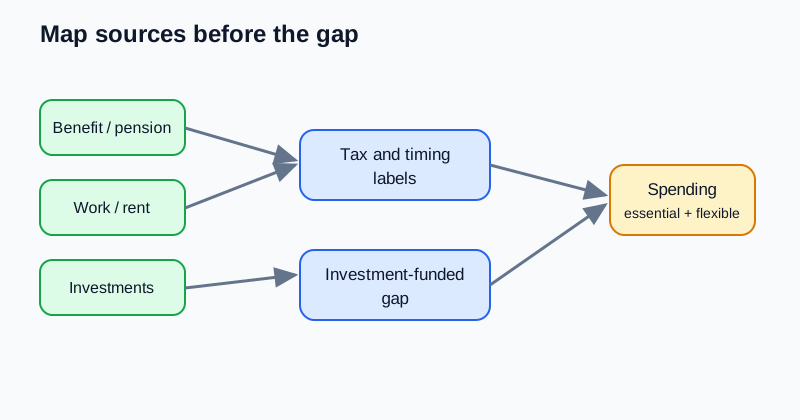
Visual: map each source and its timing before calculating the portfolio-funded gap.
2. Match timing to spending
Create a month-by-month or year-by-year timeline. Mark when work income ends, when benefits begin, when a pension option is chosen, when health costs may rise, and when large one-time expenses are expected.
Timing can change the gap even when total lifetime income looks similar. Delaying one source may increase later payments but leave a bridge period to fund. Starting another source early may reduce the amount invested but change taxes or lifetime protection. The right choice depends on current rules and personal circumstances; the checklist is for organizing the trade-off.
Split spending into essential, flexible, and one-time categories. A fixed rent or medication bill needs a different funding test from travel or a discretionary purchase. K-0059 supports identifying the goal and time frame before choosing a return or account assumption.
3. Keep tax labels beside every source
Do not write “income” without noting whether it is gross or net. A taxable withdrawal can produce less spendable cash than the same headline amount from a tax-free or already-taxed source. Rules vary by country and account type, and some U.S. examples—such as traditional and Roth account treatment—do not generalize worldwide.
Vanguard describes coordinating withdrawals across taxable, tax-deferred, and tax-free accounts because account order can affect taxes. FINRA’s payout guidance similarly notes that a large lump-sum distribution may be taxable in the year taken, depending on the account and rollover. These are reasons to verify current rules, not instructions to use one order universally.
For each source, record:
- gross amount and estimated spendable amount;
- tax category and withholding assumption;
- account or legal restrictions;
- start, stop, and adjustment rules; and
- the official document and date checked.
4. Define the investment-funded gap
After mapping other sources, calculate the gap the portfolio may need to cover. For example, if essential spending is 24,000 per year and dependable after-tax income is 18,000, the initial gap is 6,000 before flexible spending, fees, inflation, and taxes on the portfolio withdrawal.
That gap is not automatically a safe withdrawal rate. It must be tested against the starting balance, the investment mix, return order, inflation, fees, taxes, and horizon. K-0070 records why early losses combined with withdrawals can leave fewer assets for a later recovery. The sequence-risk guide explains that mechanism.
A transparent monthly illustration
The following numbers are invented for teaching and use unnamed currency units. They are not a target budget, product recommendation, or safe rate.
Scroll sideways or use arrow keys to read the full table.
| Monthly item | Year 1 illustration |
|---|---|
| Essential spending | 2,000 |
| Flexible spending | 500 |
| Other dependable income | 1,800 |
| Portfolio-funded gap before tax and fees | 700 |
| Inflation assumption | 2% per year |
| Return scenarios | Lower, middle, higher; order tested separately |
The first-year gap is 700 per month, or 8,400 before considering portfolio taxes and fees. If dependable income rises later, the gap may shrink; if spending rises faster than assumed, it may grow. If the portfolio falls early, selling to fund the gap can worsen the sequence. The purpose of the table is to expose the moving parts, not to produce a retirement answer.
5. Test longevity, inflation, and early losses
Run at least these scenarios:
- the plan lasts 10 years longer than the first horizon;
- essential spending rises faster than the broad inflation assumption;
- an income source starts later or is lower than expected;
- the first five investment years are weak;
- fees or taxes are higher than the baseline;
- flexible spending is reduced after a loss; and
- a major health, housing, or family cost appears.
For each scenario, write the response that is actually available. A model may reveal that the plan needs more savings, a later date, lower flexible spending, different timing, or qualified advice. It should not silently repair the result by increasing the assumed return.
6. Distinguish risk tolerance from risk capacity
Risk tolerance is willingness to experience uncertainty and loss. Risk capacity is the financial ability to absorb loss without undermining essential obligations or goals. K-0069 records the distinction and warns that a self-reported comfort label is not a complete suitability assessment.
Ask both questions:
- Could the household emotionally stay with the investment plan during a decline?
- Could the household still pay essential costs if the portfolio fell and recovery took years?
The answer can change after a job loss, move, health event, new dependent, debt change, or shorter time horizon. Do not infer capacity from age alone.
Keep a change log for the system. Record when a source, spending line, tax assumption, fee, or horizon changes and why. This makes it easier to tell whether a weaker result came from markets or from a household decision. It also prevents an old optimistic assumption from being mistaken for a long-standing fact when the plan is reviewed later.
Reliability is not the same as certainty. A public benefit may be governed by current law, a pension by a contract, and investment income by market prices. Labeling those differences helps the plan show where a backup is valuable without implying that any source is permanently guaranteed.
The map should also show who controls each decision. Some dates are fixed by a contract or rule; others are choices that can be delayed. Some spending is unavoidable; other spending is a lever. Marking those categories keeps the checklist practical: it distinguishes a fact to verify from a trade-off the household can actually revisit.
7. Review the system, not every headline
Set a regular review date and event triggers:
Scroll sideways or use arrow keys to read the full table.
| Item | Review trigger |
|---|---|
| Spending | New rent, medical, care, or family obligation |
| Income source | Rule, employer, benefit, contract, or start-date change |
| Taxes | New account, jurisdiction, bracket, or withdrawal rule |
| Investments | Allocation drift, fee change, or lower loss capacity |
| Longevity | Health or family information changes the horizon |
| Flexibility | Work, relocation, debt, or essential-cost change |
An annual review does not mean reacting to every price movement. It means checking whether the assumptions, documents, and cash flows still describe the household.
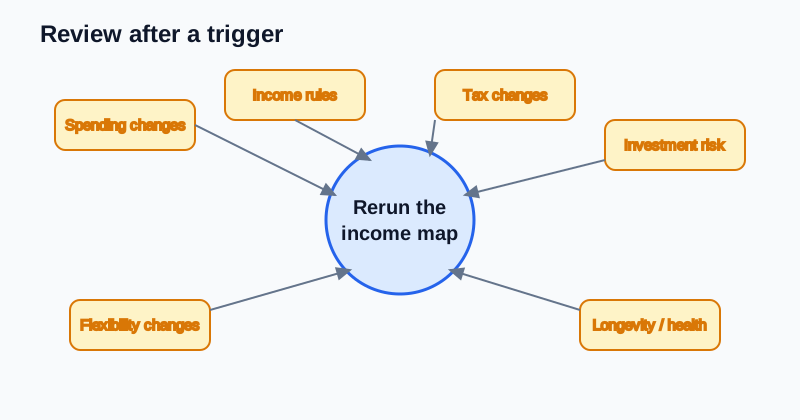
Visual: spending, income, tax, investment, longevity, and flexibility changes can trigger a review.
Copyable retirement-income checklist
Essential spending: [monthly amount, currency, inflation sensitivity] Flexible spending: [amount that can be delayed or reduced] Income sources: [source, amount, reliability, start date] Tax labels: [gross/net, account type, jurisdiction, documents] Portfolio gap: [amount, timing, fees, withdrawal assumptions] Risk tests: [early losses, inflation, longevity, fee, tax, health] Fallbacks: [controllable spending, work, timing, or savings changes] Review date: [regular date and event triggers]
The practical conclusion is modest: retirement income is a coordinated system. Make sources, timing, taxes, spending, and risk visible before treating a projection or account balance as an answer.
The long-term goal worksheet shows how to document model inputs. Continue with the Retirement & Long-Term Goals learning path, or browse the learning-path directory.
This article is general education, not individualized investment, tax, legal, benefits, or retirement advice. Examples are invented illustrations.