Index fund, active fund, and wrapper: separate the decisions
Compare index and active fund strategies separately from ETF and mutual-fund wrappers, holdings, costs, and suitability.
In this guide
An index fund tries to follow a defined benchmark. An actively managed fund gives a manager discretion to select investments within a stated objective. Either strategy can be packaged as an ETF or a mutual fund. So “index versus active” is a strategy question; “ETF versus mutual fund” is mainly a trading and access question.
The four questions to keep separate
- Holdings: What securities, sectors, countries, currencies, and issuers does the fund own?
- Strategy: Does it track rules for an index, or does a manager make discretionary choices?
- Wrapper: Are shares traded intraday on an exchange or transacted at a fund-calculated NAV?
- Access: What broker, share class, minimum, tax account, automation, and fees apply to you?
The SEC says an index fund may be a mutual fund or an ETF and warns that index funds can still have costs and risks. The label does not establish diversification, safety, or suitability.
What an index strategy does
An index strategy specifies a benchmark and rules for selecting and weighting holdings. Full replication owns every constituent; sampling owns a representative subset. Rebalancing, corporate actions, cash, taxes, and fund expenses can make results differ from the index.
Index funds usually provide a transparent rule set and often require fewer security-by-security decisions by the manager. That does not mean the benchmark is broad, simple, cheap, or low risk. A narrow sector index can be concentrated, and an index fund can use derivatives or complex methodology.
What active management does
An active manager can choose securities, hold cash, change exposures, or trade within the prospectus objective and limits. The manager may seek a benchmark-relative or absolute objective, but neither the strategy nor the manager’s skill guarantees outperformance.
Active funds can be diversified or concentrated. Read the mandate, turnover, top holdings, risk disclosures, and process. A short period of outperformance may reflect chance, factor exposure, or a particular market regime rather than a repeatable edge.
Costs are a separate comparison
Compare the expense ratio, but also trading costs, loads, account fees, advice, taxes, spreads, and currency conversion. An active fund may have higher research and trading expenses, while an index fund may still incur implementation costs. See fund expense ratio vs total cost.
Hypothetical example
Fund A tracks a broad index with a 0.15% expense ratio. Fund B is actively managed with a 0.60% ratio. If both deliver the same gross portfolio return before costs, B leaves more of that return in expenses. But this illustration says nothing about future returns, risk, taxes, or whether the funds actually hold comparable assets.
The wrapper changes the trade experience
An ETF generally trades on an exchange at a market price, with a bid–ask spread and possible premium or discount to NAV. A conventional open-end mutual fund generally receives the next calculated NAV. Either wrapper can hold an index or active portfolio, and either can be risky or diversified. Read ETF vs mutual fund for the mechanics.
A comparison table
Scroll sideways or use arrow keys to read the full table.
| Question | Index strategy | Active strategy |
|---|---|---|
| Decision rule | Defined index methodology | Manager discretion within mandate |
| Possible wrapper | ETF or mutual fund | ETF or mutual fund |
| Main review | Benchmark, tracking, holdings | Process, holdings, turnover, manager limits |
| Diversification | Depends on index holdings | Depends on portfolio holdings |
| Cost conclusion | Not automatically cheap | Not automatically expensive or better |
| Return conclusion | No guarantee of matching index | No guarantee of beating index |
A due-diligence checklist
- Name the exact benchmark or active objective.
- Check the current prospectus and shareholder report.
- Review holdings, weights, concentration, derivatives, and cash.
- Compare gross and net expenses, waivers, turnover, and trading costs.
- Check wrapper, dealing time, spread, minimum, automation, and share class.
- Match the fund’s role to your time horizon, liquidity needs, and wider portfolio.
- Record dates and assumptions; do not treat past performance as a promise.
The idea to keep
Choose the exposure and objective first. Then compare strategy implementation, wrapper mechanics, access, and total cost. “Index,” “active,” “ETF,” and “mutual fund” answer different questions; none is a shortcut for understanding what you own.
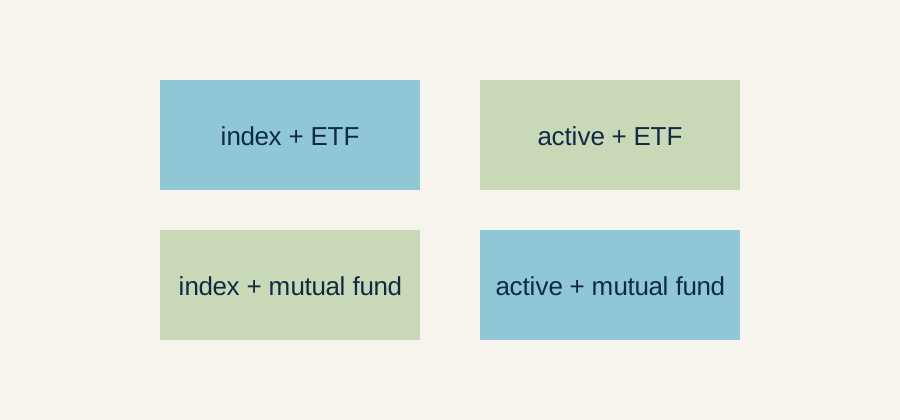 Index and active strategies can each use an ETF or mutual-fund wrapper.
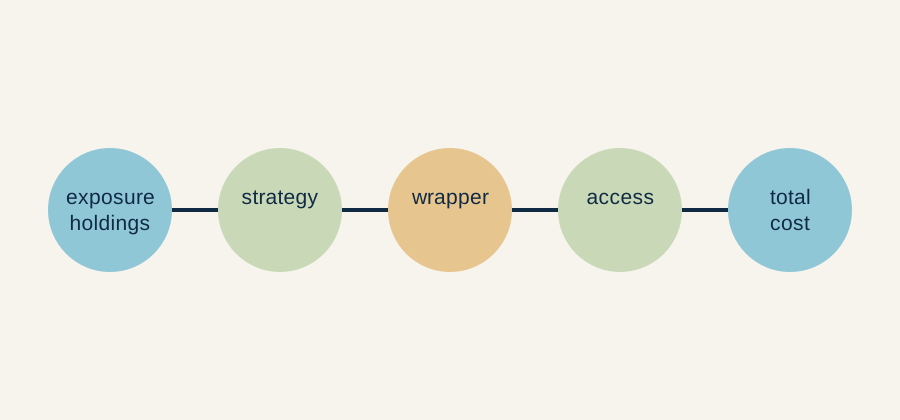 Compare exposure, strategy, wrapper, access, and total cost in that order.
General education only. This U.S.-oriented guide is not personalized investment, tax, or legal advice. Investing can result in loss.