Asset allocation vs. diversification: related but different decisions
Learn how asset allocation and diversification differ, why fund count can mislead, and how goals, horizon and risk shape the review.
In this guide
Asset allocation is the decision about how much of a portfolio belongs in broad asset classes such as stocks, bonds and cash. Diversification is the decision to spread exposure among and within those classes so the portfolio is not dependent on one investment, issuer, sector or market.
They are connected, but one does not replace the other. A portfolio can have a deliberate allocation and still be concentrated. It can also hold many investments that all respond to the same risk. Neither concept guarantees a profit or prevents loss.
In short: allocation chooses the buckets; diversification checks what is inside and how much any one risk can dominate.
What asset allocation decides
Investor.gov defines asset allocation as dividing investments among assets such as stocks, bonds and cash. The appropriate mix depends on the goal, time horizon and risk tolerance; a down-payment account and a retirement account may reasonably have different targets because their deadlines differ.
Allocation is therefore a planning decision. It asks what role each broad asset class has and what proportion is intended for a particular goal. The answer is not supplied by this article. A shorter horizon may leave less room for volatile assets, while a longer horizon may allow more time to absorb fluctuations—but time does not remove risk.
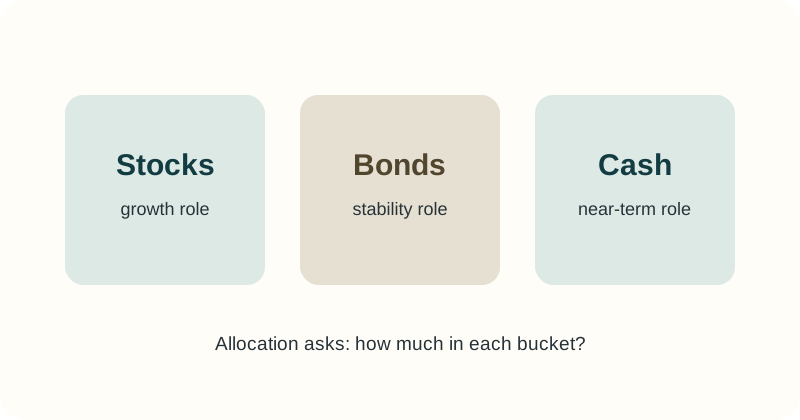
Allocation asks how much belongs in each broad bucket.
Allocation can be expressed as percentages, dollar ranges or a written policy. The format matters less than clarity about the goal, the account, the horizon and what would cause a review. A target is a starting point for monitoring, not a forecast of returns.
Allocation can also differ across accounts without being inconsistent. Money for an emergency or a near-term purchase may have a different job from money intended for a distant retirement goal. Combining every account into one pie chart can hide the fact that one goal is exposed to more volatility than its deadline allows. Review the purpose of each account before judging the household total.
What diversification changes
Diversification spreads money across different investments and, ideally, exposures that do not all react the same way to an event. It can happen across asset classes and within each class. FINRA's diversification guidance gives examples such as different company sizes, sectors, geographies, bond issuers, maturities and credit ratings.
Diversification addresses concentration risk: the possibility that one security, issuer, industry or market segment causes an outsized share of the portfolio’s loss. It does not make every holding safe. A diversified portfolio can still lose value when broad markets fall, and diversification cannot guarantee that one asset will offset another in every period.
Funds can make it easier to own many underlying investments, but a fund wrapper is not proof of diversification. Investor.gov cautions that a narrowly focused mutual fund or ETF may not diversify a portfolio, and that several funds may hold many of the same top positions.
Why allocation alone is not enough
Imagine a portfolio policy that assigns 100% to “stocks.” That is an allocation decision, but it says little about whether the investor owns one company, one sector, several countries or a broad market. The portfolio could be intentionally concentrated or widely spread; the allocation label alone cannot tell us.
Now imagine four funds: a broad domestic fund, a technology fund, a global fund and an employer-stock fund. Four line items may look diversified, yet their largest holdings or sector exposures may overlap. Counting funds is a weak shortcut. Look through to holdings, regions, industries, issuers and other material risks.
The reverse also matters. A portfolio can hold many individual securities but still have an allocation that does not fit the goal. Hundreds of volatile holdings do not make money needed soon suitable for a long-term risk target. Diversification cannot repair a mismatched horizon or liquidity need.
Diversification has limits within a single asset class too. Owning ten technology companies is different from owning companies across technology, health care, consumer businesses and industrials. Owning bonds from one issuer is different from spreading issuer, maturity and credit exposures. The appropriate breadth depends on the goal and the investor’s circumstances; “more” is not automatically “better.”
A transparent overlap example
The following figures are invented to show the method, not a recommended portfolio. Suppose an investor has two funds, each worth $5,000. Fund A is 60% technology and Fund B is 40% technology. Even before checking every company, the combined portfolio has at least $5,000 of technology exposure: $3,000 from A plus $2,000 from B. Technology therefore represents 50% of the $10,000 total, while the remaining exposures share the other 50%.
The exact overlap could be higher if both funds own the same companies. A useful review records the look-through exposure rather than assuming that two fund names mean two independent risks. The arithmetic illustrates concentration; it does not predict sector performance.
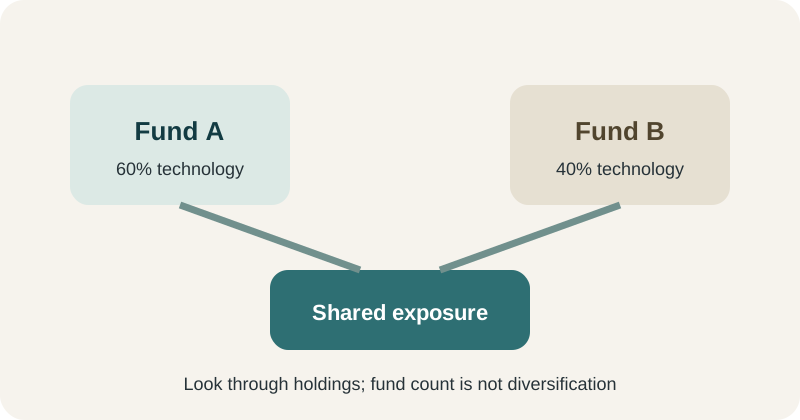
Look through holdings; fund count alone does not establish diversification.
A second look-through question
Suppose Fund C is a broad global fund and Fund D is a domestic index fund. Their names sound complementary, but the global fund may already contain a large domestic allocation. The investor should ask how much of the total portfolio is exposed to the same country, currency, mega-cap companies or economic drivers. The answer may be perfectly intentional; the point is to discover it before calling the portfolio diversified.
Look-through analysis does not require perfect precision for an educational review. Start with the fund factsheet or holdings file, note the largest positions and sectors, and flag repeated exposures. Then check whether those exposures align with the written allocation and the goal. Holdings change, so the date of the document matters.
A simple decision sequence
Start with the goal, not the product list. Write when the money may be needed and what losses would make the goal fail. Next, set a broad allocation that reflects that horizon and the investor’s willingness and financial ability to take risk. Only then examine diversification inside each bucket.
The sequence prevents a common reversal: choosing several popular funds first and trying to justify the resulting portfolio afterward. It also makes trade-offs visible. A broad fund may be simple but still have a heavy exposure to one country or company group; a collection of narrow funds may offer variety in names while increasing overlap, cost and maintenance.
After the review, document what is intentional and what needs attention. A concentration can be a deliberate choice, an employer-stock constraint or an accidental overlap. The label matters less than the explanation and the plan for reviewing it. If circumstances change, revisit both allocation and diversification rather than changing only the easiest line item.
This order also helps when a platform presents a ready-made risk label. Treat the label as a starting description, then ask what assets it actually contains, how concentrated those assets are and which account goal it serves. A polished interface cannot answer those questions for you. Reading holdings and account documents is part of understanding the portfolio.
That extra step matters when a provider uses broad marketing words such as “balanced,” “global” or “core.” Those words may describe a mandate, not the diversification a particular goal requires.
Ask for the current holdings date and read the stated investment objective.
Allocation, diversification and rebalancing
Once a target allocation is chosen, market moves or cash flows can change its weights. The portfolio rebalancing guide explains how a review can move holdings back toward a chosen target. Rebalancing does not automatically improve diversification: returning to 60% stocks and 40% bonds does not reveal whether the stock bucket contains one narrow sector or many industries.
Similarly, diversifying a portfolio does not tell you what overall stock–bond–cash mix fits a goal. The long-term financial goal plan connects goals and time horizons to a broader planning process. Your risk tolerance and capacity can differ by goal, as discussed in the portfolio-strategy learning path.
A review checklist for young investors
- Name the goal and horizon. What is the money for, and when might it be needed?
- Write the allocation. Which broad asset classes are intended, and what role does each play?
- Look through each holding. Record major issuers, sectors, countries, maturities and other material exposures.
- Check concentration. Could one security, sector, issuer or asset class dominate a loss?
- Check overlap. Do several funds own the same companies or respond to the same economic risk?
- Separate account goals. A different account may need a different target; do not blend every dollar into one score.
- Review costs and taxes. Changes can create transaction costs, tax consequences or restrictions.
- Set a review trigger. Revisit after a goal, horizon, income, debt or risk-capacity change—not only after a dramatic headline.
If a fund is difficult to understand, record that as a limitation rather than assuming it is diversified. Transparency, cost, liquidity and tax treatment are separate questions from allocation and diversification, but they can affect whether a chosen structure is workable.
Limits and common mistakes
Diversification is risk management, not insurance. Correlations can rise during stress, and an asset that usually behaves differently may fall at the same time. Allocation is not a return forecast, and a historical relationship does not promise a future one.
Avoid treating a questionnaire, a pie chart or a fund count as a complete analysis. Product names can be broad or narrow; holdings and mandates can change. Check current documents and the account’s rules. If a decision has material tax, legal or financial consequences, qualified local advice may be appropriate. This article does not provide that advice.
The idea to take with you
Allocation answers “how much in each broad bucket?” Diversification answers “how many different exposures are inside those buckets, and how much can one risk dominate?” Use both questions for each goal, then connect the answer to time horizon, liquidity, tolerance and capacity. Continue with risk tolerance vs. risk capacity, the Portfolio Strategy learning path, or the wider Investing topic.
This is general education, not personalized investment, tax or legal advice. Sources are U.S. investor-education materials; products, rules and protections differ by jurisdiction. Pages were checked on 2026-09-08.