Exchange custody, self-custody, and wallet control compared
Compare exchange custody and self-custody: private keys, recovery, hot and cold wallets, withdrawal risk, smart-contract permissions and practical trade-offs.
In this guide
Source checked 8 September 2026 · Educational comparison, not a provider recommendation
The short answer
With exchange custody, a platform controls the private keys associated with the crypto held in your account. You use a username, password and the platform’s withdrawal process, while the platform’s security, solvency, policies, legal structure and operational systems become part of your risk. With self-custody, you control the private keys or recovery material yourself. That gives you direct authorization, but also makes you responsible for setup, backups, devices, scams and recovery.
Neither model is automatically safer. Exchange custody trades some key-management work for dependence on a third party. Self-custody removes that intermediary from key control but gives you fewer ways to recover from your own mistake. The useful comparison is not “Which wallet is best?” It is “Which responsibilities can I perform reliably, and which failure would I rather manage?”
Disclosure: This is a documentation-based educational guide. It does not test a provider, inspect a wallet’s code, verify insurance, audit reserves, or recommend a named exchange or device. Products, networks, account terms and legal protections vary by jurisdiction and date.
What “custody” means
Crypto assets are recorded on a blockchain or similar ledger. A wallet normally does not contain the coins like a physical wallet contains cash; it manages the keys or credentials used to authorize transactions. A public address can receive assets. A private key or equivalent signing authority can authorize a transfer. Whoever controls that signing authority controls the practical ability to move the assets, subject to the network’s rules.
The SEC’s Investor.gov bulletin makes the distinction explicit: a private key authorizes transactions, while a public key helps verify or receive them. Losing a private key can permanently block access. A seed or recovery phrase can restore a wallet, so it is effectively a master credential and must be protected like one.
“Custody” therefore has several layers. Who holds the key? Who can approve a withdrawal? Who can reset access? Who can freeze or delay activity? Who bears the loss if a device, employee, vendor, account or legal entity fails? A comparison that answers only where an app is installed misses the important control boundary.
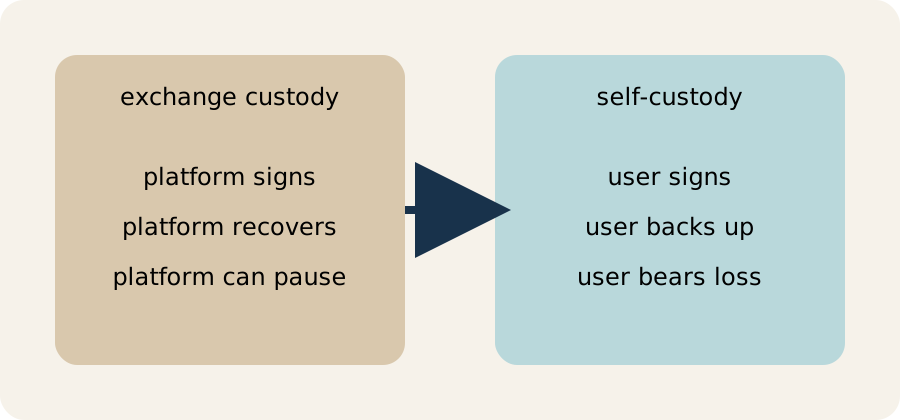
The signing, recovery and pause responsibilities move between the platform and the user; neither side removes all risk.
Exchange custody: convenience with a counterparty
When you buy crypto on a centralized exchange, the account balance is usually a platform record linked to the exchange’s custody system. You may see a deposit address or a balance, but you generally do not receive the private key for every asset in the account. The exchange controls how assets are held, pooled, moved between hot and cold systems, and released to a withdrawal address under its terms.
What exchange custody can make easier
- Password and account recovery may be more familiar than restoring a seed phrase.
- Buying, selling and converting can happen inside one interface.
- The platform may handle key storage, signing workflows, network selection and some security monitoring.
- You can keep a small trading balance available without operating your own wallet infrastructure.
Those are operational conveniences, not proof of safety or protection. A platform can pause withdrawals, limit an account, suffer an outage, change supported networks or become insolvent. The SEC bulletin specifically tells readers to ask what happens if a custodian is hacked, shuts down or goes bankrupt, whether assets are commingled or rehypothecated, which security controls are used, and what fees apply.
The questions exchange users should ask
Read the current user agreement and custody disclosures for your country. Look for the legal entity, ownership language, withdrawal rights, supported assets and networks, fee schedule, staking or lending terms, use of customer assets, insurance exclusions, account-recovery process and dispute venue. A marketing statement about “secure storage” is not the same as a legal claim to specific assets or a guarantee of access.
Also separate platform risk from market risk. A token can fall in value while the exchange operates normally. Conversely, a token can remain valuable while the exchange’s account, banking, custody or withdrawal system is unavailable.
Self-custody: direct control with direct responsibility
In self-custody, the user controls the private keys or recovery material. A wallet app is an interface to an account; it does not move the underlying blockchain record into the app. Ethereum.org explains that wallet providers do not have custody of funds in a standard self-custody model and that users remain responsible for keeping keys safe.
What self-custody can make possible
- You can authorize transactions without asking an exchange to release them.
- You can move between compatible wallet interfaces while retaining the same account credentials.
- You can interact directly with networks and applications that support the wallet and asset.
- A hardware wallet can keep private keys offline while still allowing you to sign transactions.
The control is real, but so is the responsibility. If a recovery phrase is lost, exposed, photographed, entered into a phishing site or destroyed without another reliable backup, the result may be permanent loss. No central Ethereum help desk can reset a self-custody wallet password or reverse a confirmed transaction. A hardware device can reduce online exposure, but it can be lost, damaged, stolen or used incorrectly.
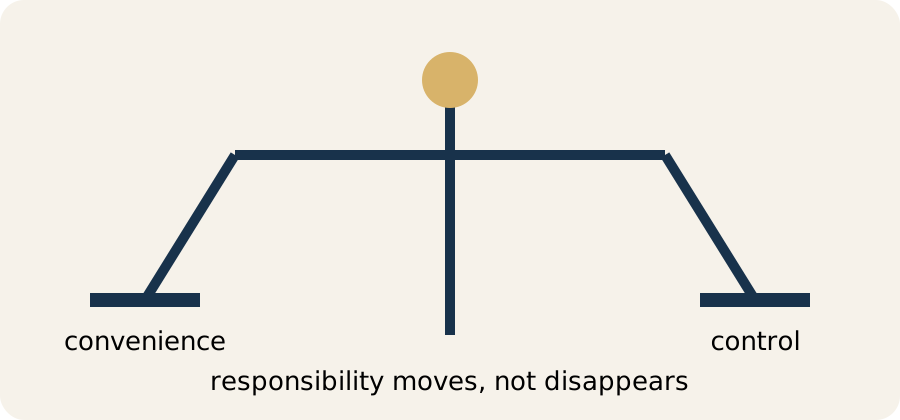
Custody changes where work and dependence sit; it does not make responsibility disappear.
Hot and cold are separate from custody
“Hot” generally means connected to the internet; “cold” generally means the signing key is kept offline. Both can be self-custody or third-party custody. A hot self-custody wallet may be convenient for applications but more exposed to phishing, malicious approvals and device compromise. A cold device may reduce remote attack exposure but adds physical handling, backup and recovery work. The label alone does not describe the full threat model.
A worked comparison with explicit assumptions
Suppose a reader has the equivalent of 500 units of a crypto asset and expects to trade twice a month. They have a reliable password manager and multi-factor authentication, but have never restored a wallet from a recovery phrase.
Keeping the whole balance on an exchange may reduce the chance of losing a seed phrase, but it concentrates platform, withdrawal and account-access dependence. Moving the whole balance to self-custody may reduce exchange dependence, but creates a single-point failure around the reader’s backup and transaction checks. A staged approach—only a trading amount on the exchange and a separately backed-up long-term amount in self-custody—can change the exposure, but it does not remove risk and is not a universal recommendation.
The example is a way to map responsibilities, not a suggested allocation. The right decision depends on the reader’s jurisdiction, amount, technical confidence, time horizon, transaction needs and ability to recover from mistakes.
Permissions can outlast a wallet connection
Self-custody does not mean every application approval is harmless. On Ethereum and compatible token-allowance systems, approving a spender can create an on-chain permission. Disconnecting a website or deleting a wallet app does not necessarily revoke that permission. Ethereum.org explains that revocation usually requires a new on-chain transaction on the relevant network, with that network’s fee, and that users must verify the account, token, spender and chain.
This matters for the comparison because exchange custody and self-custody fail differently. An exchange can impose a platform-level withdrawal restriction. A self-custody user can sign a malicious approval or send to the wrong network. “I disconnected the app” is not the same as “the authorization is gone.”
Failure modes to plan for
Exchange-side failure
Outage, insolvency, hacking, frozen withdrawals, an account lock, a failed banking partner, commingling, rehypothecation, unsupported network or changed terms can interrupt access. The exact legal result depends on the entity and jurisdiction.
Self-custody failure
Lost or exposed recovery material, a compromised device, malware, phishing, a fake support agent, a wrong address, wrong network, malicious contract approval or an irreversible transaction can cause loss. More control does not mean automatic reversibility.
Shared failure
Both models can face market volatility, blockchain congestion, protocol bugs, fraud, sanctions or legal change. A custody choice cannot insure an asset against its price falling.
One more distinction helps: control is not the same as convenience. An exchange can make a familiar password reset possible while still leaving you dependent on its withdrawal queue. A self-custody wallet can make a permissionless transfer possible while still leaving you responsible for every signature. Treat those as separate design choices. You can compare them without turning either one into an identity or a promise that mistakes will be reversible.
A transition checklist
Before moving assets, write down answers to these questions:
- Who controls the signing keys today?
- Which exact asset and network will be sent?
- Is the destination address verified through a trusted channel?
- What is the smallest test transfer that is practical for the network and fee?
- What happens if the exchange pauses withdrawals or the wallet device fails?
- Where is the recovery material stored, and who could access it?
- Have you enabled strong authentication without exposing a seed phrase?
- Which permissions will a connected application receive, and how will you revoke them?
- What fees, limits, waiting periods and tax or reporting obligations apply in your jurisdiction?
- Have you read the current terms instead of relying on a screenshot or social post?
Do not send a meaningful amount until you can explain the full path: account or wallet, asset, network, address, authorization, fee, confirmation and recovery. A small test can catch an address or network error, but it cannot prove a provider will always be solvent or a contract will always be safe.
Protection limits and what this guide does not establish
Crypto custody is not the same as an insured bank deposit, and brokerage protection rules should not be assumed to apply. The SEC bulletin is staff education, not a Commission rule or endorsement. It tells readers to research the custodian’s regulation, insurance terms, storage practices, asset use, privacy and fees; it does not certify any provider.
This guide does not rank exchanges, wallets or hardware devices. It does not establish that self-custody, cold storage or a particular platform is suitable for you. Recheck current terms, supported networks, recovery options and legal protections immediately before acting.
For a deeper security pass, read the crypto wallet security checklist. For platform-specific questions, see crypto exchanges compared. The stablecoin peg guide explains why an asset’s design target does not guarantee redemption or price stability. These are educational resources, not personal financial advice.