How stablecoins try to hold their peg—and how they can fail
Learn how reserve-backed, crypto-collateralized and algorithmic stablecoins try to hold a peg, why redemption and liquidity matter, and how de-pegs can happen.
In this guide
Source checked 8 September 2026 · Educational explanation, not a token recommendation
The short answer
Stablecoins try to maintain a peg by combining a target price with a mechanism intended to make deviations temporary. A reserve-backed coin may issue and redeem tokens against cash or other assets. A crypto-collateralized coin may lock more volatile crypto than the value of the tokens it creates. An algorithmic design may change supply or incentives using rules and market participants. These mechanisms can support a market price, but none turns the target into a guaranteed price, guaranteed redemption value, or insured deposit.
The important question is not simply “Is it pegged?” Ask instead: pegged to what, who can redeem, what backs the claim, where are the assets held, how liquid are they under stress, and what happens if confidence disappears?
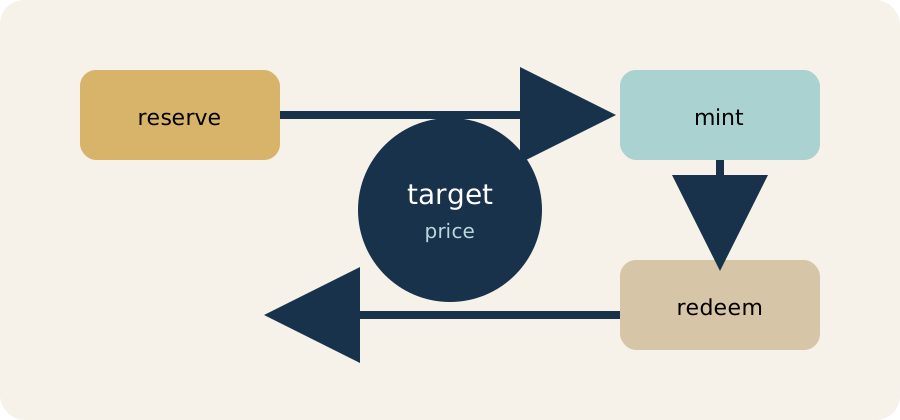
The intended loop can support a target price only when access, reserves, liquidity and settlement all work as described.
Disclosure: This guide reviews public educational, regulatory and issuer documentation. It does not test a redemption, audit reserves, inspect smart-contract code, measure market depth, or recommend a named token. Stablecoin terms, issuers, laws, networks and availability change by jurisdiction and date.
What a peg actually means
A peg is a design objective: for example, one token aims to trade near one U.S. dollar. The objective is different from a promise that every holder can exchange at exactly one dollar at any time. A person buying on an exchange sees a secondary-market price shaped by order flow, liquidity, fees, settlement, venue rules and confidence. That price can move above or below the target even when an issuer says the token is backed.
The Financial Stability Board says a global stablecoin arrangement should disclose its stabilization mechanism, financial condition and redemption rights, and should provide a robust legal claim and timely redemption. Those are policy recommendations, not proof that every token already meets them. The Bank for International Settlements likewise notes that no stablecoin has maintained parity at all times in secondary markets and that poor reserve management can leave an issuer unable to redeem in full and on demand.
The main ways a stablecoin can try to stabilize
1. Reserve-backed or fiat-referenced designs
The issuer creates tokens when eligible users provide the reference currency, and removes tokens from circulation when eligible users redeem. Reserves may include bank deposits, short-term government securities, money-market instruments or other assets defined by the issuer’s terms. In the simplest story, one token corresponds to one unit of reserve value.
That story has several conditions. The holder may need a particular account or jurisdiction to redeem directly. The reserve may be held with a custodian rather than in the holder’s name. Assets can have credit, market, custody, legal and liquidity risk. A reserve report or attestation can describe holdings at a point in time, but it does not by itself prove instant access for every holder in every stress scenario.
Circle’s current USDC terms provide a useful example of why wording matters. Circle says each USDC is intended to maintain a value of one U.S. dollar and describes dollar or dollar-denominated reserves in segregated accounts. The same terms limit direct redemption to eligible Circle Mint users and make redemption conditional on the terms, applicable law and other conditions. That is an issuer-specific arrangement, not a universal rule for stablecoins.
2. Crypto-collateralized designs
Here, the collateral is crypto rather than bank money or government securities. Because the collateral can fall quickly, the system may require over-collateralization: more collateral value is locked than the value of tokens issued. Smart contracts or governance rules may liquidate collateral when a safety ratio is breached.
Over-collateralization can create a buffer, but it does not remove risk. A fast market fall can outrun liquidations; oracle data can be delayed or manipulated; collateral may be thinly traded; and governance or software failure can interrupt the intended response. A token may trade away from its target while the system attempts to rebalance.
3. Algorithmic or supply-based designs
An algorithmic design tries to influence supply, demand or incentives rather than relying on a full reserve of the reference asset. It may mint, burn, lock or offer another token to encourage the market price back toward the target.
The mechanism depends on people believing that the incentives will remain valuable. If the supporting token falls, liquidity dries up or holders rush to exit, the rule can reinforce selling instead of stopping it. “Algorithmic” describes a mechanism; it is not a synonym for autonomous, safe or fully decentralized.
Some real systems combine categories. A token can use reserves, collateral, market-making, governance and redemption rules at the same time. Read the actual terms instead of relying on a marketing label.
Why minting and redemption can pull price toward the target
Consider a simplified reserve-backed example. Assume an eligible participant can obtain one token from the issuer for one dollar and redeem one token for one dollar, before fees and subject to the issuer’s conditions.
- If the market price falls to $0.98, a trader who can buy at $0.98 and redeem at $1 may have an incentive to buy and redeem. That demand can reduce available tokens and put upward pressure on the market price.
- If the market price rises to $1.02, an eligible participant who can create a token for $1 may have an incentive to issue and sell. That extra supply can put downward pressure on the market price.
This is an arbitrage story, not a guaranteed profit. It assumes access to the right issuer account, functioning banking and blockchain rails, enough liquidity, stable fees, no sanctions or account restrictions, and a redemption claim that remains enforceable. Retail users may not be able to perform the issuer-side step at all. Even when the mechanism works, the exchange price can remain off target while the trade settles.
How a peg can fail
The reserve is not as liquid or protected as expected
Reserves can lose value, be encumbered, sit with a failing intermediary or take time to sell. A reserve composition that looks conservative in normal markets may behave differently under a run. The relevant question is not only “How much is reported?” but also “How quickly can the right claimant access it, through which legal and operational path?”
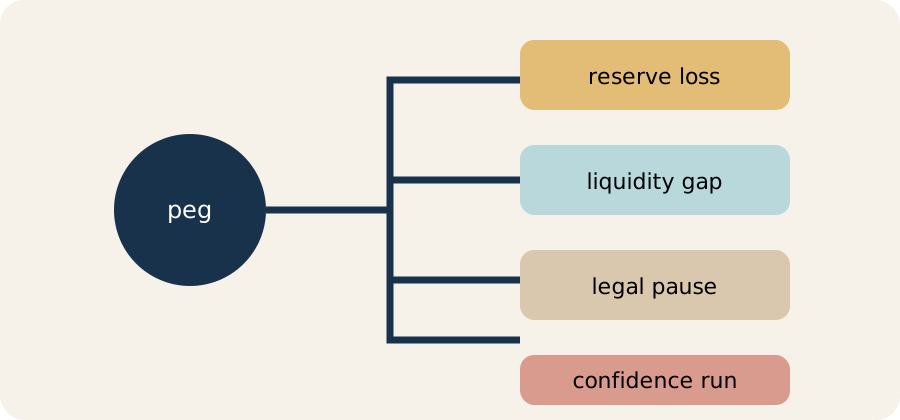
A de-peg can involve reserves, liquidity, legal access and confidence at the same time; the diagram is conceptual, not a risk ranking.
Redemption is limited, delayed or unavailable
Terms can limit who may redeem, minimum sizes, fees, operating hours, supported jurisdictions, banking partners or the situations in which the issuer can pause a service. A secondary-market holder may have a different claim from a direct customer. A legal claim is meaningful only when its holder, priority, venue and enforcement path are clear.
Liquidity and confidence disappear together
A stablecoin can trade below target because buyers step back, market makers widen spreads, or a venue pauses deposits and withdrawals. That market move can damage confidence, which can trigger more selling. BIS describes this run-like vulnerability: if holders doubt timely redemption, the pressure can become self-reinforcing.
Collateral, oracle or code failure
Crypto collateral can gap lower. An oracle can publish a bad or stale price. A smart contract can contain a bug or be exploited. A liquidation process can fail during congestion. These are different failure modes from a bank-reserve shortfall, even if the chart looks similar.
Legal, governance or operational change
The issuer can change terms, entities, supported networks or access rules. A court, regulator, bank or service provider can restrict activity. A token can continue to exist on-chain while practical redemption, liquidity or legal rights change.
A practical checklist before treating a token as “stable”
- Reference: What exactly is the token meant to track, and is the reference value clear?
- Claim: Who can redeem, in what asset, at what rate, with what conditions and fees?
- Backing: What assets or collateral support the claim, and who legally owns or controls them?
- Liquidity: Can reserves be converted quickly during stress, and are they segregated or bankruptcy-remote?
- Evidence: Are there dated reserve reports, attestations or audits? What do they actually cover?
- Mechanism: What mints, burns, liquidates or changes supply, and who can change the rules?
- Dependencies: Which bank, custodian, oracle, chain, exchange and governance process must work?
- Access: Does your country, account type and venue support the relevant token and network?
- Exit: Can you explain how you would move or redeem it if a venue pauses withdrawals?
Do not treat the words “backed,” “audited” or “stable” as complete answers. Find the primary document, identify its date and scope, and separate what the issuer says from what an independent source verifies.
Three distinctions that prevent common mistakes
Target price is not realized price. A token can be designed around one dollar while trading at $0.995 or $1.005 on a particular venue. A small deviation may reflect fees, shallow order books or settlement timing; a larger or persistent deviation needs a mechanism-specific explanation.
Reserve value is not the same as a holder’s claim. A dashboard can show assets associated with a reserve, but the legal document determines who can demand payment, from whom, in which currency, and under what conditions. A secondary-market holder may need to sell to an eligible participant rather than redeem directly.
A token balance is not a bank deposit. Stablecoins normally do not carry the same deposit-insurance framework as an insured bank account, and the applicable protection depends on the issuer, product, jurisdiction and contract. Treat the token as a technology and legal arrangement with risks to investigate, not as cash merely because its name references a currency.
What this guide does not establish
It does not establish that any named token is safe, fully reserved, legally protected, suitable for savings, or redeemable by every reader. It does not compare current yields, prices, market capitalisation or de-peg performance. Those facts require a fresh, token-specific review with a defined jurisdiction and date. A stablecoin can reduce one type of price volatility while adding issuer, custody, liquidity, technology and legal risk.
For a next step, read the crypto wallet security checklist before connecting a wallet or approving a transfer. If you use a centralized exchange, compare its custody, withdrawal and regional terms in crypto exchanges compared. These are educational starting points, not personal financial advice.