Tracking difference vs. tracking error: two ways an index fund can drift
Learn the difference between tracking difference and tracking error, what causes each, and how to read an index-fund report responsibly.
In this guide
An index fund can fail to match its benchmark in two useful-to-separate ways. Tracking difference is the fund’s signed performance gap from the index over a stated period. Tracking error describes how variable those gaps are, often using the dispersion or standard deviation of periodic differences. A fund can have a small average gap but jump around it, or a steady negative gap with little variation.
These are measurement concepts, not safety scores. The benchmark, dates, return basis, fees, taxes, trading costs, and calculation method must be visible before comparing funds.
Start with the benchmark
An index fund seeks to track a named index, not “the market” in general. Two funds may use similar names while following different versions of an index: price return, total return, currency-hedged, capped, or a custom methodology. If the references differ, their tracking statistics are not an apples-to-apples comparison.
Write down the exact benchmark, currency, distribution treatment, valuation time, and period. Investor.gov notes that index funds may underperform because of fees, expenses, trading costs, and tracking error. The benchmark itself has no fund expenses, so a persistent negative gap is not automatically evidence of poor management.
Tracking difference: the signed gap
A simple one-period expression is:
tracking difference = fund return − benchmark return
If a fund returns 7.6% and its benchmark returns 8.0% over the same period and on the same basis, the tracking difference is −0.4 percentage points. The sign matters: positive means the fund exceeded the benchmark for that period; negative means it lagged.
Over several years, providers may show an annualized difference, a cumulative difference, or a chart of rolling gaps. These are not interchangeable. A cumulative −4% gap over four years is not the same statement as −1% per year, especially when returns compound. Ask which convention the report uses.
Tracking difference is useful for asking “how far behind or ahead was the fund?” It does not show whether the path was smooth. One unusual rebalance, tax event, or valuation mismatch can dominate a short window.
Tracking error: the variability of the gap
Tracking error asks a different question: “How much do the fund’s periodic differences move around their average?” A common approach calculates the standard deviation of monthly or daily fund-minus-index returns, then may annualize it. The exact formula, frequency, and annualization convention vary.
For illustration only, suppose monthly differences are −0.2%, −0.1%, +0.3%, and −0.4%. Their average is negative, while their spread around that average captures variability. A report with higher tracking error had less consistent relative performance, even if its average difference happened to be close to zero.
Tracking error is not the same as volatility of the fund’s price. A broad equity fund can be volatile while tracking its index closely; its tracking error can still be low. Conversely, a calm-looking fund can have a material mismatch with its benchmark.
Why an index fund drifts
Fees and operating expenses
The index does not pay the fund’s management and operating expenses. Those costs tend to create a negative tracking difference, although waivers, securities lending revenue, and portfolio income can offset part of it. See the fund expense ratio vs total cost framework before treating the ratio as the whole explanation.
Trading, cash, and rebalancing
The fund may hold cash, trade at different times, pay spreads, or face market impact when the index rebalances. A sampling strategy may own a representative subset rather than every constituent. These choices can create both a gap and variability.
Taxes and distributions
Withholding taxes, realised gains, dividend timing, and the benchmark’s treatment of distributions can differ. A total-return index that reinvests gross dividends is not directly comparable with a fund return measured after withholding tax unless the basis is aligned.
Valuation and time zones
Underlying securities may trade in different time zones or be valued using different prices. The fund’s net asset value and the index calculation can therefore reflect different information at the measurement cut-off.
Index changes and implementation limits
Reconstitutions, corporate actions, liquidity limits, regulatory constraints, and operational errors can temporarily widen the gap. Prospectus risk disclosures often list these as tracking-error risks.
A comparison table
Scroll sideways or use arrow keys to read the full table.
| Question | Tracking difference | Tracking error |
|---|---|---|
| Main question | How far did the fund’s return differ? | How variable were the periodic differences? |
| Typical sign | Positive or negative | Usually a non-negative dispersion measure |
| Depends on | Period, benchmark, return basis | Frequency, sample period, formula, benchmark |
| Useful for | Seeing the direction and size of a gap | Seeing consistency around the average |
| Does it predict future results? | No | No |
A miniature calculation that separates the two ideas
Suppose two funds report quarterly fund-minus-index differences. Fund A shows −0.10%, −0.10%, −0.10%, and −0.10%. Fund B shows +0.20%, −0.40%, +0.20%, and −0.40%. Both series have an arithmetic average gap of −0.10% per quarter, but they do not behave alike. Fund A has no variation around that average in this simplified series; Fund B moves 0.30 percentage points above and below it.
This example illustrates the distinction rather than a reporting standard. A provider may calculate tracking difference over the full compounded holding period and tracking error from daily, weekly, or monthly observations, then annualize the result. Changing the frequency or look-back window can change the number. Never compare Fund A’s daily three-year tracking error with Fund B’s monthly one-year statistic as though the labels alone made them equivalent.
The same caution applies to signs. Tracking difference can be positive or negative. Tracking error is a dispersion measure and is ordinarily reported as zero or positive. A negative “tracking error” in a table is a reason to inspect the label and methodology—it may actually be a signed tracking difference.
NAV return and market-price return answer different questions
For an ETF, decide which return sits on the fund side of the comparison. Net asset value reflects the value assigned to the portfolio under the fund’s valuation process. The exchange price reflects what buyers and sellers paid and can include a premium or discount to NAV plus bid–ask friction. Comparing an ETF’s NAV return with its index focuses more directly on portfolio implementation. Comparing an investor’s market-price return with the index can also capture when and how the investor traded.
Neither basis is universally “the right one”; they answer different questions. A prospectus or shareholder report should identify the basis used. If two providers use different bases, normalize them before ranking the results.
What these metrics cannot tell you
A close match does not prove that an index, fund, or portfolio is suitable. Tracking statistics do not reveal whether the benchmark is diversified, whether its rules create concentration, whether the fund is liquid when you need to trade, or whether taxes and account fees change your result. They also do not show counterparty, securities-lending, currency, or operational risk by themselves.
Use tracking measures after identifying the exposure you want—not as a substitute for that decision. The ETF vs. mutual fund guide separates wrapper mechanics from holdings, while the fund-cost guide maps expenses and trading friction beyond a single ratio.
How to read a fund report
- Identify the exact index and whether returns are price or total return.
- Match the period, currency, valuation time, and distribution assumptions.
- Check whether the reported gap is cumulative, annualized, or rolling.
- Find the tracking-error frequency and look-back window.
- Read the expense ratio, holdings method, cash policy, and securities-lending notes.
- Look for unusual markets, index rebalances, tax effects, or data-quality notes.
- Compare like with like and record the as-of date.
The idea to keep
Tracking difference tells you the direction and size of a fund’s relative gap over a defined period. Tracking error tells you how consistently that gap behaved. Neither replaces reading the benchmark methodology, fund disclosures, costs, holdings, liquidity, and risks. Use both as evidence about implementation—not as a promise that tomorrow’s return will match an index.
General education only. This U.S.-oriented explanation is not personalized investment, tax, or legal advice. Investing can result in loss.
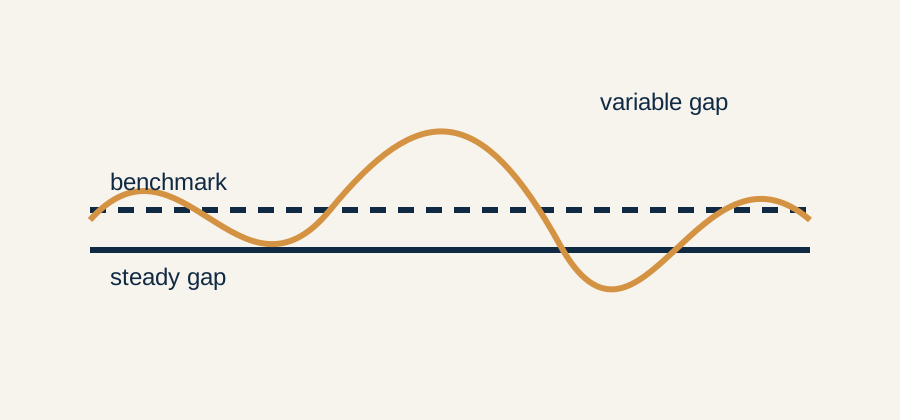 Tracking difference is the direction and size of a gap; tracking error is its variability.
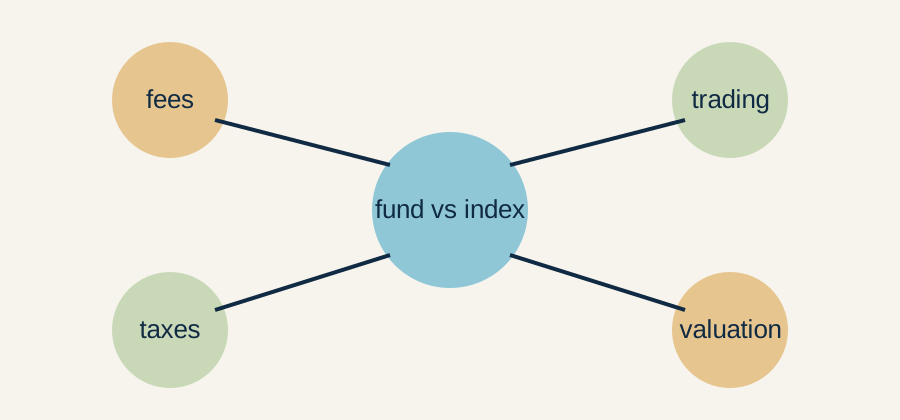 Fees, trading, taxes, and valuation can all contribute to drift.