Rebalancing bands vs. calendar schedules: how the rules differ
Compare threshold and calendar rebalancing rules, with illustrative drift examples, cost checks and limits.
In this guide
Threshold and calendar rebalancing are two ways to decide when to review a portfolio. A calendar rule checks on set dates. A threshold rule checks whether an asset group has moved outside a preset band around its target. A hybrid rule does both: review on dates, but trade only after a band is crossed.
None of these rules is universally best. Rebalancing is meant to return holdings toward a chosen allocation after market moves or cash flows change the mix—not to predict prices or guarantee better returns. Investor.gov and FINRA describe calendar reviews and preset percentage changes as common approaches while leaving the choice to the investor’s plan.
In short: calendar rules organize attention; threshold rules tie action to the size of drift. The right comparison includes costs, taxes, monitoring effort and whether the target still fits the goal.
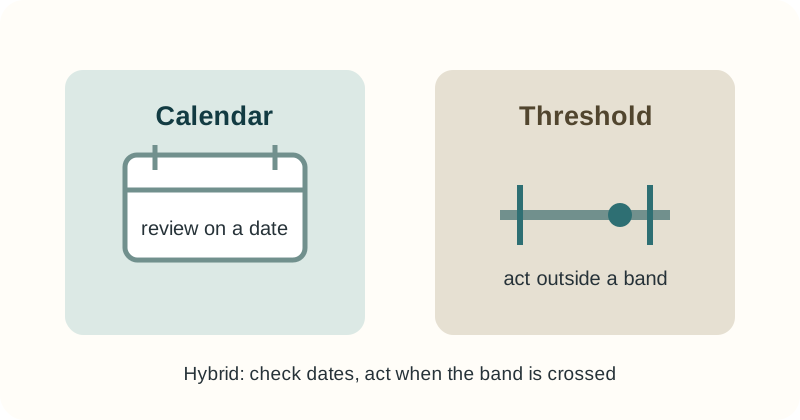
A hybrid process checks dates and acts only when a documented band is crossed.
Start with the target, not the trigger
There is no useful threshold without a written target allocation. The target should belong to a specific goal and account, with a time horizon, liquidity need and risk profile. A near-term deposit fund may need a different target from a retirement account. This article does not supply a target or a universal band.
Rebalancing is also different from changing the plan. If income, debt, dependants, time horizon or risk capacity changes, update the target first. Applying a precise trigger to an outdated target only makes the wrong plan more precise. See the long-term financial goal plan for the goal and horizon context.
How a calendar rule works
With a calendar rule, the investor reviews the portfolio every six or 12 months, or on another documented interval. Investor.gov gives six- and 12-month reviews as examples, not as a prescription. At the review, compare current weights with targets, confirm the goal still fits and decide whether the written policy calls for action.
The main advantage is simplicity. A date can be placed on a calendar or automated reminder, and the investor does not need to watch daily price moves. The limitation is timing: a large drift can occur between reviews, and a review can arrive when the portfolio has barely changed. A calendar date is a review trigger, not an instruction to trade every time.
How a threshold rule works
With a threshold rule, action is considered when a holding or asset group moves outside a preset tolerance band. For a target weight, the band may be defined in percentage points or as a relative percentage, but the definition must be written clearly before a stressful market move. This guide does not recommend a particular number.
Thresholds connect action to material drift. They may avoid unnecessary trades after small changes, but they require reliable monitoring and a consistent calculation. Prices, contributions, withdrawals and account transfers can change the denominator, so “weight” must be defined as current holding value divided by current portfolio value. Different accounts may need separate calculations.
A transparent example
The figures below are invented and not a recommended allocation. Suppose a portfolio target is 60% stocks and 40% bonds. After a market move, the portfolio is 66% stocks and 34% bonds: a six-point drift in each direction.
Under a calendar-only rule, the investor waits for the next scheduled review, even if that is several months away, unless the written policy includes an exception. Under a threshold rule with a six-point band, the boundary has been reached and the policy may call for review or action. Under a hybrid rule, the investor checks on the scheduled date and acts only if the band is crossed.
The example does not say that six points is sensible. It shows why the same portfolio can produce different actions under different rules. The outcome also depends on contributions, withdrawals, taxes, trading costs and whether the target remains suitable.
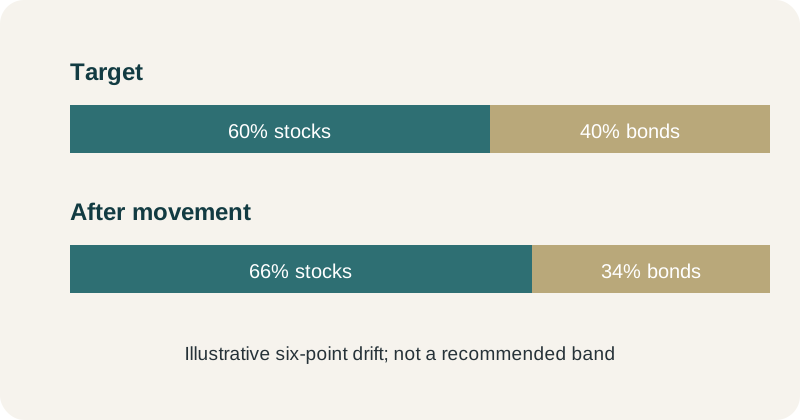
Illustrative six-point drift only; it is not a recommended threshold.
Comparing the trade-offs
Simplicity and attention
Calendar rules are easier to explain and may suit someone who wants a low-maintenance routine. Threshold rules can be more responsive but require data, alerts or a dependable review process. A complicated rule that is not followed is less useful than a simple rule that is documented and applied.
Trading frequency and drift
Calendar checks can trade when drift is small or miss a large move between dates. Threshold checks can wait through small movements and respond to larger drift, but a volatile market can cross a band repeatedly. Neither approach controls how markets move afterward.
Costs and taxes
Trading may create transaction charges, bid–ask costs, fund costs or tax consequences. The SEC's fee guidance notes that transaction and ongoing fees reduce the amount left invested. A threshold policy should state whether cash flows can be used first and how taxes or account restrictions affect the decision. A calendar policy has the same checks; fewer reviews do not make a trade cost-free.
Behavioral fit
A calendar can prevent constant checking and headline reactions. A threshold can provide a prewritten answer when an investor is tempted to improvise. Both rules can feel uncomfortable when they require trimming a recent winner or adding to a lagging asset. The process should be understandable enough to follow during stress.
A hybrid approach
A hybrid process sets review dates and also defines a band. On each date, the investor measures drift; between dates, an alert may prompt an earlier review if monitoring is available. The policy should say whether the alert triggers a trade, a human check or simply a note for the next date.
Hybrid does not mean “always trade.” It is a way to separate measurement from action. A review can conclude that the target changed, cash flows are sufficient, costs are too high or no action is needed. Record the reason so a later decision is not based only on the latest market result.
Checklist before choosing a rule
- Write the target and the goal it serves.
- Define current weight and the denominator consistently.
- Choose calendar, threshold or hybrid only after considering monitoring ability.
- State whether bands use percentage points or relative percentages.
- Decide how contributions, withdrawals and dividends will be used.
- Check transaction costs, taxes, account limits and settlement timing.
- Set a review trigger for changes in goals, horizon, income, debt or risk capacity.
- Record every review, including a deliberate decision not to trade.
The portfolio-rebalancing guide covers implementation methods. The asset allocation and diversification guide explains why a target mix can still contain overlapping or concentrated holdings. Continue with the Portfolio Strategy learning path or Investing topic.
What these rules cannot guarantee
Neither calendar nor threshold rebalancing guarantees profit, prevents loss, identifies market highs or lows, fixes an unsuitable target or creates diversification. A threshold can be crossed just before prices reverse; a calendar review can happen just before a major move. Taxes, fees, liquidity and account rules vary by jurisdiction. If consequences are material or unclear, qualified local advice may be appropriate.
This is general education, not personalized investment, tax or legal advice. Sources are U.S. investor-education materials; pages were checked on 2026-09-08.