Short Treasury ETFs compared: SGOV, BIL, and VGSH
Compare SGOV, BIL, and VGSH by Treasury maturity exposure, fees, duration, distributions, liquidity considerations, and reader fit.
In this comparison



SGOV, BIL, and VGSH all provide exchange-traded access to U.S. Treasury securities, but they are not interchangeable. SGOV targets 0–3 month Treasuries, BIL targets 1–3 month Treasury bills, and VGSH targets 1–3 year Treasuries. That maturity difference is the first thing to understand: VGSH generally has more interest-rate sensitivity, while SGOV and BIL stay nearer the very short end.
There is no overall winner here. The useful choice depends on the time horizon, tolerance for price movement, trading setup, distribution preference, fees, taxes, and the documents you are willing to review. The facts below are provider-reported and can change; check the current prospectus and product page before acting.
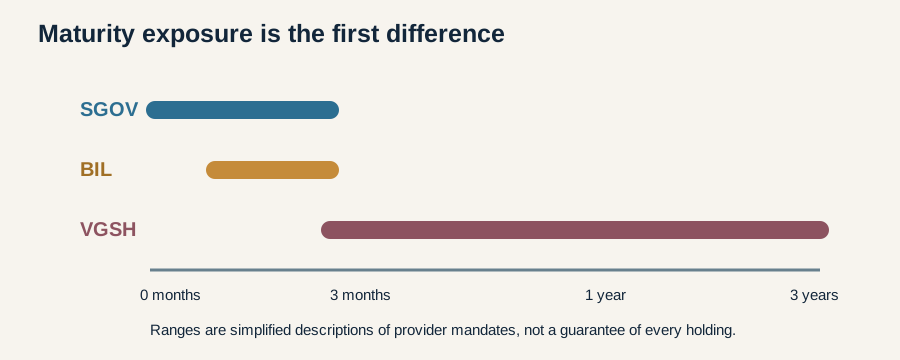 Simplified mandate ranges; individual holdings and portfolio statistics can change.
At-a-glance comparison
Scroll sideways or use arrow keys to read the full table.
| ETF | Provider | Stated exposure | Expense ratio shown by provider | Distribution schedule shown by provider | Reader question |
|---|---|---|---|---|---|
| SGOV | iShares / BlackRock | U.S. Treasury securities with 0–3 months remaining maturity | 0.09% | Monthly | Do I want the shortest target range? |
| BIL | State Street SPDR | Bloomberg 1–3 Month U.S. Treasury Bill Index | 0.1353% gross | Monthly | Do I want 1–3 month T-bill exposure? |
| VGSH | Vanguard | Bloomberg U.S. Treasury 1–3 Year Bond Index | 0.03% | Monthly | Can I accept a longer short-term range and more duration? |
Expense-ratio labels and portfolio statistics are as displayed in the cited provider materials checked for this draft. They are not a forecast of total return. A lower expense ratio does not automatically mean lower risk, better tracking, or better fit.
What the three funds have in common
Each fund is an ETF whose mandate centers on U.S. Treasury obligations. ETFs trade on an exchange during the day, so the market price can differ from NAV and a bid-ask spread can affect the amount you receive. The funds can lose value; Treasury exposure reduces issuer-credit concerns relative to many corporate bonds but does not remove interest-rate, liquidity, inflation, operational, or market-price risk.
The word “short” also needs context. SGOV and BIL are concentrated near Treasury bills with very short remaining maturities. VGSH reaches into the 1–3 year range, so its portfolio value can respond more when market yields move. The bond duration guide explains why duration is a useful sensitivity lens, not a promise about the next price move.
SGOV: 0–3 month Treasury exposure
iShares describes SGOV as seeking to track an index of U.S. Treasury securities with remaining maturities of three months or less. Its product page lists a 0.09% expense ratio. This structure may be relevant to a reader who wants a very short Treasury ETF and accepts that the fund continually rolls maturing bills rather than holding one bill to a personal maturity date.
Short maturity can reduce, but not eliminate, price sensitivity. The fund’s NAV still moves with rates, flows, accrued income, and market conditions. A monthly distribution is not a guaranteed rate, and the amount can vary as bills mature and are replaced.
BIL: 1–3 month Treasury bills
State Street’s BIL page says the fund seeks to track the Bloomberg 1–3 Month U.S. Treasury Bill Index. The page shows a 0.1353% gross expense ratio and monthly distribution frequency. Its index description focuses on Treasury bills with one to three months of remaining maturity.
BIL can therefore suit a comparison focused specifically on 1–3 month bills, but the index range is not identical to SGOV’s 0–3 month description. The difference may be small in some market conditions and meaningful in others. Compare the current holdings, weighted maturity, duration, spread, and premium/discount rather than assuming the tickers are substitutes.
VGSH: 1–3 year Treasury exposure
Vanguard’s VGSH product materials describe a passively managed fund tracking the Bloomberg U.S. Treasury 1–3 Year Bond Index. The fact sheet lists a 0.03% expense ratio and an average duration of 1.9 years as of the document’s stated date. Because the fund reaches into one-to-three-year maturities, its price can generally move more for a given rate change than a very-short-bill fund.
That additional duration is not automatically a flaw. It may be relevant to a reader seeking a somewhat longer Treasury exposure and willing to accept more price movement. It also means a cash need in a few weeks should not be evaluated only by looking at the fund’s name. Review the current duration, maturity distribution, yield convention, and prospectus.
A simple rate-sensitivity illustration
Assume, only for illustration, that a fund with duration 0.15 experiences a parallel 1 percentage-point yield rise, while a fund with duration 1.9 experiences the same small move. A first-order estimate would be roughly −0.15% versus −1.9% before income, fees, convexity, spread, and other effects. This is not a prediction and does not describe the current duration of every fund.
The point is comparative: maturity exposure affects sensitivity. A longer “short-term” fund can still have a meaningfully different price path from a bill-focused fund. Actual results depend on the curve move, cash flows, trading price, and timing.
Distribution is not the same as a fixed rate
All three providers show monthly distributions, but a distribution amount can change. The fund receives income from its holdings, pays expenses, and continually replaces securities. A monthly payment does not turn an ETF into a bank deposit or guarantee a particular annual yield.
Yield labels also require care. A 30-day SEC yield, distribution yield, and yield to maturity answer different questions and use different conventions. Compare like with like, note the as-of date in the provider document, and do not treat a displayed yield as a guaranteed future return.
Liquidity, NAV, and trading costs
ETF shares trade at a market price that can be above or below NAV. The spread can widen in stressed or thin markets. A low expense ratio does not tell you the cost of your specific trade, and frequent trading can add commissions or spread costs depending on the account.
Before trading, check the bid and ask, the time of day, the premium/discount history, and the order type your broker supports. A market order can fill at an unexpected price in a fast market; a limit order controls price but may not execute. These mechanics are separate from the Treasury credit profile.
Tax and account context
U.S. Treasury interest can receive federal and state tax treatment that differs from corporate or municipal income, but the result depends on the account, investor, jurisdiction, and the fund’s reporting. The providers publish tax documents and prospectuses; use current documents rather than assuming every distribution has the same treatment.
A neutral reader-fit path
Use the following questions rather than a ranking:
- Horizon: Is the money needed in weeks, months, or several years?
- Price movement: How much NAV variation can you tolerate before the money is needed?
- Exposure: Do you want 0–3 month, 1–3 month, or 1–3 year Treasury exposure?
- Trading: Does your account provide reasonable ETF execution and access?
- Costs: What are the expense ratio, spread, commission, and tax implications?
- Documents: Have you read the current prospectus and checked duration, holdings, and distribution method?
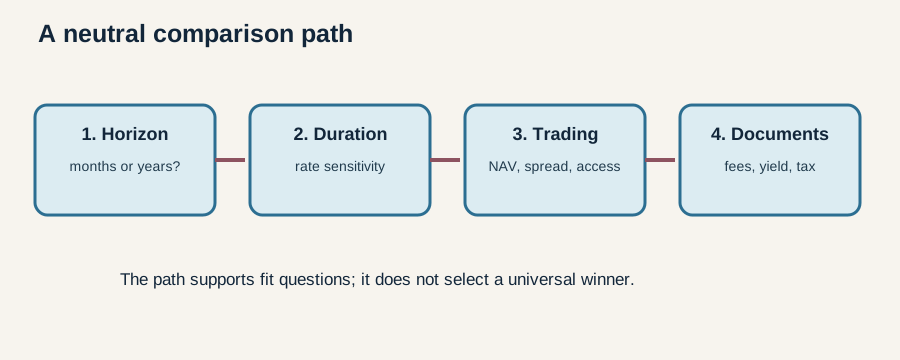 A fit framework, not an automated recommendation or winner selection.
Risks and limits
- Interest-rate risk: VGSH’s longer range generally creates more sensitivity than bill-focused funds, but every ETF’s NAV can move.
- Market-price risk: An ETF can trade away from NAV, especially when liquidity is stressed.
- Reinvestment risk: Rolling bills or bonds means future purchases occur at future yields.
- Inflation risk: Treasury principal and interest can lose purchasing power when prices rise.
- Operational and tracking risk: Index methods, sampling, expenses, and trading can produce results that differ from a simple benchmark assumption.
- Tax and account risk: Treatment and access vary by jurisdiction and account.
The idea to keep
SGOV, BIL, and VGSH are three ways to access short Treasury exposure, not three labels for the same portfolio. SGOV emphasizes 0–3 months, BIL 1–3 months, and VGSH 1–3 years. Compare the current mandate, duration, fees, trading conditions, distributions, and documents with your own horizon. The comparison informs a question; it does not make a universal choice.
Continue through the Bonds & Rates learning path for duration and fixed-income risk concepts.