How fees compound against long-term retirement savings
See how transaction costs, ongoing charges, account fees, and taxes can reduce long-term retirement savings—and how to compare the total cost.
In this guide
Retirement investment fees reduce the money that stays invested and can therefore reduce the returns that money might earn later. The effect is not limited to one visible charge: transaction costs, fund expenses, advice fees, account administration, spreads, taxes, and withdrawal costs may sit in different documents or be deducted in different ways.
The useful comparison is total cost for the service and investment you actually receive—not simply the lowest number on one fee line. A fee illustration can show the mechanism, but it cannot predict your balance or identify a suitable product.
The short answer: list every cost that can leave the plan
Start with these questions:
- What is charged when you buy, sell, transfer, or convert currency?
- What ongoing product expenses are deducted from the investment?
- Is there an advice, management, platform, or account fee?
- Are there spreads, loads, redemption charges, or inactivity fees?
- Which taxes apply to contributions, income, gains, or withdrawals?
- What service, custody, administration, or features are included?
- Can the fee change, and where is the current schedule?
The SEC’s Investor.gov bulletin distinguishes transaction and ongoing costs and explains that costs reduce the amount left in a portfolio to earn a return. K-0016 records the same mechanism for zcompound’s educational use. The exact fees and tax treatment still depend on the product, account, provider, and jurisdiction.
Why a small annual cost can have a large opportunity cost
Suppose two hypothetical retirement accounts each start with 10,000, receive 300 at the end of every month for 30 years, and earn a constant gross return of 5% per year. One has no ongoing fee in the illustration; the other deducts 1% per year. The account with the fee compounds at a lower net rate, so it ends with less money even though the fee is not paid as one large bill.
Using monthly compounding only as a teaching shortcut, the no-fee path is about 260,000 and the 1% fee path about 210,000. The difference is roughly 50,000 in this invented scenario. It is not a forecast, a recommendation, or an estimate of any real product. It ignores taxes, trading costs, changing returns, contribution changes, inflation, and the ways real fees are charged.
The point is the lost compounding: money deducted today cannot remain invested for later periods. K-0011 describes the underlying compounding mechanism while also warning that investments can lose value.
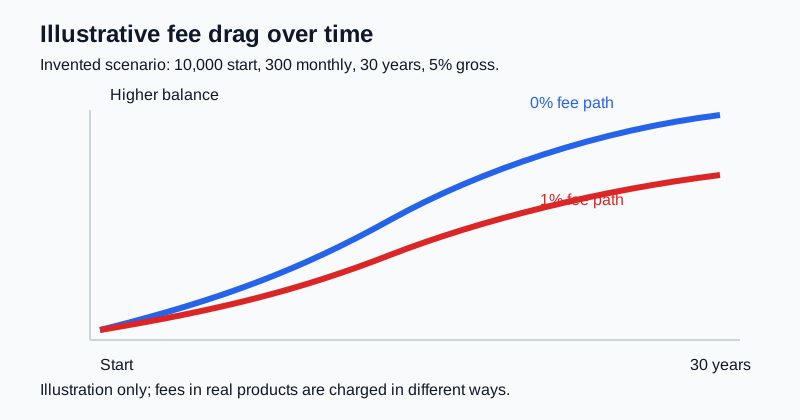
Visual: an invented comparison showing how a lower net rate can widen the balance gap over time.
Expense ratio is only one line
An expense ratio generally describes a fund’s operating expenses relative to its assets. It can be useful, but it is not a complete ownership-cost measure. A low ratio does not establish better holdings, lower trading friction, better tax treatment, or suitability.
For a fund or exchange-traded product, ask separately about:
- operating expenses and fee waivers;
- trading costs inside the portfolio;
- bid-ask spread and any premium or discount to net asset value;
- sales loads, redemption or transaction charges;
- advice, platform, custody, or account fees;
- tax treatment and the account wrapper; and
- the cost of accessing, transferring, or closing the account.
K-0066 records this distinction as source-supported secondary evidence. It is a checklist, not a ranking of funds or a claim that the cheapest product will produce the best outcome.
Fees can be explicit or embedded
Some charges appear as a line in a statement. Others are embedded in a price, spread, transaction, or product structure. A “commission-free” trade can still have other costs. A platform with a higher fee may include services that a bare account does not. The question is whether the service is useful and whether the total cost is clear.
Ask how often the charge is applied, what balance it uses, and whether it is taken from cash or by reducing the investment. A percentage fee on a larger balance grows in absolute currency even when the percentage stays constant. A flat monthly fee can be especially material for a small account.
Compare like with like. A fund expense ratio and a platform subscription may cover different things, so adding them without checking the fee base can double-count or miss a charge. Some plans offer an employer contribution, research, custody, or automated service that changes the value comparison. That does not make a higher fee good by itself; it means the service and the cost need to be described together.
Also ask whether a quoted fee is gross or net of a temporary waiver. A waiver can expire, and a promotional rate may apply only to a balance range or account type. Record the ordinary fee, the waiver conditions, and the date you checked them. This matters when a projection assumes the same cost for 20 or 30 years.
Keep return, inflation, and fees in one consistent model
A retirement projection should state whether returns and spending are nominal or inflation-adjusted. If you model a gross nominal return and subtract a fee, say how the fee is applied. If inflation is included, do not present the result as today’s purchasing power without converting it.
The U.S. Bureau of Labor Statistics explains that price indexes can translate nominal amounts into constant-dollar purchasing power. That method is U.S.-oriented and may not match a reader’s spending basket elsewhere. Healthcare, housing, and education can move differently from a broad index.
The long-term goal worksheet can help make the goal, time frame, contributions, inflation, return scenarios, and omissions visible. The sequence-risk guide explains why fees and withdrawals interact with return order, while the rebalancing guide covers a related maintenance decision.
A transparent fee illustration
These are invented inputs for learning, not a recommended investment or expected result.
Scroll sideways or use arrow keys to read the full table.
| Input | Illustration |
|---|---|
| Starting balance | 10,000 |
| Monthly contribution | 300 at month-end |
| Time | 30 years / 360 months |
| Gross annual return | Exactly 5% every year |
| Ongoing fee scenarios | 0% and 1% per year |
| Inflation | Excluded from this nominal illustration |
| Taxes and trading costs | Excluded |
Under the shortcut above, the fee scenario ends lower because the account compounds at a lower net rate. Real products may deduct fees daily, monthly, from fund assets, from cash, or through a spread. A one-number calculator cannot capture every contract.
Do not reverse-engineer a desired retirement balance by selecting the lowest fee or highest return. If the cost difference matters, compare the actual service, access, tax wrapper, investment exposure, liquidity, and risks alongside the fee.
Compare costs without mistaking a fee for the whole decision
Use a table with one row per provider, account, or product and columns for:
Scroll sideways or use arrow keys to read the full table.
| Field | Question |
|---|---|
| Product exposure | What do you own or get exposure to? |
| Ongoing cost | What percentage or flat amount is deducted, and from what base? |
| Transaction cost | What happens when you buy, sell, transfer, or convert currency? |
| Account/platform cost | What administration, custody, or access fee applies? |
| Tax and wrapper | Which current rules apply to this account and activity? |
| Service | What support or feature is included? |
| Exit and change | What happens if you transfer, close, or change products? |
| Source and date | Where did you verify the figure, and when? |
Keep an evidence date beside every changing fee. A search snippet or an old review is not a current fee schedule. Read the provider’s official schedule, prospectus, plan document, or account agreement where available.
Stress-test the fee assumption
Run the same projection with a lower, middle, and higher total-cost case. Then test:
- contributions that rise or pause;
- a smaller starting balance;
- a higher inflation assumption;
- a lower return path;
- a spread or transaction cost on periodic trades;
- tax withheld on income or withdrawals; and
- a change in provider or account after several years.
The result is a sensitivity table, not a probability of success. The largest fee is not always the only risk, and the smallest fee is not automatically the best choice.
When you compare two options, keep the comparison window the same. A one-year fee difference may look small while a 30-year projection magnifies it, but a long horizon also magnifies uncertainty about returns, contributions, tax, and account access. Show both the fee effect and the assumptions that make the effect visible.
What fees cannot tell you
Fees do not reveal whether an investment is diversified, liquid, appropriate for a goal, protected by a particular regime, or likely to produce a specific return. A low-cost product can still fall in value. A higher-cost service can still be poor value. Product availability, taxes, investor protection, and retirement-account rules vary by jurisdiction and change over time.
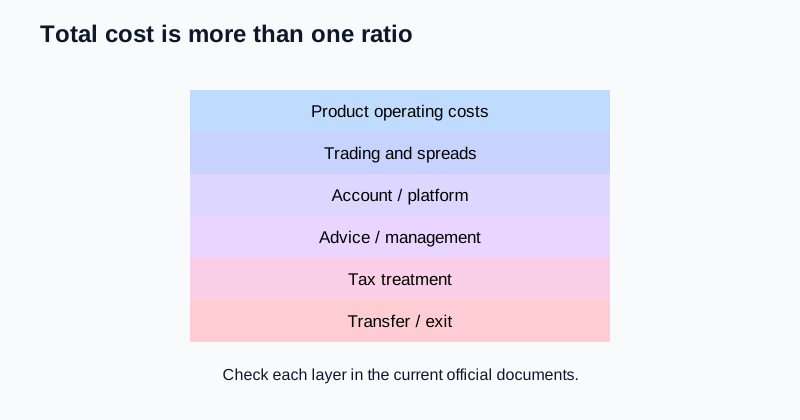
Visual: product, trading, account, advice, tax, and exit layers should be checked separately.
For a high-stakes retirement decision, verify current official rules and consider a qualified professional whose credentials, scope, conflicts, and fees you can check. This article is general education, not individualized investment, tax, or legal advice.
Copyable retirement-fee checklist
Goal and horizon: [what the money must support and when] Product exposure: [what the account or product actually owns] Ongoing expenses: [percentage, flat fee, balance base, frequency] Transactions: [buy, sell, transfer, currency, spread] Account and advice: [platform, custody, administration, management] Taxes: [what is included, excluded, and jurisdiction] Exit terms: [transfer, withdrawal, closing, redemption] Evidence date: [official document and date checked] Stress tests: [higher cost, lower return, pause, inflation, tax]
The practical lesson is simple: every fee is a use of money that could otherwise remain in the plan, but cost is only one part of a retirement decision. Make the full cost visible, keep the model’s assumptions beside the output, and review the evidence when terms change.
Continue with the Retirement & Long-Term Goals learning path, or browse the learning-path directory.
All numerical examples are invented illustrations. No product ranking, return forecast, or individualized recommendation is provided.