Credit utilization explained: overall and per-account balances
Learn the credit utilization formula, compare overall and per-card ratios, and understand statement timing, limits, closures, and score caveats.
In this guide
Credit utilization is the share of revolving credit you are using compared with the credit limits reported for those accounts. The basic formula is:
utilization = reported balance ÷ reported credit limit × 100
There are two useful views. Per-account utilization looks at one card or revolving account. Overall utilization adds the reported balances and limits across the accounts included in the calculation. A low overall percentage can coexist with a very high balance on one card, and that concentration may matter to a scoring model. There is no single percentage that guarantees a particular credit score, approval, rate, or outcome.
A simple example
Imagine two cards:
Scroll sideways or use arrow keys to read the full table.
| Account | Reported balance | Reported limit | Per-account utilization |
|---|---|---|---|
| Card A | $300 | $1,000 | 30% |
| Card B | $2,500 | $5,000 | 50% |
| Overall | $2,800 | $6,000 | 46.7% |
Card A’s ratio is $300 ÷ $1,000 = 30%. Card B’s is $2,500 ÷ $5,000 = 50%. Overall utilization is $2,800 ÷ $6,000, or about 46.7%. The overall figure is not the average of 30% and 50%; it is weighted by the limits.
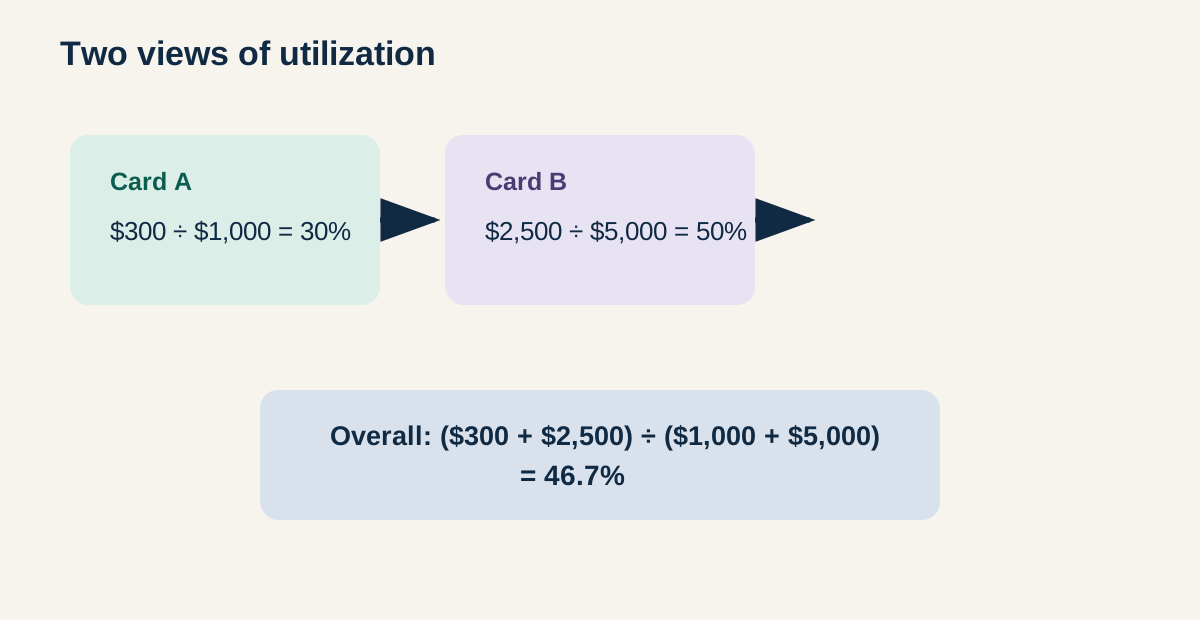
Visual: calculate each account separately, then add balances and limits for the overall ratio.
If you pay $500 off Card B and the lower balance is the one reported, its ratio becomes 40% and overall utilization becomes about 38.3%: $2,300 ÷ $6,000. If instead Card B’s limit falls from $5,000 to $3,000 while the $2,500 balance stays, its per-account ratio jumps to 83.3% and overall utilization becomes 56.3%: $2,800 ÷ $5,000. A limit change can therefore alter utilization without new spending.
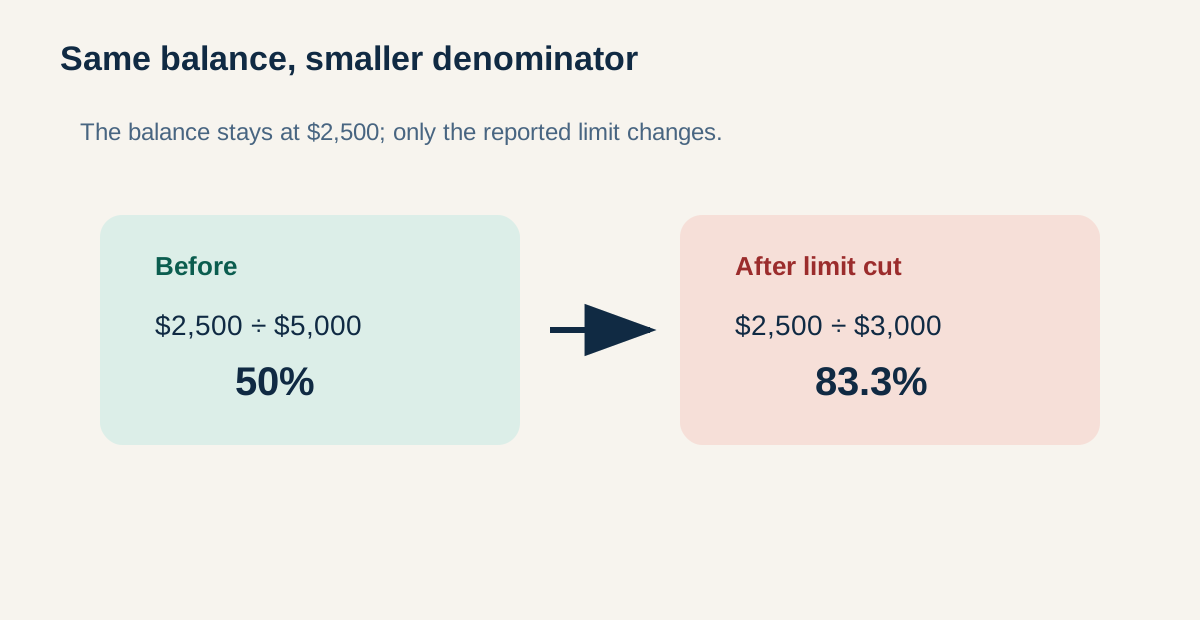
Visual: a smaller reported limit raises the percentage even when the balance is unchanged.
These are demonstrations, not score forecasts. Different scoring models use different data, timing, and weighting.
Overall and per-account utilization answer different questions
Overall utilization asks how much of the combined revolving capacity is being used. It can show that one card’s high balance is offset by unused capacity elsewhere. Per-account utilization asks whether a particular account is close to its own limit. A model may consider both, as well as the highest-utilized account or other features of the credit report.
FICO explains that its scores calculate utilization by dividing an account’s outstanding balance by its credit limit and that the “Amounts Owed” category is important in a typical FICO score.[1] FICO also says its models consider overall utilization and high utilization on specific revolving accounts.[2] Those statements describe FICO methodology, not every score sold or used in every country.
Consider two people with the same overall ratio of 40%:
- Person 1 owes $400 on each of five cards with a $2,000 limit each. Each card is at 20%, and total balances are $2,000 against $10,000 of limits.
- Person 2 owes $2,000 on one $2,000-limit card and $0 on four other cards with $2,000 limits. The total is still $2,000 against $10,000, or 20% overall—not 40%—but one account is maxed out.
The second profile has a much higher concentration even when its total is the same. The example is intentionally simple: actual reports and scoring models can include different accounts, dates, limits, and data quality.
Which balance matters: current, statement, or reported?
Your banking app may show a current balance, while your statement shows a statement balance and the credit report may later show a balance furnished by the issuer. These dates do not always match. The CFPB explains that scores may be calculated at different times; a high balance on the scoring date can affect a score even if you pay the card in full the next day.[3]
That is why “I pay in full every month” and “my reported utilization is always zero” are not identical statements. Paying the full statement balance can avoid purchase interest under the card’s terms, but a balance may still be reported before the payment posts or at another reporting date. The issuer’s agreement and reporting practice control.
Do not carry interest-bearing debt just to create utilization. The CFPB says you do not need to carry a balance to get a good score and that paying in full helps keep interest costs low.[4] If a high balance is temporary and you want to lower the balance that gets reported, an earlier payment may help in some situations, but it is not a universal scoring trick and it does not replace paying at least the minimum by the due date.
What can change utilization without new purchases?
A credit-limit decrease
If a card issuer reduces a limit while the balance is unchanged, the denominator shrinks and utilization rises. CFPB research on credit-line decreases found that affected consumers’ utilization increased sharply and that credit scores declined across score tiers after the decrease.[5] That research describes observed relationships; it does not mean every limit decrease produces the same score change.
Closing an account
Closing a card can remove available credit from the denominator used in an overall ratio. The CFPB warns that closing an existing card can increase utilization and lower a score, although the full effect varies with the rest of the profile.[6] Closing can still be sensible when a fee, poor terms, fraud risk, or unaffordable borrowing outweighs a possible score effect. A score concern is not a reason to keep an account that creates a bigger financial problem.
A refund, payment, or new charge posting
The balance that gets furnished can change when purchases, credits, payments, or disputes post. A refund may reduce a balance, but timing matters. A payment can lower today’s app balance while the older statement balance remains the one sent to a bureau. Keep records and check the actual report if accuracy matters for an application.
A new account or transfer
A new card may add available limit, but it can also create a hard inquiry, a new account, a balance-transfer fee, or a large balance on the receiving card. Moving debt around does not make it disappear. Compare the interest, fees, promotional expiry, and repayment plan as well as the utilization math.
What utilization does not tell you
Utilization is about revolving credit capacity; it is not the same as your total debt-to-income ratio, cash-flow safety, or ability to repay. A card at 5% utilization can still carry a costly purchase if the APR is high, and a card at 60% can be paid in full without interest under the account’s terms. The ratio also does not tell you whether a charge is disputed, whether a lender will approve an application, or which score version a lender will use.
Do not confuse a reported balance with a recommendation to spend. A low ratio produced by a high limit can conceal a large dollar obligation. Conversely, a temporary high ratio caused by a reimbursable work purchase may not describe your long-term finances, but it can still appear in the data used at that moment. Review the dollars, the due dates, and the source of repayment alongside the percentage.
Reporting can also lag reality. If you pay a card today, the bureau may not receive the update until the issuer’s next cycle. If you are checking for an application, allow time for the statement to close, the payment to post, and the report to refresh; exact timing is issuer- and bureau-specific. Keep copies of confirmations when correcting an error, and dispute inaccurate information through the applicable process rather than repeatedly opening new accounts to change the denominator.
The “30% rule” needs context
You may hear that utilization should stay below 30%. The CFPB repeats that some experts advise using no more than 30% of total credit, but it also says you do not need outstanding debt to get a good score.[4] A 30% line is a rule of thumb, not a legal threshold or a guaranteed score boundary. Some models respond to lower utilization, some profiles score differently, and lenders may use their own underwriting.
Use the ratio as information, not as a reason to borrow, pay unnecessary fees, or close an old account impulsively. The most important household question is whether the balance and payment fit the budget. Interest, late fees, and missed payments can cost more than a temporary utilization change.
A practical checklist
- List each revolving account. Record the limit, current balance, statement balance, due date, annual fee, and any promotional end date.
- Calculate both views. Divide each reported balance by its reported limit, then add balances and limits for the overall ratio.
- Identify the reporting timing. Ask the issuer when it normally furnishes data, but treat that as a practice rather than a guarantee.
- Pay at least the minimum on time. Utilization is not a substitute for payment history.
- Avoid a new purchase just to improve a ratio. The interest and fees may outweigh any score effect.
- Check the credit report. Look for incorrect limits, duplicate accounts, balances that do not belong to you, or accounts reported after closure.
- Consider the whole decision before closing a card. Weigh fees, security, temptation to overspend, age, available limit, and upcoming credit needs.
- Recalculate after a limit change. A lower limit can make an unchanged balance look much larger as a percentage.
Bottom line
Credit utilization is a percentage, not a debt-repayment method and not a promise about a score. Per-account utilization shows concentration; overall utilization shows the combined picture. Reported balances and limits, not only what your app shows today, drive the calculation used by a particular model.
Paying on time, keeping borrowing sustainable, checking reports for errors, and understanding the dates and terms matter more than chasing a magic number. Use utilization to diagnose how your revolving balances appear, then make decisions that protect cash flow and avoid unnecessary interest.
Continue with the Debt & Credit learning path, or review APR vs. APY and debt avalanche vs. debt snowball.
Checked 2026-09-08. U.S. CFPB and FICO pages provide educational and model-specific context; scoring models, reporting practices, and legal rights vary by provider and jurisdiction. Examples are original illustrations, not score forecasts.
Sources
- FICO, How FICO Scores Look at Credit Card Limits
- FICO, Understanding Accounts That May Affect Your Credit Utilization Ratio
- Consumer Financial Protection Bureau, Will paying off my credit card balance every month improve my credit score?
- Consumer Financial Protection Bureau, How do I get and keep a good credit score?
- Consumer Financial Protection Bureau, Credit Card Line Decreases
- Consumer Financial Protection Bureau, Does it hurt my credit to close a credit card?