Bond credit risk: ratings are a starting point, not a guarantee
Learn a practical way to evaluate bond credit risk using ratings, issuer finances, covenants, maturity, seniority, and the limits of every shortcut.
In this guide
Bond credit risk is the possibility that an issuer or other obligor cannot make promised interest or principal payments on time. The practical answer to “how do I evaluate it?” is not “find the highest rating.” Start with the rating, then examine the issuer, the bond’s legal position, the cash-flow burden, and the risks the rating does not measure.
The SEC says credit ratings estimate relative credit risk and should not be treated as investment advice. FINRA similarly describes ratings as one part of due diligence. A rating can be useful shorthand, but it is an opinion about creditworthiness—not insurance, a price forecast, or a guarantee that you will recover principal.
The risk map at a glance
Scroll sideways or use arrow keys to read the full table.
| Question | What to inspect | Why it matters | What remains uncertain |
|---|---|---|---|
| Can the issuer pay? | Revenue, cash flow, debt, liquidity, refinancing needs | Payment capacity can weaken before a missed coupon | Forecasts, accounting choices, and future shocks |
| Where do I stand? | Seniority, security, guarantees, covenants, collateral | Legal priority affects recovery if something goes wrong | Enforcement, valuation, and restructuring outcomes |
| What does the rating say? | Agency, symbol, date, outlook, watch status | Provides a comparable relative-risk signal | Ratings can lag events and agencies can disagree |
| What could I lose before default? | Price, spread, duration, liquidity, call terms | Market value can fall without a default | Sale timing, bid-ask spread, and buyer demand |
1. Define credit risk precisely
Credit or default risk is the risk that a company fails to make interest or principal payments when due. It can also involve a restructuring, covenant breach, delayed payment, or recovery that is less than the promised amount. The exact trigger depends on the bond’s indenture and governing terms.
Credit risk is not the same as interest-rate risk. A bond can lose market value because comparable yields rise even while the issuer remains healthy. It can also lose value because investors demand a wider credit spread, because liquidity dries up, or because the issuer’s outlook worsens. The bond duration guide covers the rate-sensitivity question; this article focuses on the issuer and legal promise.
2. Use ratings as a common language
Credit-rating agencies assign symbols intended to rank relative credit risk. The SEC’s investor bulletin explains that scales differ, but a typical scale runs from AAA at the stronger end toward D for default. Agencies may distinguish investment grade from speculative or high-yield categories, often around BBB/Baa and BB/Ba boundaries depending on the agency’s definitions.
Do not compare a symbol without checking:
- Who rated it: Agencies use different methodologies and symbols.
- What was rated: The issuer and a particular bond can have different ratings.
- When: The rating may be stale relative to a refinancing, acquisition, earnings shock, or downgrade.
- Outlook or watch status: These can signal a possible direction but are not a prediction.
- Whether the rating is solicited: The source and scope can affect the information available.
The rating is a starting filter, not the conclusion. A high rating does not remove interest-rate, liquidity, call, inflation, currency, or tax risk. FINRA’s bond tools also warn that ratings do not address market-value or liquidity risk.
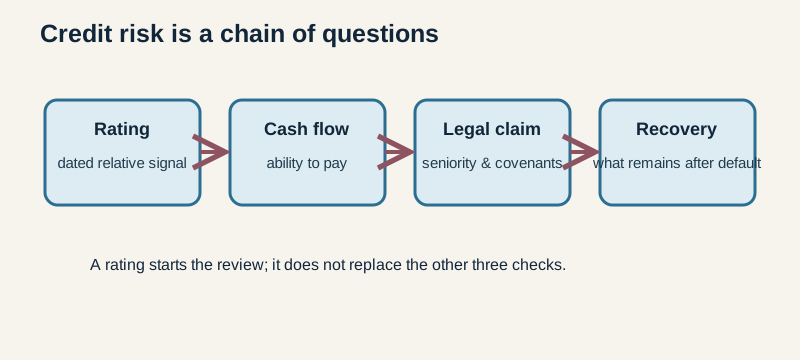 A rating starts the review; issuer capacity, legal priority, and recovery complete the questions.
3. Read the issuer’s ability to pay
For a corporate bond, ask how the issuer generates cash and how much of that cash is already committed. Useful questions include:
- Is operating cash flow positive and repeatable, or dependent on asset sales and new borrowing?
- How large are interest payments relative to operating income or cash flow?
- When does debt mature, and can the issuer refinance under plausible conditions?
- How much cash and committed liquidity is available?
- Are leverage and coverage improving, stable, or deteriorating?
- Does one customer, commodity, geography, or project dominate repayment capacity?
Ratios are clues, not magic cutoffs. Compare a company with its own history and close peers, and read the notes that explain unusual items. A single quarter can be noisy; a persistent deterioration in cash generation or access to financing is more informative than one headline ratio.
4. Check the bond’s legal position
Two bonds from the same issuer can carry different credit risk because their legal claims differ. Read the prospectus, offering memorandum, and indenture for:
- Seniority: Which claims are paid first in a default or restructuring?
- Security: Is collateral pledged, and how is it valued and maintained?
- Guarantees: Which entity guarantees payment, and are there limits or exclusions?
- Covenants: Do terms limit additional debt, asset sales, distributions, or mergers?
- Call and put rights: Can the issuer refinance or the investor demand repayment under specified conditions?
- Maturity and amortization: Is principal due in one large amount or paid down over time?
“Secured” does not mean “certain.” Collateral can lose value, rank behind another claim, or be difficult to liquidate. “General obligation,” “senior,” or “investment grade” are useful labels only when you read the actual legal terms.
5. Separate default probability from recovery
Credit analysis has at least two questions: how likely is a payment problem, and how much might be recovered if one occurs? A senior secured bond may have a better recovery position than a junior unsecured bond from the same issuer. But recovery depends on collateral, competing claims, enterprise value, bankruptcy costs, and the restructuring process.
The coupon and yield can compensate investors for perceived risk, but a high yield is not a safety margin. It may be the market’s price for a meaningful probability of loss, poor liquidity, or a long and uncertain recovery. Do not treat yield as proof that a bond is cheap or attractive.
6. Understand what price and spread are saying
Bond prices incorporate more than the promised coupon. If investors demand a larger spread over a comparable government yield, the bond’s price generally falls. That spread can reflect changing default expectations, liquidity, sector stress, technical demand, or a mix of causes.
Price moves are information, not a diagnosis. A sharp fall may be a warning, but it can also reflect a thin market or a broad rate move. A stable price may be misleading when the bond rarely trades. Check recent transaction information where available, the bid-ask spread, and how the displayed price was formed.
A hypothetical comparison
Imagine two five-year bonds, each with $1,000 par value and a 5% coupon. Bond A is senior unsecured debt from a company with stable cash flow and $40 million of cash interest expense. Bond B is junior debt from a more cyclical company with $75 million of cash interest expense and a large refinancing due in year four. Both display an “investment-grade” label in this hypothetical example.
The label alone does not answer which has lower credit risk. You would need the agencies, dates, issuer financials, covenants, seniority, guarantees, maturity schedule, and current prices. Bond B may offer a higher yield because investors demand more compensation, but that higher yield does not remove its refinancing and subordination risks. The example is illustrative, not a recommendation or a current quote.
Ratings can lag and can disagree
Agencies periodically review ratings and may revise them when conditions or expectations change. A downgrade can arrive after the market has already repriced the bond; an upgrade can lag an improvement. Agencies can also disagree because they use different models, assumptions, and information.
That does not make ratings useless. It means the reader should treat them as one dated input and investigate material changes. A rating is not a substitute for the bond’s own documents or for understanding what event would constitute default.
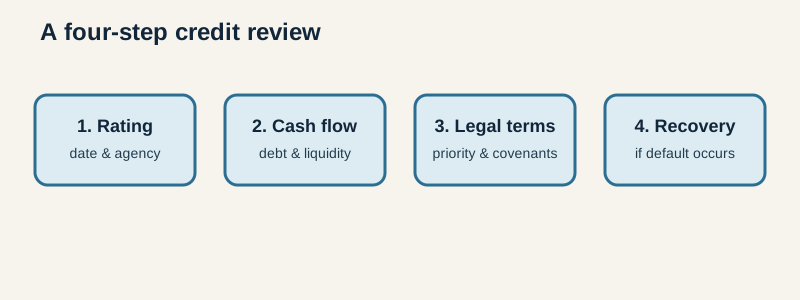 A practical sequence for organizing credit questions; it is not a scoring model.
Watch the refinancing calendar
An issuer can appear able to pay today yet face a difficult maturity wall later. List the debt coming due by year, then compare those obligations with cash on hand, operating cash flow, committed credit lines, and realistic access to markets. A company that must refinance a large balance during a period of weak demand or high borrowing costs may carry more risk than a snapshot ratio suggests. This is a scenario to investigate, not a prediction that refinancing will fail.
Credit risk in bond funds
A bond fund spreads exposure across holdings, but diversification does not eliminate credit risk. The fund can own many issuers, sectors, maturities, and ratings. Its portfolio can change, its net asset value can fall, and its yield measure can move. Read the prospectus, latest holdings, duration, concentration, credit-quality breakdown, fees, and manager policy.
An individual bond held to maturity and a bond fund are different experiences. The individual bond still faces default and liquidity risk, while the fund does not promise to return a fixed principal amount on one date. Neither wrapper is automatically safer because of its label.
A practical due-diligence checklist
Before relying on a bond rating or yield, ask:
- What exactly is the issuer and the legal obligor?
- Which agency rated this particular issue, when, and with what outlook?
- What are the seniority, collateral, guarantees, covenants, calls, and maturity terms?
- How does the issuer generate cash, and what debt comes due before maturity?
- What does the current price or spread imply, and is the bond liquid enough to sell?
- What could cause a downgrade, covenant breach, missed payment, or restructuring?
- What happens to recovery if the optimistic scenario fails?
- Are taxes, fees, currency, duration, reinvestment, and concentration risks acceptable for the intended use?
The idea to keep
Ratings are useful shorthand for relative credit risk, but they are not guarantees and do not measure every risk. Evaluate the issuer’s cash capacity, the bond’s legal priority, the timing of refinancing, current price and liquidity, and the recovery scenario. Then keep the result conditional: a bond can be high quality and still lose market value, and a high-yield bond can still default.
Continue through the Bonds & Rates learning path for duration, yield, and other fixed-income concepts.
This U.S.-oriented educational guide was checked on 2026-09-08. It does not report current ratings, issuer financials, prices, spreads, or a personalized recommendation. The example is hypothetical. Legal terms and recovery outcomes depend on the instrument and jurisdiction. The guide has not received independent human expert review.