Dollar-cost averaging: the discipline, trade-offs, and limits
Learn how dollar-cost averaging works, when it may reduce timing pressure, and why fees, cash drag and market losses still matter.
In this guide
Dollar-cost averaging (DCA) means investing equal amounts at regular intervals, regardless of whether the price is rising or falling. The same dollar amount buys more shares when the price is lower and fewer when it is higher. The approach can reduce the pressure to guess the “right” day, but it does not guarantee a profit, prevent losses or make a risky investment appropriate.
The most important question is what money you are scheduling. Regular contributions from each paycheck are different from holding a large cash balance on the sidelines. With new income, DCA may simply describe how money becomes available. With cash already available, spreading purchases out creates a trade-off: less money is exposed immediately, but more may remain in cash while markets rise.
In short: DCA is a contribution method, not a prediction. It can support consistency and behavior, while potentially sacrificing some upside and adding costs or delay.
How the share-count effect works
Suppose an investor contributes $100 in each of three periods. If the price is $20, $10 and $25, the purchases are 5, 10 and 4 shares—a total of $300 buying 19 shares. The average price paid per share is $300 ÷ 19, or about $15.79. The simple average of the three prices is $18.33. The difference occurs because the fixed dollar amount buys different numbers of shares.
This example is arithmetic, not a return forecast. It does not say the investment will rise, that three periods are representative, or that DCA will beat another path. A falling price can buy more shares and still leave the account worth less. If the investment later becomes unsuitable, buying it on a schedule only repeats the problem.
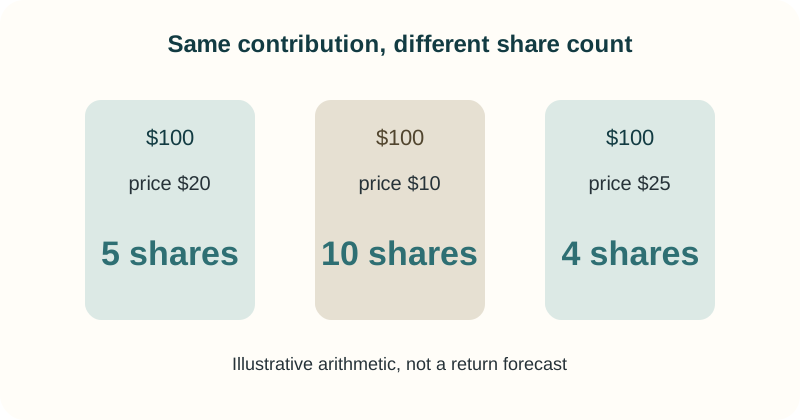
Illustrative arithmetic only; it does not forecast performance.
Why investors consider DCA
It creates a repeatable habit
An automatic contribution can turn investing into a routine rather than a series of emotional decisions. FINRA describes DCA as equal portions invested at regular intervals despite market movements. A written schedule may help a reader keep contributing when headlines are noisy.
It reduces the need to pick one entry date
Market timing requires a forecast about when to buy and when to wait. FINRA warns that attempts to time markets can backfire. A schedule replaces that forecast with a rule. The rule may reduce regret about choosing one unlucky day, even though it cannot remove market risk.
It changes the purchase pattern
As the example shows, equal-dollar purchases acquire more shares at lower prices and fewer at higher prices. That is a mechanical result, not a promise that the average cost will be lower than every alternative strategy.
It may fit earned income
If money arrives monthly from wages, there may be no large sum to invest immediately. Contributing as income arrives can be a practical way to put new money to work while keeping cash for near-term needs. FINRA notes that workplace retirement contributions often operate this way.
The trade-off: DCA versus investing available cash
If $12,000 is already available for a suitable long-term investment, investing $1,000 per month for 12 months leaves part of the money in cash during the schedule. If prices rise throughout those months, the delayed purchases may have fewer shares or a higher average purchase price than investing the $12,000 at the start. If prices fall soon after the start, the staged approach may show a smaller early loss.
Neither path can be declared the winner without specifying actual prices, cash yield, fees, taxes, timing and the investor’s goal. FINRA summarizes the central trade-off: DCA can reduce the risk and emotion of entering at one moment, but holding cash longer often produces lower returns than investing a lump sum, especially over longer periods.
The comparison also changes when the money is not available today. A person should not create “cash drag” by delaying each paycheck until a future date just to imitate a lump-sum comparison. The relevant alternative is usually investing new money when it becomes available, subject to emergency and spending needs.
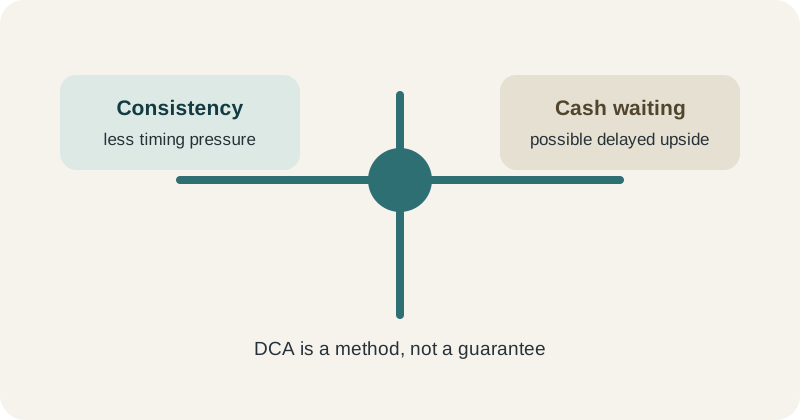
DCA can reduce timing pressure while leaving some available cash uninvested temporarily.
Costs, taxes and practical friction
More purchase events can mean more transaction charges, account fees or bid–ask costs, depending on the provider and product. Even small costs can compound. Check the account’s fee schedule, minimums, fractional-share rules and whether automatic purchases are actually free.
Tax treatment depends on jurisdiction, account type, holding period and the asset. Repeated purchases also create multiple tax lots and records. This article does not estimate a tax bill or prescribe an account. Read the product and account documents and use current local rules.
Cash waiting for the next instalment may earn interest, nothing, or a variable amount depending on where it sits. That cash return is part of the comparison. Inflation can also reduce purchasing power while money waits, although the size of that effect is not assumed here.
DCA does not remove investment risk
FINRA’s investor communications state that periodic plans do not assure a profit or protect against loss in declining markets. A schedule continues buying while prices fall. It can therefore add to an asset that keeps declining, and it cannot diversify a concentrated holding or fix a goal that needs the money soon.
DCA also requires the ability to continue contributions during low prices. A job loss, emergency, debt payment or other obligation may make the schedule impossible. A plan that competes with essential cash needs is not disciplined; it is a mismatch between the schedule and the person’s financial capacity.
What DCA is—and is not
DCA is not an emergency-fund strategy. Cash needed for a near-term bill belongs in a place and account designed for that need, not in a volatile asset simply because purchases are spread out. It is not diversification: buying one concentrated fund every month remains concentrated. It is not rebalancing: rebalancing changes weights back toward a target, while DCA describes how new money enters. And it is not a market forecast. A schedule can be followed through many price paths without telling you which path will occur.
Automation also needs an exit and review process. Confirm the destination account, pause or change the amount when income changes, and review statements for failed payments or purchases that do not match the intended asset. Automatic investing is a convenience, not a waiver of responsibility. Keep enough accessible cash for known expenses and an emergency before treating the remaining amount as investable.
The schedule should also be realistic about missed months. Skipping a contribution because an essential expense arose is different from abandoning a plan because a headline predicted a crash. Record why the change happened, then reassess the goal and cash flow. A flexible process that protects solvency is more useful than a rigid rule that creates a new financial strain.
Finally, compare the schedule with the account’s actual settlement and investment timing. A contribution may arrive on a holiday, remain as cash, or be invested at the next available price. Those operational details do not change the definition of DCA, but they can change the experience and the costs. Read the provider’s instructions rather than assuming an automation executes instantly.
Three illustrative scenarios
The numbers below are invented to explain the decision, not to predict results or recommend a schedule.
Regular paycheck contributions
Alex receives $500 of investable income each month after essential expenses and a cash reserve. The money is not available before payday. Automating a contribution may reduce timing anxiety and keep the process consistent. The main checks are affordability, fees, diversification and whether the goal and time horizon fit the chosen investment.
A cash bonus already in the account
Bea has $6,000 already available for a long-term goal. She compares investing it immediately with six monthly purchases of $1,000. Immediate investing gives the money market exposure sooner; staged investing keeps more cash temporarily and may feel easier during a volatile period. The result depends on the actual path, not on a universal DCA advantage.
A concentrated or short-term goal
Chen plans to use the money for a deposit in two years but considers a volatile single-sector fund because a DCA video made the process sound safer. The schedule does not solve the short horizon or concentration. The first question is whether the asset belongs in that goal at all, not how often to buy it.
A review checklist before automating
- Identify the source of money. Is it new income or cash already available?
- Name the goal and time horizon. When might the money be needed?
- Protect essential liquidity. Keep required spending and emergency needs separate from investing money.
- Understand the asset. Check concentration, volatility, liquidity, fees and what could cause a permanent loss.
- Compare alternatives. For available cash, compare immediate investment, staged investment and a documented reason for either.
- Check account mechanics. Review fees, tax lots, fractional shares, minimums and automatic-purchase controls.
- Test affordability. Could contributions continue through a period of low prices or lower income?
- Set a review rule. Revisit after a change in goals, horizon, income, debt, dependants or risk tolerance.
How DCA fits a wider plan
DCA is not asset allocation or diversification. The risk-tolerance and risk-capacity guide explains why a contribution schedule cannot determine whether an exposure fits a goal. Once a suitable allocation exists, the portfolio rebalancing guide covers how market moves can change its weights.
The long-term financial goal plan helps connect contributions to a goal and horizon. Continue with the Portfolio Strategy learning path or the wider Investing topic for the surrounding concepts.
The idea to take with you
DCA exchanges a single entry decision for a repeatable schedule. That can be valuable when new money arrives over time or when a rule helps an investor avoid impulsive timing. For cash already available, the cost is that some money waits; a rising market can make that delay expensive. In every case, check suitability, liquidity, fees, taxes and the ability to keep investing during declines.
This is general education, not personalized investment, tax or legal advice. Sources are U.S. investor-education materials; products, rules and taxes differ by jurisdiction. Pages were checked on 2026-09-08.