Payment for order flow and execution quality: questions for a broker
Learn how price improvement, spreads, speed, fill likelihood, Rule 605 and Rule 606 disclosures help you question a broker’s execution quality.
In this guide
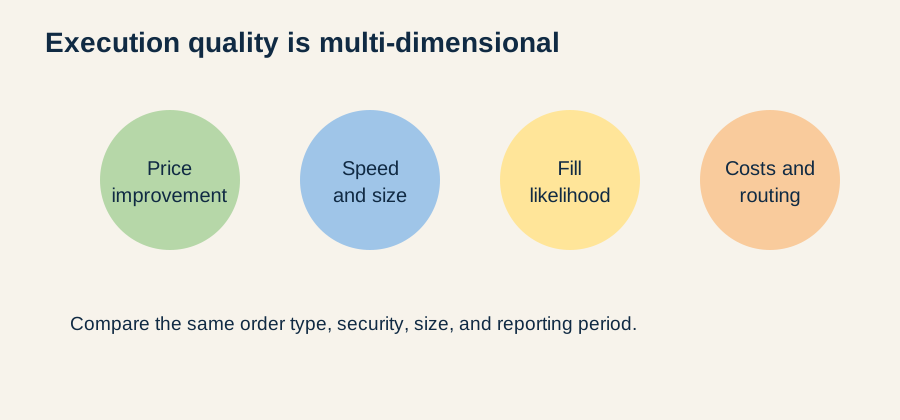 Execution quality combines price, speed, fill likelihood, size, and costs.
Short answer: evaluate execution quality by looking beyond commission. Ask how a broker routes your order, what price improvement or disimprovement it records, how often limit orders fill, how quickly and completely orders execute, and whether payment for order flow (PFOF) could influence routing. U.S. Rule 605 and Rule 606 disclosures provide evidence, but they are aggregated reports—not a guarantee for your next trade. This guide is educational, based on sources checked 2026-09-08.
What “best execution” involves
FINRA Rule 5310 says a broker’s regular and rigorous review should consider price improvement opportunities, price disimprovement, likelihood of execution for limit orders, speed, execution size, transaction costs, customer needs, and internalization or PFOF arrangements. No single metric answers every question. A market order may prioritize speed; a limit order may prioritize price control and remain unfilled. See market order vs. limit order.
PFOF is a relationship, not a performance score
Payment for order flow can include rebates, discounts, or other financial credits connected with routing customer orders to a venue. A broker may receive compensation from a market maker while still owing customers a duty of best execution. FINRA says firms should evaluate whether PFOF affects the quality they obtain and whether reliable, superior prices are available elsewhere.
That creates a question about incentives, not proof that every paid route is bad or every non-paid route is good. Compare the broker’s disclosures, execution data, order type, security, and time period. A zero-commission headline can coexist with spread, market-impact, or opportunity costs.
What Rule 605 reports can show
Rule 605 reports are monthly execution-quality statistics for covered NMS-stock orders and market centers, with newer amendments expanding reporting and adding summary reports. Depending on the report, you may see measures tied to the national best bid and offer (NBBO), execution speed, effective spreads, realized spreads, and price improvement across order categories and sizes.
Use the report to ask: how did this venue perform for comparable order sizes and securities during the same month? Do not treat one favorable percentage as your personal expected fill. The report is aggregated, definitions are technical, and market conditions can change.
What Rule 606 reports can show
Rule 606 requires public quarterly routing disclosures for held orders and additional disclosures for certain not-held orders on request. Reports identify where orders were routed and describe material relationships, including PFOF or profit-sharing terms that may influence routing. Enhanced disclosures separate marketable and non-marketable limit orders and remain available on a free website for three years.
Routing concentration is a prompt for questions, not a verdict. A broker may route different securities or order types to different venues. Read the quarter, category, and footnotes; compare the stated routing reason with execution-quality data and the broker’s best-execution review.
A transparent hypothetical
Suppose two brokers both advertise $0 commissions. For a 100-share marketable order, Broker A reports a slightly better average execution price than the displayed quote but routes most flow to a venue that pays it. Broker B reports less price improvement but faster average execution and a different routing mix. You cannot decide between them from these two facts alone: the order’s spread, size, volatility, fill timing, and the measurement window all matter. The example is invented and makes no provider claim.
Put execution differences in dollars—and preserve the reference point
A price difference becomes easier to interpret when converted into an order-level amount. For a buy order, a simple implementation-shortfall screen is:
(execution price − reference price) × shares executed
If a 200-share buy order is compared with a $25.00 reference price and fills at an average $25.03, the difference is $6 before commissions, fees and later market movement. For a sell order, reverse the subtraction. This example is hypothetical and does not establish that the broker caused the price change.
The reference price must be defined. It might be the quote when the broker received the order, the prevailing NBBO, or another benchmark permitted by the report. Changing the timestamp can change the result, especially in a fast market. Also record partial fills: 100 shares filled quickly and 100 filled later should not be treated as one instantaneous fill.
Compare matched samples wherever possible—same order type, similar order size, similarly liquid securities, the same trading session and the same reporting period. Then examine price, speed, fill rate and routing together. A small average price advantage may not compensate for weak fill likelihood on the orders you actually use, while fast execution alone does not show that the price was competitive.
Questions to ask before choosing a broker
- Where does the broker publish current Rule 605 and Rule 606 reports?
- Does the broker disclose PFOF, rebates, profit sharing, or internalization by order category?
- How does it define price improvement and compare against the NBBO?
- Are marketable and non-marketable limit orders separated?
- What are the time period, security universe, order size, and exclusions?
- How does the firm review speed, fill likelihood, execution size, and transaction costs?
- What happens to your order during volatile markets, extended hours, or partial fills?
- Are your instructions routed differently when you use a limit, stop, fractional, or options order?
Common reading errors
Treating price improvement as profit. A better execution price on one order does not establish investment return or suitability.
Comparing unlike samples. A report for small liquid stocks in one month cannot answer performance for a large volatile order today.
Ignoring unfilled orders. Speed and price statistics for executed orders may not capture the cost of a limit order that never fills.
Assuming routing equals quality. A venue receiving the most orders is not automatically best; look at the broker’s review and the order type.
Reading PFOF as a simple bribe. It may create a conflict that requires scrutiny, but the existence of payment alone does not prove inferior execution.
The rule to remember
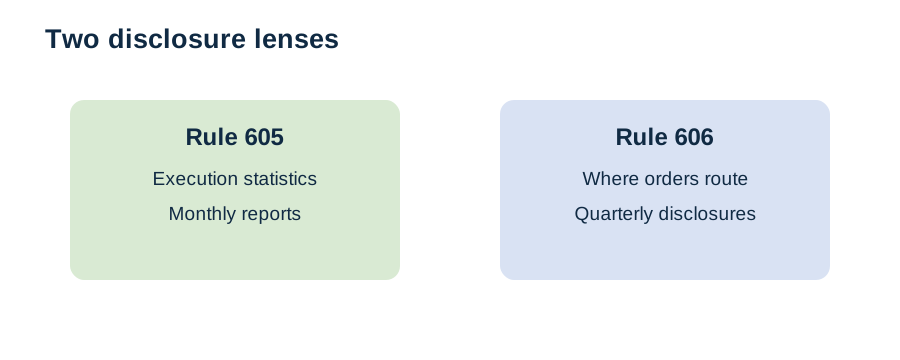 Rule 605 reports execution statistics; Rule 606 reports routing.
Execution quality is a process and evidence question. Start with your order type and objective, then compare dated Rule 605 and Rule 606 reports, PFOF terms, spreads, price improvement, speed, fill likelihood, size, and costs. Keep the limits visible: reports are aggregated, past statistics do not guarantee your fill, and investment quality is separate from execution mechanics.
U.S. market-structure scope; rules and report formats were checked 2026-09-08. This is general education, not investment, legal, or tax advice.