Cash, inflation, and purchasing power: what a balance does not show
Learn how inflation changes what savings can buy, how to compare nominal and real returns, and why CPI may not match your household.
In this guide
Inflation can leave the number in your savings account unchanged while reducing what that number can buy. If your balance earns a nominal 3% and the prices relevant to you rise 4%, your purchasing power falls even though the account statement shows more dollars. The practical comparison is therefore not “did the balance grow?” but “how did the balance grow relative to prices, after fees and taxes?”
This article uses U.S. Consumer Price Index (CPI) concepts checked against the Bureau of Labor Statistics (BLS) on September 8, 2026. CPI is an average measure; your household’s spending can move differently. No current inflation rate or forecast is implied here.
Nominal dollars versus real purchasing power
Nominal means the amount written in today’s account statement. Real means the amount adjusted for changes in prices. A nominal balance of $10,300 after earning 3% is not automatically worth more in practical terms than $10,000 today. If prices rose faster than the account yield, the future balance may buy less.
A useful approximation is:
real return ≈ nominal return − inflation rate
For more precise work, use:
real return = (1 + nominal return) / (1 + inflation rate) − 1
These formulas assume the rates cover the same period and ignore taxes and fees. They are educational approximations, not a promise about a particular account.
A transparent example
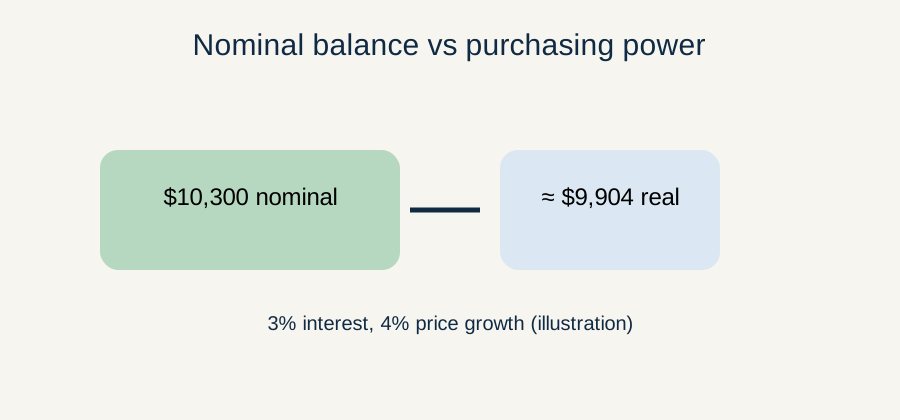
Visual guide: a larger nominal balance can represent lower purchasing power.
Assume $10,000 stays in an account for one year. The account earns 3% and charges no fee. Prices represented by a chosen index rise 4%.
Scroll sideways or use arrow keys to read the full table.
| Measure | Result |
|---|---|
| Starting balance | $10,000 |
| Ending nominal balance | $10,300 |
| Approximate real return | −0.96% |
| Approximate purchasing power in starting dollars | $9,904 |
The $10,300 ending balance is calculated as $10,000 × 1.03. The purchasing-power figure divides by 1.04. It is not a prediction of your grocery bill or rent; it is a controlled illustration using one price-growth assumption.
Why the CPI is useful—and limited
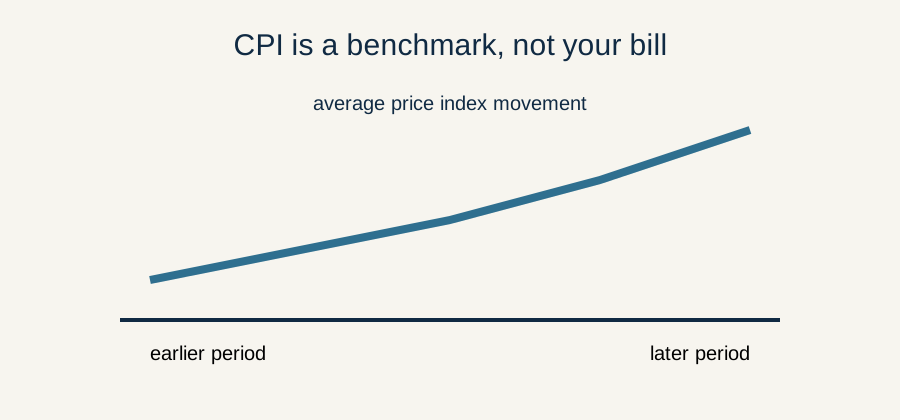
Visual guide: an index tracks average movement across its defined scope.
BLS constructs the CPI from a basket of consumer goods and services and publishes index values over time. Comparing index values can translate a nominal amount into constant-dollar terms. If an index rises from 100 to 104, the same basket costs about 4% more under that index’s scope.
The CPI is an average, not a personal inflation meter. A household that rents, commutes, or pays tuition may have a different spending pattern from the national basket. Product quality, substitution, location, and timing also affect lived costs. Use the index to create a transparent benchmark, then explain where your own spending may differ.
The interest rate you see is not the whole result
When comparing savings accounts, start with APY, then subtract the effects that APY does not personalize:
- monthly maintenance or transfer fees;
- taxes on interest, where applicable;
- a promotional rate that expires;
- a lower tier after your balance changes;
- days when money is outside the account during a transfer or hold.
For example, a 4% APY with a $60 annual fee may produce less net value than a 3.6% APY with no fee for a modest balance. The outcome depends on the balance, fee, timing, and tax situation. See APR vs. APY for why APY and borrowing APR are not interchangeable.
Inflation does not affect every goal in the same way
Money for next month’s rent has a different time horizon from money for a home deposit in eight years. Short-term cash usually prioritizes access and stability; a longer horizon may allow a broader plan, but that introduces market risk and is not a reason to treat investments as guaranteed inflation protection.
State the goal, date, currency, and acceptable access before comparing yields. A higher expected return can come with price volatility or loss risk. A deposit account can preserve its dollar value while failing to preserve purchasing power; an investment can rise faster than inflation but can also fall.
Use a break-even rate as a scenario, not a forecast
For a stated inflation assumption, the nominal return needed to preserve purchasing power before fees and taxes is the rate that makes the real return zero. The exact relationship is:
required nominal return = (1 + target real return) × (1 + inflation assumption) − 1
If the target real return is 0% and the scenario assumes 4% inflation, the break-even nominal return is 4% before fees and taxes. A $50 annual fee on a $5,000 average balance adds roughly one percentage point of drag in a quick screen because $50 ÷ $5,000 = 1%. Actual results can differ with changing balances, fee timing, compounding and tax treatment.
Do not turn that break-even figure into a prediction. Run a lower, middle and higher inflation scenario over the same horizon, then compare each with the account's current terms. This shows how sensitive the result is without claiming to know the future inflation rate or your household's personal price changes.
A simple workflow for checking purchasing power
- Record the starting balance, deposit APY, fees, tax assumption, and dates.
- Choose the price index and geography. For a U.S. consumer comparison, identify the CPI series and period.
- Calculate the nominal ending balance.
- Convert that balance using the ratio of index values.
- Compare the result with the actual spending goal, not just the headline percentage.
- Label every assumption and the date checked.
If you change the index, horizon, or fee assumption, the answer changes. That is a feature of transparent analysis, not a defect in the calculator.
What a balance cannot tell you
A statement does not show whether the account is easy to access during an emergency, whether the rate can change tomorrow, whether a fee was waived, or whether the institution is insured. FDIC insurance protects eligible deposits at insured banks up to $250,000 per depositor, per bank, per ownership category; it does not protect purchasing power or market investments.
For broader planning, connect the cash decision to a long-term financial goal plan. Keep emergency liquidity, provider safety, currency exposure, and the possibility of price changes visible rather than hiding them behind one return number.
Common mistakes
Treating any positive interest as a real gain. Compare the rate with a stated inflation measure.
Using a current CPI number as a personal forecast. CPI describes an average past or measured change, not your next bill.
Ignoring fees and taxes. A gross APY is not a personalized net result.
Assuming a savings account must beat inflation. Deposit rates can lag, match, or exceed inflation at different times.
Using an investment as a guaranteed hedge. Market prices can fall, and no return is assured.
Keep the comparison current
Rates, fees, tax rules, and price indexes update. Recheck the provider disclosure and the BLS series when making a dated calculation. This is general education, not individualized financial, legal, or tax advice.
Sources
- U.S. Bureau of Labor Statistics, Consumer Price Index Frequently Asked Questions.
- U.S. Bureau of Labor Statistics, CPI databases and average price data.
- Federal Reserve, Why do interest rates matter?.
- CFPB, Regulation DD Appendix A — Annual Percentage Yield Calculation.
- FDIC, Understanding Deposit Insurance.