Minimum payments and payoff time: why the small number can mislead
Learn what a credit-card minimum payment covers, why payoff can take years, and how to read your statement’s repayment estimates.
In this guide
The minimum payment is the smallest amount your credit-card statement requires by its due date. It keeps the account from being immediately treated as unpaid under the agreement, but it is usually not a payoff plan. If you make only the minimum while interest and new charges continue, repayment can take years and cost much more than the original purchase.
The CFPB says card statements must show how long it could take to repay the current balance with minimum payments and how much you would need to pay each month to clear that balance in 36 months, subject to the disclosure rules.[1] Those estimates assume no new charges and use the statement’s assumptions. They are warnings and comparison tools, not promises about your future account.
What the minimum payment does — and does not do
Your statement normally shows a new balance, minimum payment, due date, interest or fees, and sometimes separate APR categories. The minimum may be a percentage of the balance, a fixed dollar floor, accrued interest and fees, past-due amounts, or an amount over the limit. The exact formula is in the card agreement. It is not safe to assume that every issuer uses the same percentage.
Paying at least the minimum by the due date matters. Missing it can trigger a late fee, violate the agreement, hurt your credit history, or cause an introductory rate to end or a penalty APR to apply, depending on the contract and law.[2] Paying the minimum does not necessarily stop interest on the remaining balance. If a grace period does not apply, interest may continue to accrue under the agreement.
The minimum is therefore a floor for staying current, not a signal that the account is becoming affordable. A payment can be “on time” and still leave the balance barely moving.
The first-month math
Consider a simplified $1,000 purchase balance at a fixed 24% annual percentage rate. Assume monthly interest is approximated as 24% ÷ 12 = 2%, no fees, no new charges, and a $35 payment.
Scroll sideways or use arrow keys to read the full table.
| Step | Approximate amount |
|---|---|
| Starting balance | $1,000.00 |
| One month of modeled interest | $20.00 |
| Payment | $35.00 |
| Principal reduction before other contract details | $15.00 |
| Balance after this simplified month | $985.00 |
The example is not an issuer calculation: many card companies calculate interest daily, may have different balance categories, and may apply payments according to the agreement.[3] The point is the direction. When interest is $20 and the payment is $35, only about $15 reduces principal in this simplified month.
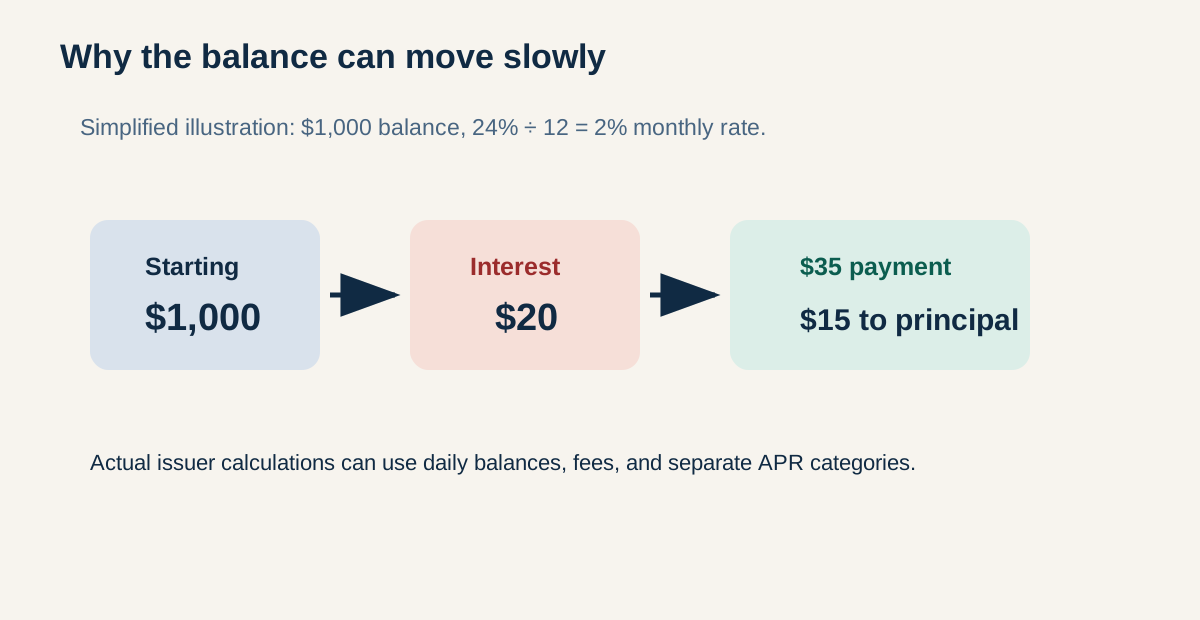
Visual: in the illustration, $20 of a $35 payment covers modeled interest and about $15 reduces principal.
If the same $1,000 balance were paid at a fixed $35 every month under the same simplified monthly-rate model, the mathematical payoff would be roughly 43 months. Paying $50 would be roughly 26 months; paying $100 would be roughly 12 months. These are rounded illustrations, not quotes. A real minimum usually declines as the balance declines, while fees, variable APRs, promotional balances, and new purchases can extend the schedule.
Why new purchases change the answer
The statement’s repayment estimate is based on the balance at that statement date and generally assumes no future charges. A new purchase adds principal and may have a different APR or grace-period treatment. A cash advance or balance transfer can have separate pricing and fees. If you keep using the card, the payment that would have cleared yesterday’s balance in three years may no longer be enough.
The CFPB’s repayment-disclosure FAQ makes this limit explicit: the 36-month amount is calculated from the current balance and does not account for future purchases.[1] Treat the estimate as a snapshot, not a guarantee.
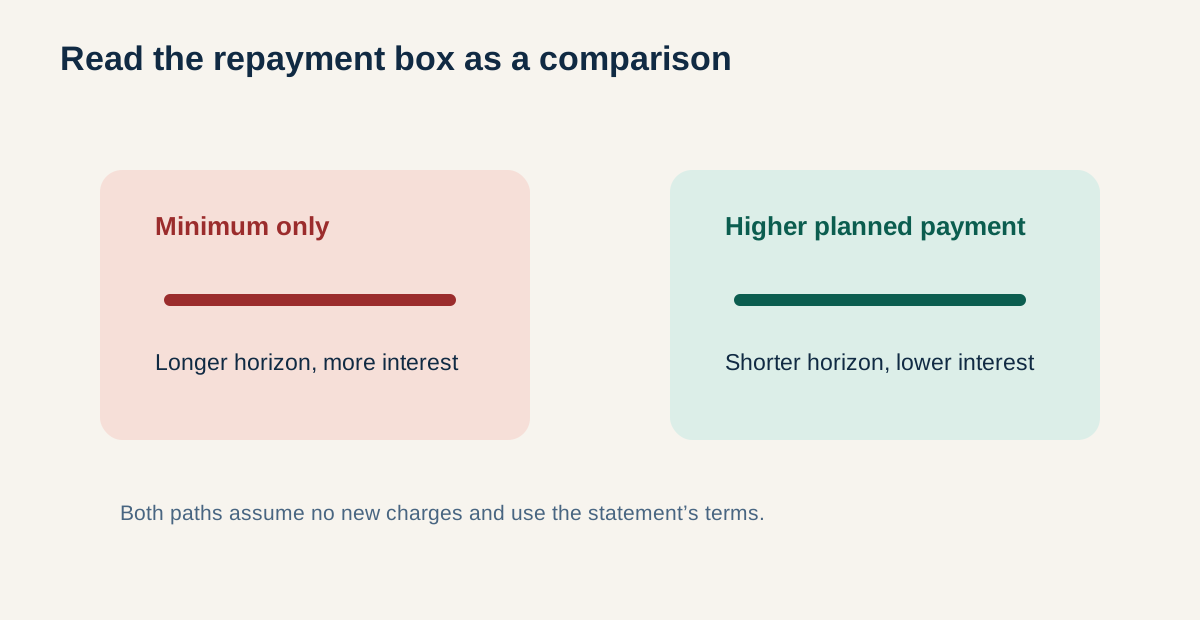
Visual: the statement warning compares horizons under stated assumptions; it is not a personalized forecast.
Interest is not always one simple monthly charge
Many issuers calculate interest daily using an average daily balance. Purchases, balance transfers, and cash advances may carry different APRs. A grace period can allow you to avoid interest on new purchases if you pay the full balance by the due date, but the terms and eligibility matter. CFPB guidance says the statement must identify different APR categories, and the agreement explains how payments are applied.[3]
When you pay more than the minimum, the amount above the minimum is generally applied first to the balance with the highest APR under U.S. rules, while the issuer’s agreement controls the minimum-payment portion.[3] That is one reason to read the balance breakdown instead of assuming every dollar goes to the purchase you have in mind.
Deferred-interest promotions are another trap. “No interest if paid in full” can mean interest is charged retroactively if the promotional balance is not cleared by the deadline or if the contract’s conditions are breached. The CFPB advises calculating the monthly amount needed to finish before the deadline rather than relying on the minimum.[4]
How to read the repayment box on your statement
Look for four separate pieces of information:
- The minimum-payment estimate. This is the time and total cost if you make only the minimum and make no new charges, using the issuer’s assumptions.
- The 36-month estimate. This is the monthly amount and total cost to repay the current balance in three years, where the disclosure rules require it.
- The assumptions. Check APRs, fees, balance categories, and whether the estimate excludes new transactions.
- The actual due date and minimum. The disclosure is not a substitute for paying the amount shown by the due date.
If the statement is confusing, ask the issuer for the agreement and a balance explanation. The CFPB maintains a database of credit-card agreements, but it warns that the agreement on file may not be identical to the terms of your individual account.[5]
A practical way to reduce payoff time
- Stop adding new charges to the balance you are trying to clear. If that is not possible, separate new spending from the payoff calculation.
- Pay at least the minimum by the due date. Set a reminder or reliable payment method, while checking that autopay has the correct amount and account.
- Choose an extra amount that survives a normal month. A smaller sustainable payment is more useful than a large promise that causes another missed bill.
- Check the APR and balance type. Put high-rate or fee-heavy balances in the calculation; do not assume a promotional rate lasts forever.
- Compare the statement’s 36-month figure with your planned payment. If your payment is lower, the balance may take longer than three years.
- Review the result after a real change. A new purchase, returned payment, rate expiry, fee, credit-limit change, or income shock changes the model.
The debt-avalanche method in our repayment guide can help organize extra payments across multiple balances, but it does not remove the need to cover essentials and minimums first. If you cannot make minimums, contact the issuer or a qualified nonprofit counselor before ignoring the account.
What minimum-payment warnings cannot answer
A statement estimate cannot tell you whether a purchase is affordable, whether your income will remain stable, how a hardship program will change terms, or what local collection and insolvency rules apply. It also cannot predict every fee, rate change, dispute, returned payment, or new transaction. The estimate may be accurate under its assumptions and still be a poor plan for your real budget.
Do not treat a low minimum as evidence that the debt is low risk. A $30 payment can coexist with a large balance, a high APR, and years of interest. Conversely, paying more than the minimum should not force you to skip rent, utilities, food, insurance, taxes, or an essential cash buffer.
If the minimum is all you can pay
Paying the minimum is still better than missing it when the account is otherwise current, but it may be a sign to change the plan rather than a permanent budget line. First protect essentials and make a realistic list of every due date. Then contact the issuer before a missed payment if you expect a short-term income shock. Ask what hardship, reduced-rate, fee-waiver, or structured-payment options exist, and request the terms in writing. An offer can change the APR, payment, reporting, or ability to use the card, so compare the whole agreement.
Avoid taking a new high-cost loan simply to make a minimum payment without understanding the combined schedule. A balance transfer may have a fee and an expiry date; a debt-management plan may affect card use and is not the same as debt settlement. A counselor can explain options, but verify fees, credentials, and conflicts. No service can guarantee a particular score or erase a debt without consequences.
Bottom line
The minimum payment is a contractual floor, not the cost of the purchase and not a promise of a short payoff. Read the statement’s time-and-cost warning, understand the APR and payment allocation, and model the balance with no new charges before deciding what “affordable” means.
Pay on time, avoid unnecessary new interest, and choose a payment you can sustain after essentials. If the minimum is already difficult, seek issuer or local nonprofit help early; waiting for the balance to become unmanageable can reduce your options.
Continue with the Debt & Credit learning path, or compare APR vs. APY.
Checked 2026-09-08. U.S. CFPB guidance and Regulation Z disclosures provide U.S.-specific consumer context; card agreements, rates, fees, grace periods, payment formulas, and legal remedies vary by issuer and jurisdiction. Examples are original simplified illustrations, not account forecasts.
Sources
- Consumer Financial Protection Bureau, repayment disclosure FAQ
- Consumer Financial Protection Bureau, Know Before You Owe: Credit cards
- Consumer Financial Protection Bureau, How does my credit card company calculate the amount of interest I owe?
- Consumer Financial Protection Bureau, Deferred-interest credit-card purchase
- Consumer Financial Protection Bureau, Credit card agreement database
- Consumer Financial Protection Bureau, Regulation Z §1026.7