How to compare savings accounts beyond the advertised APY
Compare savings accounts by APY, fees, access, rate conditions, FDIC coverage, and realistic dollar outcomes—not the headline alone.
In this guide
The best savings account is not automatically the one with the biggest number in an advertisement. Compare the APY for your balance and time horizon, then check fees, access, rate conditions, deposit protection, and whether the provider is actually the insured institution. A slightly lower APY can leave you better off if it avoids a monthly fee or makes emergency cash available when you need it.
This guide uses U.S. disclosure and FDIC terminology checked on September 8, 2026. Other countries use different protection systems and disclosure rules. Rates and offers change, so treat every example as a method, not a current offer.
Start with the job of the money
Before opening comparison tabs, write down what the account must do. Daily spending needs reliable access. An emergency fund needs liquidity and low operational risk. Money needed on a known date may fit a time deposit if the withdrawal rules are acceptable. A foreign-currency account introduces exchange-rate risk even when its quoted yield looks attractive.
The goal changes what “best” means. A high promotional APY that expires before your planned use may be less useful than a stable account with simple transfers. A locked certificate of deposit may suit a known future expense but not a rent buffer.
APY is the starting line, not the finish line
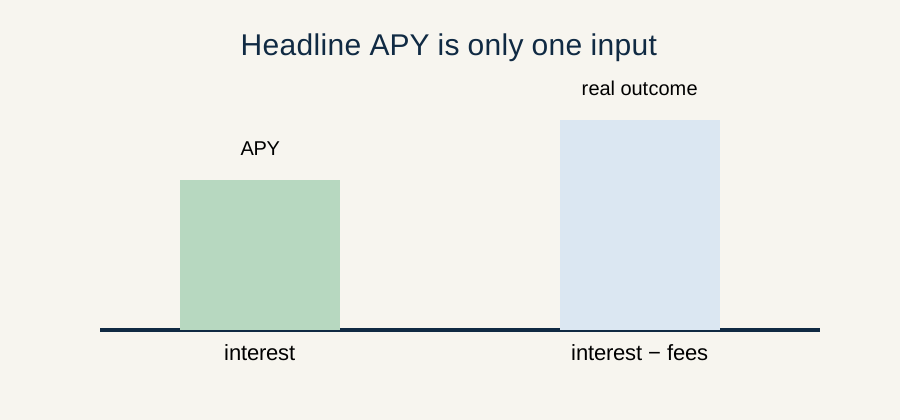
Visual guide: interest and fees belong in the same comparison.
APY is designed to express the annual yield on a deposit with compounding included. It helps compare similar accounts, but it is calculated under stated assumptions. Variable rates can change, tiered accounts can pay different yields at different balances, and promotional rates may require conditions or expire.
Check four details beside the APY:
- Is the rate fixed, variable, stepped, or promotional?
- What balance tier earns the displayed APY?
- How often is interest compounded and credited?
- What event ends the promotional period or changes the tier?
Do not compare a savings-account APY with a loan APR as if the difference were profit. They measure different cash flows. For the definitions, see APR vs. APY.
Convert the headline into dollars
Suppose Account A advertises 4.50% APY with no monthly fee. Account B advertises 4.75% APY but charges $5 each month unless you keep $500 in the account. Assume a $1,000 balance stays unchanged for one year and the rates remain available. Ignoring tax and timing details, the APY difference is about $2.50 of interest. Account B’s $60 annual fee overwhelms that advantage if you do not meet the waiver condition.
The comparison changes if your balance is $10,000, the fee is waived, or the rate changes. That is why a simple worksheet should calculate a likely dollar result under your own stated assumptions rather than rank percentages in isolation.
Read the fee schedule line by line
Look for monthly maintenance fees, excess-withdrawal fees, wire or transfer charges, paper-statement fees, returned-payment fees, and early-closure penalties. Ask whether the fee is avoidable and what exact action avoids it. “No fee” in a headline can mean no monthly fee, not no fee of any kind.
Use a conservative scenario: assume you miss a balance threshold once, need an urgent transfer, or close the account early. If that event creates a large charge, it belongs in your decision even if it is not likely every month.
Check access and timing
An account is part of your cash system. Confirm how to withdraw, how to transfer to an external bank, whether transfers are subject to holds, and whether there are daily or monthly limits. For a time deposit, note the maturity date, automatic-renewal instruction, and early-withdrawal penalty.
Test the operational questions before moving important cash: Is there a working customer-support channel? Can you reset access securely? Does the app show pending transfers clearly? These are usability checks, not a promise that a provider will resolve every problem quickly.
Compare access failure modes
Normal-day convenience is only half the test. Ask what happens when a transfer is delayed, your phone is lost, the account is frozen for verification, or you need more than the daily transfer limit. Check whether another withdrawal channel exists and whether support is available during the hours you may need it.
For emergency savings, write down the slowest plausible route from the account to a bill. An account that takes several business days to reach your spending account may still be useful, but the delay belongs beside the APY. Splitting cash across institutions can add resilience, yet it also creates more credentials, transfer links, statements, and balances to monitor. More accounts are not automatically safer or simpler.
Verify who holds the deposit and the protection
FDIC insurance covers eligible deposits at an FDIC-insured bank up to $250,000 per depositor, per insured bank, per ownership category. Checking, savings, money market deposit accounts, and CDs are common covered products. All deposits in the same ownership category at the same bank are added together. Stocks, bonds, mutual funds, crypto assets, annuities, and safe-deposit-box contents are not covered merely because a bank sells them.
An app may use a partner bank. Find the legal institution holding the funds, confirm it in FDIC BankFind, and understand whether a pass-through or sweep arrangement applies. Coverage is not established by a debit card, a familiar app name, or the phrase “FDIC eligible” alone.
Compare minimums, tiers, and transaction rules
Some accounts require an opening deposit, a minimum daily balance, direct deposit, recurring transfers, or a particular number of monthly transactions. A tiered schedule may pay 4.75% on one slice of the balance and a lower rate on the rest. Ask for the marginal rule: does the condition affect the entire balance or only money above a threshold?
Write the rule in plain language. “APY up to 5%” is incomplete until you know the balance range and activity required to earn it.
Account types are not interchangeable
Instant-access savings, high-yield savings, money market deposit accounts, and CDs can all appear in a search result but have different jobs. A money market deposit account is a bank deposit; a money market mutual fund is an investment and is not FDIC-insured. A CD may offer a known rate but restrict access until maturity. A high-yield savings account may be variable and may require electronic statements or online-only service.
Compare like with like first. Then decide whether the difference in access, term, and protection is worth the yield difference.
A worked comparison table
Assume a $5,000 balance, no additional deposits, one-year horizon, and rates that stay unchanged. The figures are illustrative, before tax.
Scroll sideways or use arrow keys to read the full table.
| Item | Account A | Account B |
|---|---|---|
| Advertised APY | 4.25% | 4.50% |
| Monthly fee | $0 | $4 unless $1,000 minimum is maintained |
| Interest at stated APY | About $212.50 | About $225.00 |
| Fee if minimum is missed for three months | $0 | $12.00 |
| Illustrative net before tax | $212.50 | $213.00 |
Account B looks better until the balance condition is included. If you always maintain the minimum, its higher APY may produce more interest. If the fee is likely, the advantage is almost gone. Neither column predicts a future variable rate or your tax result.
Find the break-even rate advantage
A quick break-even calculation turns a fee into a comparable percentage:
annual fee ÷ expected average balance × 100
If an account charges $4 a month and your expected average balance is $5,000, the annual fee is $48, or about 0.96% of the balance. Ignoring compounding and tax, the account needs roughly 0.96 percentage points of extra yield just to offset that fee. If the fee applies for only three months, $12 is about 0.24% of $5,000—almost the entire 0.25-point APY advantage in the example.
This shortcut is an estimate, not the APY formula. Use the actual balance timing, waiver rules, rate tiers, and fee dates for a final comparison. It is most useful for spotting when a small headline advantage cannot plausibly cover a recurring charge.
A ten-minute comparison checklist
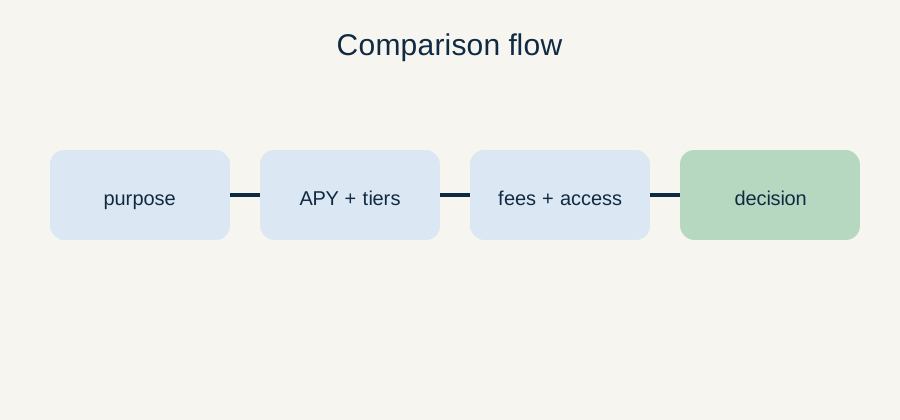
Visual guide: a repeatable order for comparing accounts.
Save the disclosure page or PDF with the date checked, then record:
- APY, rate type, compounding and crediting frequency;
- balance tier and every condition for the quoted rate;
- monthly, transaction, transfer, statement, and early-closure fees;
- opening minimum and ongoing minimum balance;
- withdrawal, transfer, hold, and maturity rules;
- legal bank, FDIC status, ownership category, and any sweep/pass-through structure;
- customer-support and account-recovery options;
- what happens if the promotional rate ends;
- expected dollar result under a realistic balance and fee scenario.
If two options remain close, prefer the one whose restrictions you understand and can follow. Simplicity and access have value, especially for emergency cash.
Common comparison mistakes
Chasing the top rate: rates move and may be promotional. Record the end date and recheck before relying on it.
Ignoring fees because the APY is higher: a recurring fee can exceed the extra interest.
Assuming all “cash” is a deposit: brokerage cash, money market mutual funds, and app balances can have different legal treatment.
Counting branches as separate banks: FDIC aggregation follows the insured institution and ownership category, not the branch address.
Treating a calculator result as a guarantee: examples assume a balance, rate, timing, and behavior. Actual results can differ.
Keep the comparison current
Rates, fees, partner banks, transfer limits, and promotional terms change. Recheck the provider’s current disclosure when opening the account and after a material notice. Keep the date and assumptions beside your notes. This article is general education, not individualized financial, legal, or tax advice.
Sources
- CFPB, Regulation DD § 1030.2 — Definitions.
- CFPB, Regulation DD Appendix A — Annual Percentage Yield Calculation.
- CFPB, Regulation DD § 1030.4 — Account disclosures.
- FDIC, Understanding Deposit Insurance.
- FDIC, Are My Deposit Accounts Insured?.
- FDIC, Financial Products That Are Not Insured by the FDIC.
- FDIC, Deposit Insurance FAQs.