Bank account fees and access: a practical comparison checklist
Compare bank accounts by total fees, waiver rules, access, overdraft options, provider identity, and deposit protection—not the word free.
In this guide
To compare bank accounts fairly, calculate the likely annual cost for your actual behavior, then test access and protection. Look beyond “free” or a high APY: check monthly maintenance, ATM and transfer charges, overdraft/NSF rules, minimum-balance waivers, rate conditions, support, and the legal institution holding the deposit.
This guide uses U.S. consumer-disclosure and FDIC concepts checked September 8, 2026. Banks and credit unions can use different terms, and other countries have different rules. Examples below are illustrative, not current offers.
Start with how you will use the account
List your normal month: number of deposits, cash withdrawals, external transfers, card payments, and likely low-balance days. Separate a spending account from savings or emergency cash. An account that is cheap for online transfers may be costly if you regularly use an out-of-network ATM.
Access is part of cost. A transfer delay, branch-only service, or weak account-recovery process can matter more than a small fee difference when rent or an emergency bill is due.
Read the disclosure and fee schedule
U.S. Truth in Savings rules require disclosures about fees, interest rates, APY, and other account terms. CFPB guidance says institutions must tell you upfront about monthly maintenance fees and how requirements such as minimum balances or direct deposit can avoid them. Fees and terms can later change with written notice.
Request the account-opening disclosure and current fee schedule. Do not rely on a comparison page that omits exceptions. Record the fee amount, trigger, waiver, timing, and whether the charge applies per transaction or per statement period.
Build a fee inventory
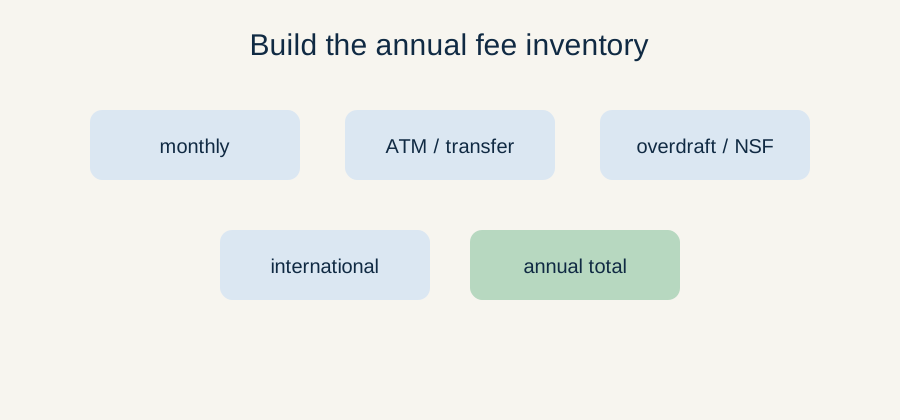
Visual guide: collect recurring and event-based charges before comparing accounts.
Check these lines:
- monthly maintenance or service fee;
- ATM fee, including the provider’s fee and possible network surcharge;
- incoming and outgoing transfer or wire fees;
- overdraft and nonsufficient-funds (NSF) fees;
- stop-payment, returned-item, paper-statement, and cashier’s-check fees;
- excess-withdrawal or early-closure charges;
- foreign-currency conversion or international-use fees.
“No monthly fee” does not mean “no possible fee.” A “free” account may still charge for overdrafts, out-of-network ATMs, bounced checks, stop payments, or printed checks.
Test waiver conditions, not just the headline
A fee waiver might require a minimum daily balance, direct deposit, recurring transfer, electronic statements, or a particular account bundle. Write the condition as an action you can reliably perform. If the account requires $1,500 every day, a $1,000 average balance is not enough.
Ask what happens when a condition is missed for one day, one month, or part of a statement cycle. Also check whether the bank can change the waiver requirements and how it notifies you.
Understand overdraft choices
An overdraft occurs when a transaction exceeds available funds. Depending on the program and your choices, a bank may decline the transaction, pay it and charge a fee, or transfer money from a linked account for a fee. CFPB materials emphasize that you can ask about options and opt-out rules; the account agreement controls the details.
Compare the cost of declining a transaction, a linked transfer, and an overdraft. Keep a buffer if you choose one, but do not treat a buffer as permission to spend beyond your means. Overdraft protection does not make a payment affordable.
Compare access and operational resilience
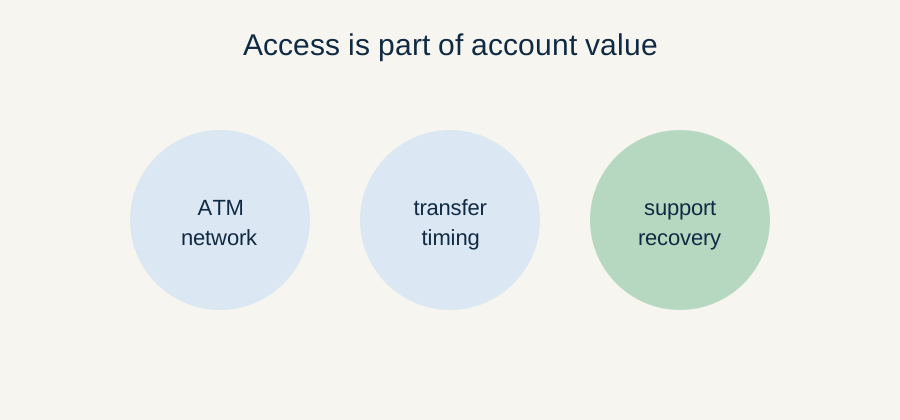
Visual guide: access is a practical part of account value.
Record ATM locations, surcharge reimbursement, branch hours, transfer limits, hold periods, mobile check-deposit timing, customer support, and account-lockout recovery. Ask how quickly you can move money to another bank and whether a weekend or holiday changes the timing.
For an emergency fund, test the process with a small transfer before moving the full balance. This is an operational check, not a promise about future service.
Verify the provider and deposit protection
FDIC insurance covers eligible deposits at an FDIC-insured bank up to $250,000 per depositor, per insured bank, per ownership category. Checking, savings, money market deposit accounts, and CDs are common covered products. Stocks, bonds, mutual funds, crypto assets, annuities, and safe-deposit-box contents are not covered merely because a bank sells them.
An app or fintech brand may use a partner bank. Identify the legal institution, confirm it with FDIC BankFind, and understand any sweep or pass-through arrangement. A debit card or “FDIC eligible” label is not enough by itself.
Compare interest and fees together
APY is useful for comparing deposit yields, but fees can reverse the result. Assume a $2,000 balance for one year:
Scroll sideways or use arrow keys to read the full table.
| Item | Account A | Account B |
|---|---|---|
| APY | 3.50% | 4.00% |
| Gross interest (illustrative) | $70 | $80 |
| Monthly fee | $0 | $5 unless waived |
| Fee if waiver missed for four months | $0 | $20 |
| Illustrative net before tax | $70 | $60 |
Account B’s higher APY is not automatically better. If you reliably meet the waiver, its result could be $80; if not, the fee can dominate. Actual interest depends on compounding, daily balances, timing, and tax.
A ten-minute comparison worksheet
For each candidate, record:
- account purpose and expected balance;
- APY, rate type, and promotional end date;
- monthly and transaction fees;
- waiver conditions and the cost of missing them;
- ATM, transfer, overdraft, NSF, and international-use rules;
- access channels, limits, holds, and support;
- legal bank, FDIC status, ownership category, and sweep structure;
- expected annual dollar result under a realistic scenario;
- date and source of each term.
If two accounts remain close, choose the one whose rules you understand and can follow. Reliability and access are part of value.
Common mistakes and limits
Choosing a “free” label: read the full schedule. Counting a waiver you cannot maintain: model a missed condition. Ignoring small recurring charges: add every likely fee annually. Assuming all apps are banks: verify the partner institution. Treating FDIC insurance as protection from fees or inflation: it protects eligible deposits from insured-bank failure, not purchasing power or account costs.
Rates, fees, limits, and provider arrangements change. Recheck the current disclosure before opening or moving significant cash. This article is general education, not individualized financial, legal, or tax advice.
For related context, see APR vs. APY and a long-term financial goal plan.