Buy now, pay later is still credit: questions to ask first
BNPL is credit. Learn how pay-in-four schedules, autopay, fees, returns, credit reporting, and stacked plans can affect the real cost.
In this guide
Buy now, pay later (BNPL) is a form of credit, not a discount. A typical pay-in-four product lets you receive an item now and repay in several scheduled installments, often with little or no initial payment. The payment at checkout may look small, but the full obligation still competes with rent, bills, other debt, and future income.
The safest first question is not “Can I cover this installment?” It is: What will I owe, on which dates, through which payment method, and what happens if the item is returned or a payment fails? The answers vary by provider, merchant, product, country, and state. Read the loan agreement and checkout disclosures before accepting.
How pay-in-four usually works
At an online or in-store checkout, a BNPL provider may pay the merchant while you agree to repay the provider on a schedule. The Consumer Financial Protection Bureau describes a common structure as four or fewer payments, with the first due at checkout or shortly afterward.[1] Some products have longer terms, interest, hard credit inquiries, or different underwriting, so “BNPL” is not one identical contract.
The provider may require a debit card, credit card, or bank-account authorization. Many pay-in-four products do not use a hard inquiry, but that does not mean the loan is invisible or consequence-free. The CFPB says payment history may or may not be reported to consumer reporting companies, depending on the product.[1]
The main risks are easy to miss
1. Small installments can hide the total obligation
Four payments of $25 feels different from a $100 purchase, even though the arithmetic is the same. The psychological split can make it easier to add another purchase before the first schedule ends. If you have three active plans, your next pay period may contain several “small” debits that arrive together.
The CFPB’s 2025 analysis of linked BNPL and credit-record data found that about 21% of consumers with a credit record financed at least one pay-in-four loan with one of six large firms in 2022. About 63% of BNPL borrowers originated multiple simultaneous loans at some point that year, and 33% did so across multiple firms.[2] Those figures describe a U.S. research sample and do not predict what any individual will do. They do show why a single checkout screen can understate the household-level obligation.
2. Autopay can turn a missed date into a cascade
Autopay is convenient, but it can pull money when your account is already needed for rent, utilities, food, or another scheduled payment. A failed debit may lead to a late fee, a returned-payment fee, a frozen account, or another collection step, depending on the agreement and local rules. Repeated retries can also create overdraft risk at your bank.
Before accepting, identify the exact debit dates, which account or card will be charged, how to change the funding source, and how to cancel or pause an authorization. Do not assume deleting an app cancels a loan.
3. “Interest-free” does not mean cost-free or risk-free
Some pay-in-four plans advertise no interest when payments are made on time. The provider may still charge late fees, and other BNPL products may charge interest or fees. The CFPB’s consumer page specifically warns that many BNPL loans charge late fees for missed payments.[1]
Compare the total of scheduled payments, every possible fee, the consequence of a failed payment, and the cost of using a card or bank account to fund the plan. A zero-interest label says nothing about affordability, opportunity cost, or whether the purchase itself is necessary.
4. Credit reporting can be incomplete or product-specific
Do not assume a BNPL payment will help your credit score, and do not assume a missed payment will be treated exactly like a missed credit-card payment. Reporting practices vary by provider and product. The CFPB says many BNPL lenders have not typically furnished data to the nationwide consumer reporting companies, limiting visibility into borrowers’ current liabilities.[2]
That creates two problems. You may not receive positive credit-building credit for on-time payments, and another lender may not see every active BNPL obligation when assessing your ability to repay. Some products or longer-term loans can use hard inquiries or report payment history, so check the documents rather than relying on a marketing label.[1]
5. Returns and refunds do not always stop the schedule immediately
The merchant and BNPL provider are separate parties. A return may need to be accepted by the merchant before the provider adjusts the loan. You may be asked to keep making scheduled payments while a return, refund, shipping problem, or dispute is investigated.
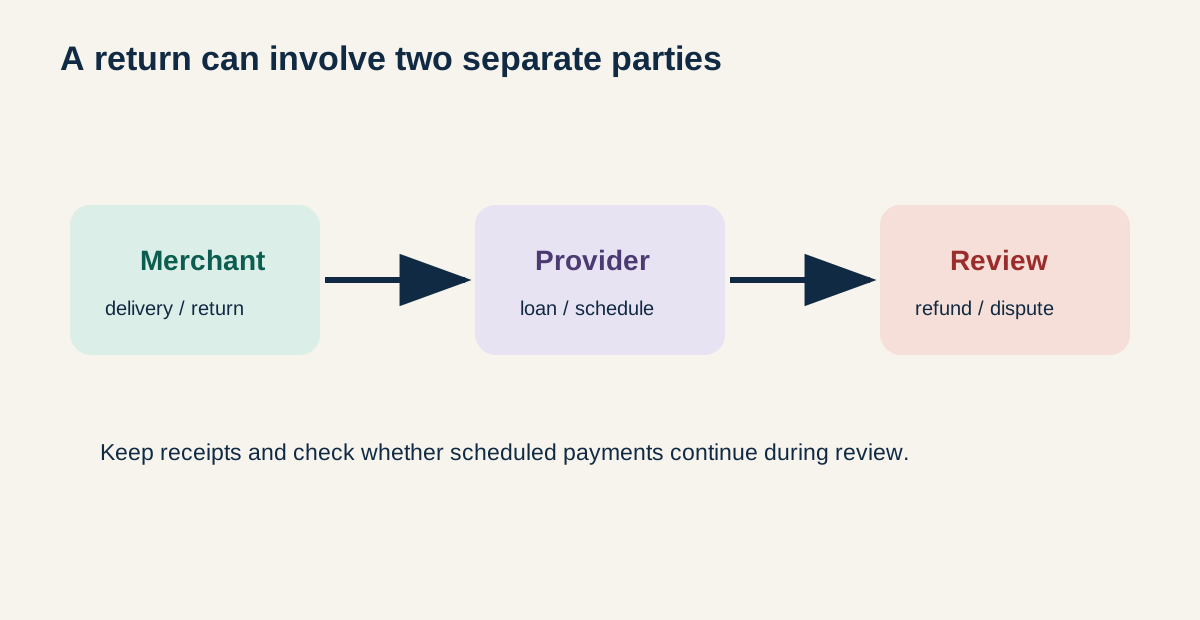
Visual: a return can involve separate merchant and provider steps; keep records and check the payment terms during review.
Before checkout, find the return window, who receives the dispute, whether you must continue paying during a review, and how a partial refund changes the remaining schedule. Keep receipts, tracking, and written confirmation. The CFPB has identified consumer complaints involving payments still being expected for goods that were returned, not received, or disputed.[3]
6. The app can collect more than payment information
BNPL is embedded in a shopping interface. Providers may collect transaction and behavioral data to operate the product, assess risk, market offers, or personalize the shopping experience. The CFPB has raised data-collection and monetization concerns in its market research.[4]
Review permissions, connected accounts, marketing choices, data-sharing language, and account-deletion procedures. Convenience is not a reason to grant more access than the product requires. Privacy terms and legal rights vary by jurisdiction.
A simple worked example
Suppose a fictional $120 purchase is split into four equal, on-time payments. There is no interest, no fee, and the first payment is due at checkout.
Scroll sideways or use arrow keys to read the full table.
| Item | Amount |
|---|---|
| Purchase price | $120.00 |
| Number of scheduled payments | 4 |
| Each scheduled payment | $30.00 |
| Scheduled total if everything is on time | $120.00 |
Now add two realistic complications. First, you already have two other plans with $20 and $35 due during the same fortnight. Your BNPL payments are not “$30”; your combined scheduled debits are $85 before groceries, transport, or bills. Second, a $10 late fee or bank charge can make the actual cost exceed the advertised four-way split. The amounts here are illustrations, not a provider’s terms.
The point is not that every BNPL plan is expensive. It is that affordability depends on the whole calendar, not the installment shown beside one product.
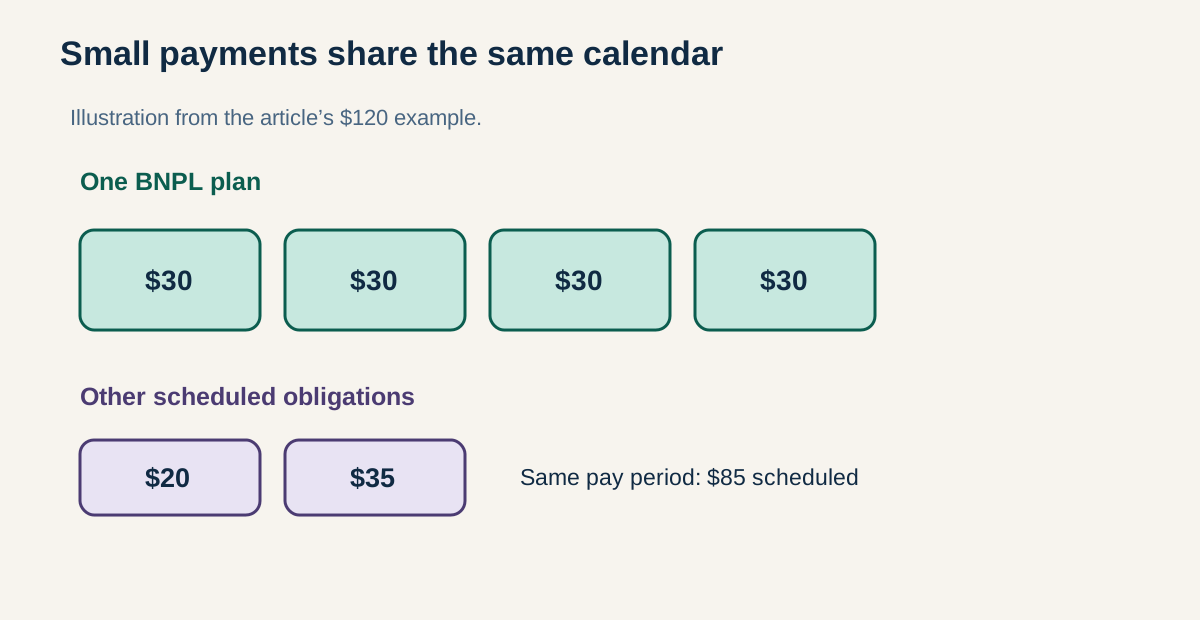
Visual: the $120 example becomes $85 scheduled in the same pay period when two other obligations are included.
Questions to ask before pressing “confirm”
- What is the total price? Include taxes, shipping, service fees, and any optional add-ons.
- How many payments and on which dates? Put every date in your own calendar.
- What happens if a payment fails? Check late fees, retries, account freezes, collections, and credit reporting.
- Which funding source is authorized? Confirm whether it is a debit card, credit card, or bank account and how to change it.
- Is there a hard inquiry or reporting? Read the provider’s explanation for this exact product.
- What are the return and dispute rules? Identify the merchant and the provider’s roles, deadlines, and payment expectations during review.
- Are you already using another plan? Count every active BNPL schedule across apps, stores, and cards.
- What data and permissions are requested? Review app access, account linking, marketing, and sharing.
- Could you pay the full price without this option? If not, the installment may be hiding an affordability problem rather than solving it.
- What is the alternative? Waiting, buying a lower-cost version, saving first, negotiating with the merchant, or using a different regulated credit product may change the trade-off.
Red flags that deserve a pause
Be cautious when a checkout says “guaranteed approval,” hides the total cost, preselects an autopay source, pressures you to accept before showing the agreement, or makes it difficult to find the provider’s contact details. A lender or intermediary that demands an advance fee in exchange for a guaranteed loan is a classic scam warning; the FTC says legitimate lenders do not guarantee credit and then require an upfront payment before granting it.[5]
Pause when you are using one plan to make payments on another, borrowing for a recurring essential, or relying on a future paycheck that is already committed. BNPL can be useful as a payment mechanism for an affordable purchase, but splitting a cost does not make an unaffordable purchase affordable.
If something goes wrong
Save the order confirmation, agreement, payment schedule, merchant correspondence, and screenshots of the checkout terms. Contact the merchant about delivery or return issues and the BNPL provider about the loan record and payment status. If a payment is unauthorized or a credit report is inaccurate, use the provider’s dispute process and the applicable consumer-reporting process in your jurisdiction. Do not stop paying solely because a dispute is open unless the agreement or a qualified local adviser confirms what is allowed.
For a pattern of missed payments, multiple overlapping loans, or debt that no longer fits your budget, consider a nonprofit credit counselor or another regulated local service. Verify fees, credentials, conflicts, and whether the service handles BNPL debts in your country.
Bottom line
BNPL is still credit. The central risks are not just interest: they are stacked payment dates, autopay and late fees, uncertain reporting, return and dispute friction, data permissions, and the temptation to buy more because each installment looks small.
Before checkout, write down the total price, schedule, funding source, fees, reporting policy, return process, and every other active plan. If the full calendar does not fit after essentials and existing obligations, the most useful “pay later” decision may be to postpone the purchase.
Continue with the Debt & Credit learning path, or review debt avalanche vs. debt snowball for repayment-order trade-offs.
U.S. sources provide consumer education and U.S.-specific context; terms, reporting, fees, refunds, and protections vary by provider and jurisdiction. Examples are original illustrations, not offers or recommendations.
Sources
- Consumer Financial Protection Bureau, What is a Buy Now, Pay Later (BNPL) loan?
- Consumer Financial Protection Bureau, Consumer Use of Buy Now, Pay Later and Other Unsecured Debt
- Consumer Financial Protection Bureau, The Buy Now, Pay Later Market
- Consumer Financial Protection Bureau, Buy Now, Pay Later: Market trends and consumer impacts
- Federal Trade Commission, What To Know About Advance-Fee Loans
- Investopedia, Buy Now, Pay Later (BNPL): What It Is, How It Works, Pros and Cons